- Sacred Monuments
- Religious monuments
Prieuré Saint-Martin de Montereau-Fault-Yonne
About this place
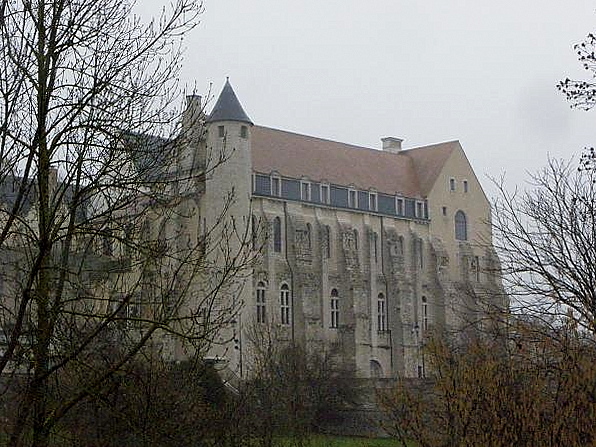
Prieuré Saint-Martin in Montereau-Fault-Yonne is a former Benedictine priory built on the slope of the Surville hill, on the right bank of the Seine close to its confluence with the Yonne, on the site once occupied by a Roman settlement known as Saint-Jean. The complex follows a roughly quadrangular plan: the priory church closes it to the south, a medieval pottery workshop stood to the north, and nineteenth-century farm buildings occupy the east and west sides.
How old is the priory and who founded it?
The priory traces its origin to the year 908. From its early days it was attached to the Benedictine abbey of Saint-Lomer in Blois, one of the region's more prominent monastic houses. This kind of dependency was common practice for medieval priories: a smaller local house managed nearby estates while remaining under the spiritual and administrative authority of its distant mother abbey.
What survives from the medieval buildings?
The oldest surviving structure is the church itself, which blends Romanesque and Gothic work raised between the 11th and 13th centuries; the surrounding monastic ranges were built in stages from the 13th century right through to the 19th. The Romanesque choir is flanked by two side chapels and sits above a set of four crypts, a design used to compensate for the steep fall of the ground. Sarcophagi unearthed during excavations in the nave are now kept inside these crypts.
The main entrance still shows construction work from the 12th and 13th centuries, including columns and vaulting. On the west side, heavy buttresses support a multi-storey claustral building whose walls reveal several distinct building campaigns.
How did the priory change over the centuries?
The outer enclosure wall was eventually destroyed, and in the 17th century the whole complex was converted into a working farm — which explains the 19th-century agricultural outbuildings still standing on the site today. Despite this change of use, the original proportions of the monastic layout remained legible, and they can still be traced across the property.
The site's heritage value was formally recognised by a decree of 15 January 1979: the church was listed as a classified historic monument (classé), while the facades and roofs of the remaining buildings were registered (inscrit) on the same date.
What is the priory used for today?
The former monastic buildings now serve a cultural role, hosting theatre performances, concerts, and exhibitions. Since 2018 the priory has held a season of classical music concerts, with one performance a month running from October through March.
Frequently asked questions
Where is the Prieuré Saint-Martin located? It stands on rue du Prieuré in Montereau-Fault-Yonne, on the slope of the Surville hill above the Seine, near the point where the Yonne joins the river.
When was the priory founded? Its foundation dates to 908, and it was attached to the abbey of Saint-Lomer in Blois.
What architectural style does the church show? The church combines Romanesque and Gothic elements built between the 11th and 13th centuries, with a choir flanked by two chapels and four crypts beneath it.
Can visitors see the priory today? The site now functions as a cultural venue, hosting concerts, plays and exhibitions, including a recurring classical music season from October to March.
Is the priory a protected heritage site? Yes. The church has been a classified historic monument since 1979, and the facades and roofs of the other buildings are listed in the historic monuments register.
Nearby places

Earn badges for the places you visit
Download NextOnTrip, discover new places and check off your trails.