About this place
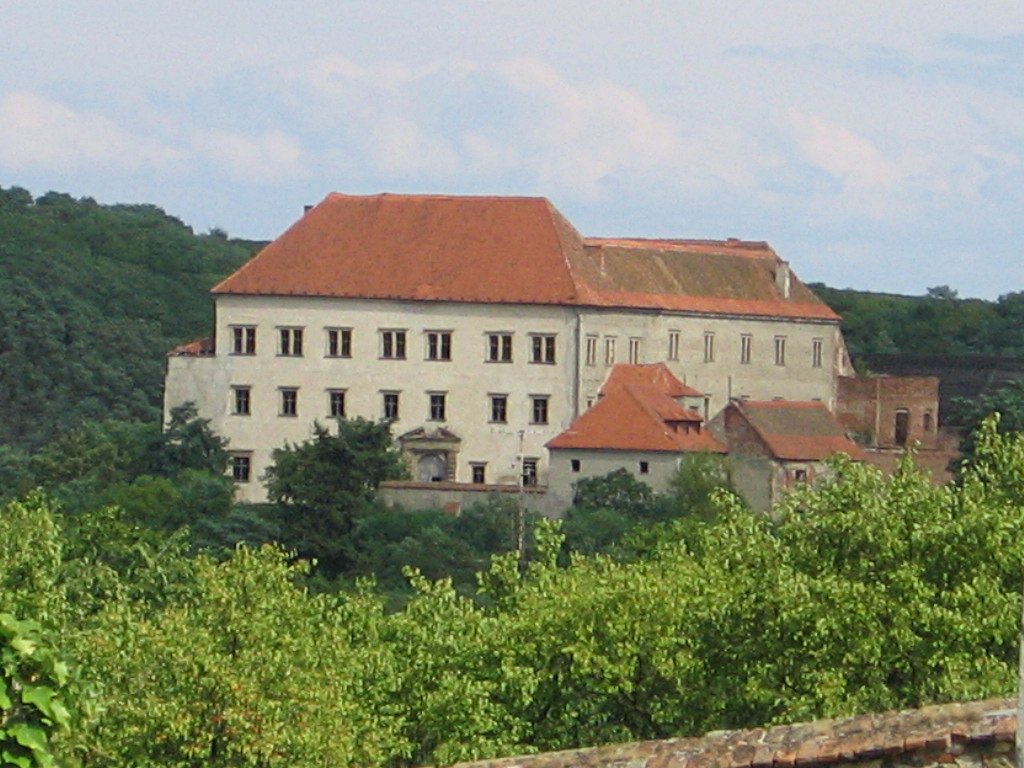
Židlochovice Castle is a Classicist hunting chateau in the town of Židlochovice, in the Brno-venkov district of the South Moravian Region in the Czech Republic. Few hunting residences on the continent survive in such intact condition, and the estate still carries on a local tradition of managing game and forest grounds that stretches back centuries.
Where is the castle located?
Židlochovice is a small town south of Brno, the capital of South Moravia. The castle stands within the town itself, surrounded by a large park near the Svratka river, in an area long used for hunting grounds and game preserves. Its proximity to Brno makes it an easy day-trip destination for anyone touring the region.
How did the site's history begin?
The earliest records of a building on this site go back to the 14th century, when a fortified stronghold surrounded by water stood here, positioned along an old overland route that merchants once used to move amber southward toward the Mediterranean. Over the following centuries the estate passed through several noble hands - among them the Pernštejn, Žerotín, Dietrichstein and Waldstein families, and later the Habsburgs - with each owner adding to its gradual rebuilding and expansion.
Who shaped the castle as it looks today?
A decisive phase of rebuilding came at the turn of the 17th and 18th centuries, under a count of the Sitzendorf family, who held Židlochovice from 1696 to 1743. He did much to establish the estate's hunting character, developing its pheasantries and game grounds. The Classicist form seen today, however, dates mainly from the turn of the 19th and 20th centuries, when the property belonged to Archduke Friedrich, its owner from 1895 to 1918. During his time the estate became known for its large-scale hunts of small game, and hunting trophies gathered from across the Austro-Hungarian lands came to fill the chateau's rooms.
What changed after 1918?
With the founding of independent Czechoslovakia in 1918, the chateau and its adjoining park passed into the ownership of the Czech state, and they remain state property today. During the 1920s and 1930s, President Tomáš Masaryk visited Židlochovice on several occasions, using it as a retreat for summer stays away from the capital.
What can visitors see in the castle park?
The park surrounding the chateau was laid out in the early 18th century and was later reshaped into an English-style landscape garden. It covers roughly 22 hectares and is open to visitors all year round, making it a pleasant place for a walk regardless of season. Its greenery forms a natural complement to the chateau's Classicist architecture.
Can the castle be visited or is it possible to stay there?
Today Židlochovice Castle operates as a higher-end hotel with a conference centre, setting it apart from many other Czech chateaux that only open their doors for guided tours. Guests can book a stay within the historic interiors, while the surrounding park remains open to anyone visiting the town.
Frequently asked questions
Where is Židlochovice Castle located? In the town of Židlochovice, in the Brno-venkov district of the South Moravian Region, south of Brno.
When did the earliest building on this site appear? Records of a fortified water stronghold on the site date back to the 14th century.
Who had the greatest influence on the castle's current appearance? Its present Classicist form largely dates from the ownership of Archduke Friedrich, who held the estate from 1895 to 1918.
Is the castle still owned by the state? Yes - since 1918, when Czechoslovakia was founded, the chateau and its park have belonged to the Czech state.
Can visitors stay overnight at the castle? Yes - it currently operates as a higher-end hotel with a conference centre, offering accommodation in its historic interiors.
What is worth seeing around the castle? An English-style park of roughly 22 hectares, laid out in the early 18th century and open to visitors year-round.
Nearby places

Earn badges for the places you visit
Download NextOnTrip, discover new places and check off your trails.