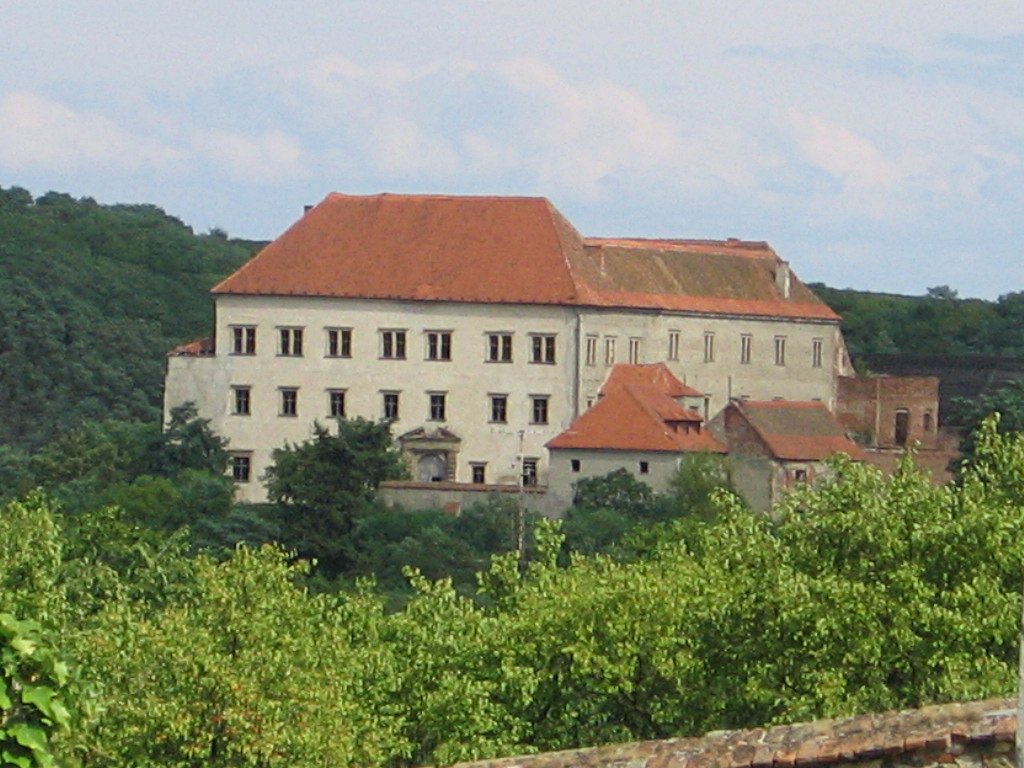
About this place
Dolní Kounice Chateau rises on a rocky hill above the Jihlava River, right next to the ruins of the Rosa Coeli monastery, forming one of the most recognizable silhouettes in South Moravia. It is one of the few places in Europe where a genuine Gothic fortress has survived alongside the Renaissance mansion later built into and around it, making the site a layered record of several centuries of Moravian architecture.
How old is the castle?
The first mention of an owner of the hillfort on this site dates back to 1162, though the Gothic castle in the form that underlies today's building was only completed around 1330, replacing the earlier 12th-century stronghold. It was built largely to guard the neighboring Premonstratensian convent of Rosa Coeli. In the 14th century an extensive outer bailey with a gate tower was added on the entrance side, and in the 15th century the castle was further enlarged and strengthened with bastions.
When did it become a Renaissance residence?
After the monastery was dissolved in the 16th century, the castle passed to the Moravian margrave and king Ferdinand I, who sold it in 1537 to Jiří Žabka of Limberk, vice-chancellor of the Kingdom of Bohemia. Žabka needed a representative seat and had the castle rebuilt in Renaissance style. A further Renaissance reconstruction took place at the turn of the 16th and 17th centuries under the Drnovský of Drnovice family, whose additions still shape much of what visitors see today.
What happened after the Bohemian Revolt?
Following the defeat of the Estates Uprising, the Drnovský family's property was confiscated, and in 1622 the castle was bought by the House of Dietrichstein. The fortifications proved their worth decades later: in 1663 the well-defended castle withstood a raid by Tatar forces, a testament to the strength of its medieval and Renaissance defenses.
What happened to the castle in the 20th century?
The 20th century was hard on the building, which suffered considerable damage. After World War II it was acquired by the lawyer Václav Édl, but in 1959, under the communist regime, the property was nationalized. After the fall of communism in 1989, Édl regained the castle and began restoring it before selling it to the entrepreneur Zoubek and his company, which has continued gradual repair work ever since.
What can visitors see today?
The castle is considered one of the most valuable Gothic-Renaissance monuments in Moravia. Its ongoing restoration reveals layers from different eras side by side — medieval defensive walls and the gate tower, Renaissance residential wings, and the remains of bastion fortifications. Together with the neighboring ruins of the Rosa Coeli monastery and its position on a hill above the Jihlava, the site is one of the most photogenic spots in the South Moravian region.
Frequently asked questions
How old is Dolní Kounice Chateau? The first record of an owner of the hillfort on this site comes from 1162, and the Gothic castle whose core forms the basis of today's building was completed around 1330.
Who rebuilt the castle in Renaissance style? The reconstruction was started by Jiří Žabka of Limberk after 1537 and continued at the turn of the 16th and 17th centuries by the Drnovský of Drnovice family.
Did the castle ever serve a defensive purpose? Yes — in 1663 the well-fortified castle successfully withstood a Tatar raid.
What historic site is located near the castle? Directly below the castle, by the Jihlava River, lie the ruins of the Rosa Coeli monastery, one of the symbols of Dolní Kounice.
Who owns the castle today? After being nationalized in 1959 and restored to private ownership after 1989, the castle now belongs to the entrepreneur Zoubek and his company, which is gradually restoring it.
Nearby places

Earn badges for the places you visit
Download NextOnTrip, discover new places and check off your trails.