About this place
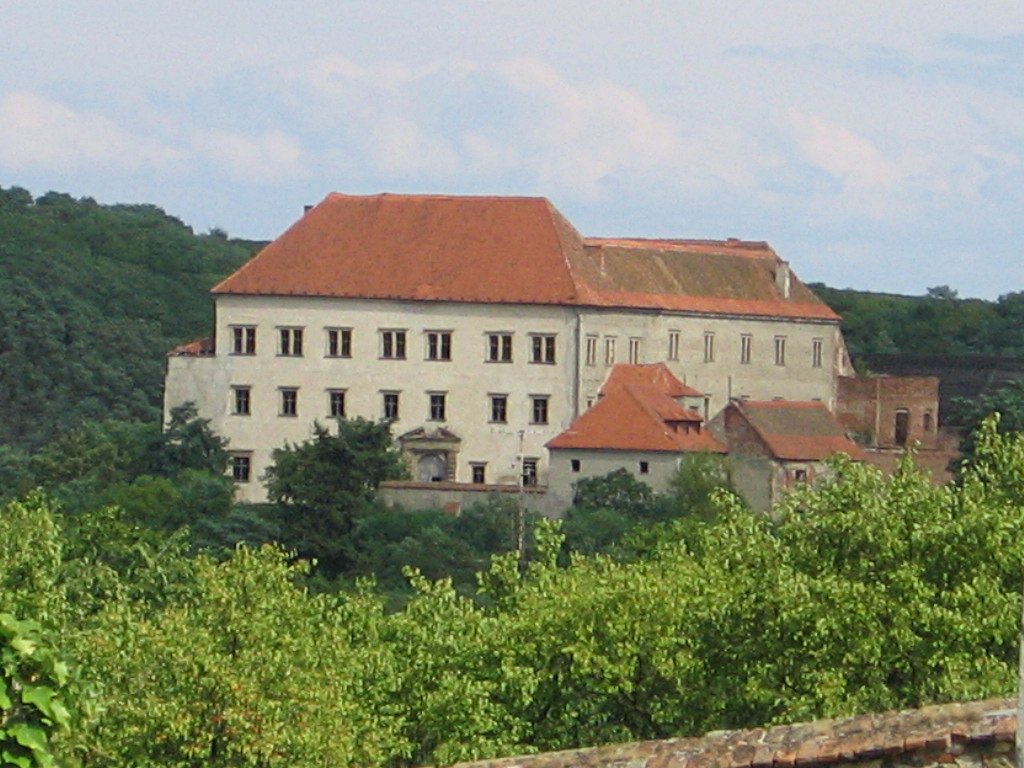
Hajany Castle, in the village of Hajany south-west of Brno, is a modest Baroque manor whose ownership changed hands repeatedly over three centuries — from a church-controlled estate to a private residence, and eventually to postwar rental flats.
Who built Hajany Castle?
Until the early 18th century, Hajany belonged to a convent of Cistercian nuns based in Staré Brno. In June 1714 the nuns sold the village, along with neighbouring estates, to Johann Baptist Kaschnitz von Weinberg, an administrator of the military treasury. It was almost certainly Kaschnitz who commissioned the two-storey Baroque building that still forms the eastern wing of the castle today.
How did the estate pass between owners?
In 1746 the property passed to Jindřich Xaver Hájek von Waldstätten, who went on to become the highest provincial chancellor in Moravia. A more unusual chapter began in 1790, when Matyáš Smetana, a tax controller for the Moravian administrative office, bought the estate. The Smetana family is remembered locally not for politics but for industry: in 1797 they set up the first vinegar factory in Moravia on the grounds. In 1857 the Mitrovský family took over and carried out the renovations that gave the castle much of its present-day appearance.
What happened after 1948?
The postwar period was harsh on the building. The Czechoslovak state confiscated the estate in 1948, and the castle went into decline soon after — its rooms were split up into ordinary rental apartments, stripping the property of its former character as a manor house.
Is the castle protected today?
Yes. On 15 August 2025 the Czech Ministry of Culture declared the Hajany castle complex a cultural monument, a decision that took legal effect on 29 April 2026. The listing formally recognises the site's historical value after decades of use as an unremarkable residential building.
What can visitors expect to see?
The castle sits in a small village in the Brno-Country district, and its stripped-down Baroque eastern wing is the clearest surviving trace of its original construction. Walking around the building, it is possible to trace the layers added by successive owners — from the early 18th-century administrative residence to the 19th-century remodelling under the Mitrovský family.
Frequently asked questions
When was Hajany Castle built? The oldest section, the eastern wing, dates to around 1714, shortly after Johann Baptist Kaschnitz von Weinberg bought the village.
Did one family own the castle for a long time? No single family held it for centuries. Ownership passed from the Kaschnitz family to Hájek von Waldstätten, then to the Smetanas, and finally to the Mitrovský family, who kept it from the mid-19th century until the 1948 confiscation.
Can the castle be visited today? For decades the building functioned as a residential property, so access to the interior is limited. Its 2025/2026 listing as a cultural monument may pave the way for greater public access in the future.
What is the castle's connection to vinegar production? The Smetana family, who owned the estate from 1790, founded Moravia's first vinegar factory on the grounds in 1797 — one of the more unusual footnotes in the castle's history.
Nearby places

Earn badges for the places you visit
Download NextOnTrip, discover new places and check off your trails.