About this place
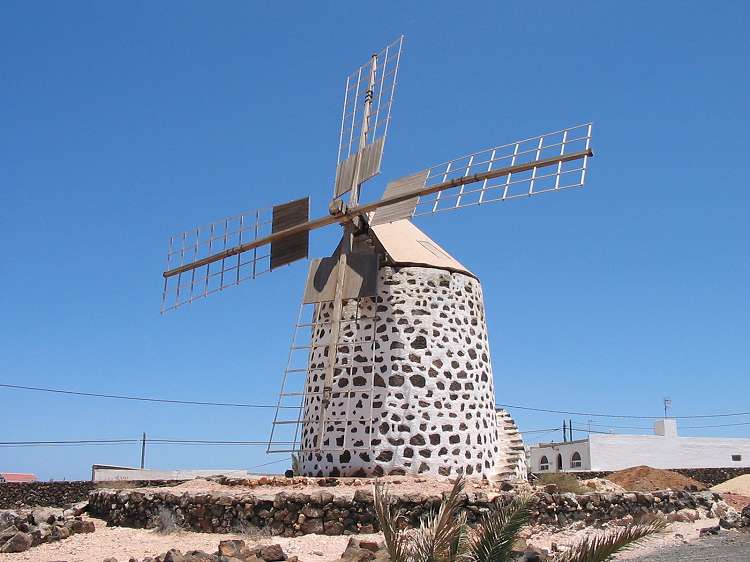
The Windmill of Lajares stands as a quiet landmark in this small village in the municipality of La Oliva, on Fuerteventura, an island long associated with windmills and traditional craftsmanship. It rises on flat, volcanic ground in the island's north, where steady trade winds were historically harnessed to grind grain into gofio, the roasted-grain flour still central to Canarian cooking.
Where does this windmill actually come from?
The story behind the structure is more unusual than it looks. The sails and internal machinery were not originally built in Lajares — they were bought in 1951 from Andrés Fernández Fránquiz, a resident of Tiscamanita, for 5,000 pesetas, then transported and reassembled in Lajares. This kind of relocation was not unusual on the island: a working milling mechanism was valuable enough that moving one made more sense than starting from scratch.
Andrés later passed the windmill on to his son, José Luis, who carried out its first restoration. Ownership eventually passed to the Fernández Martín family, who took on a full, ground-up rehabilitation without any public subsidy. The work was a family effort: Marisol, the owner's wife, together with their children Andrés and Leticia, handled the restoration themselves. The cap was fitted in early November, and the sails were "crowned" on November 21 and 22 — a moment that marked, for the family and the wider village, the completion of the project.
How did windmills end up on Fuerteventura in the first place?
Windmills are not native to the island's landscape — they were introduced by settlers in the 18th century. The technology spread quickly, especially through the central and northern parts of Fuerteventura, where consistent winds and grain farming created ideal conditions. Over time, windmills became more than agricultural tools: alongside the island's traditional lime-and-stone houses, they turned into one of the visual markers of Fuerteventura's identity.
Why is Lajares linked with windmills and crafts?
Lajares is one of the villages where the milling tradition lasted longest and is now actively preserved as part of local heritage. The village is also known for its handicrafts — a weekly artisan market draws visitors looking for locally made goods, and the windmill itself serves as both a landmark and a physical reminder of the region's agrarian past. Unlike larger, museum-style milling complexes such as the one in Tiscamanita, the Lajares windmill has kept a more private, family character: it is the result of one household's effort rather than an institutional reconstruction.
What should visitors look out for on site?
The structure itself — a stone tower topped with wooden sails — follows the typical Fuerteventura windmill design, built to handle the island's strong, dry winds. Worth noticing are the mechanical details: the rotating cap that lets the sails be turned to face the wind, and the sails themselves, which kept their traditional look after restoration. The surrounding landscape, with volcanic hills in view and the Corralejo dunes not far away, reinforces the raw, open character typical of this part of the island.
Frequently Asked Questions
Was the windmill always located in Lajares? No. Its sails and mechanism originally came from Tiscamanita — they were purchased in 1951 and moved to Lajares, where they were reassembled.
Who restored the windmill? The first restoration was carried out by José Luis, son of the original buyer. A full, comprehensive rehabilitation, done without public funding, was later completed by the Fernández Martín family.
Is the windmill still used for milling grain? Available sources don't indicate ongoing commercial milling. Today the structure mainly stands as a restored heritage piece and a visual landmark within the village.
Why does Fuerteventura have so many windmills? Windmills were brought to the island by settlers in the 18th century. Steady winds and grain cultivation in the central and northern areas made the technology spread quickly, turning it into a defining feature of the local economy.
Nearby places

Earn badges for the places you visit
Download NextOnTrip, discover new places and check off your trails.