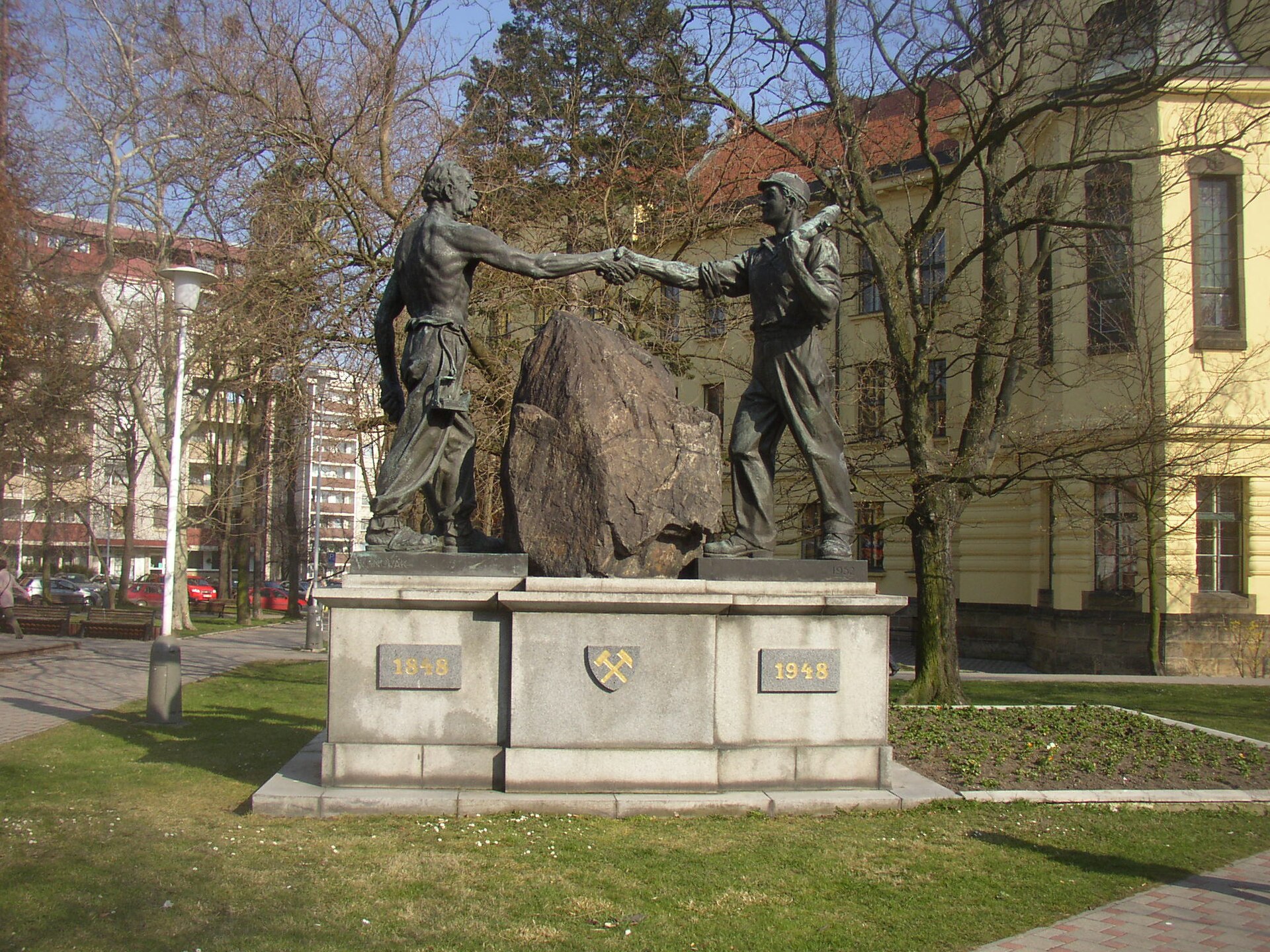
About this place
Váňův kámen (Váňa's Stone) is a small monument in the Czech town of Kladno that pairs a mid-19th-century boulder with a bronze sculpture group added exactly a century later. It stands in a modest park in front of the local grammar school on today's Edvarda Beneše Square, marking the birth of coal mining in Kladno and honoring the man who started it.
Who was Jan Váňa?
Jan Váňa (1811–1864) is remembered as the most famous miner in Kladno's history. He was the first to identify coal deposits in the area and went on to become the first mining director of the local pits. He later rose further within the region's heavy industry, becoming director of the mines operated by the Prague Iron Works Company (Pražská železářská společnost), one of the largest ironworking enterprises in the Czech lands at the time. His career mirrors Kladno's own transformation during the 19th century, from a farming district into a center of coal mining and metallurgy.
Where did the stone come from, and why this one?
The boulder that gives the monument its name originally weighed four tons and lay beside a road near Kročehlav, now part of Kladno. Váňa reportedly picked it out himself, drawn to its size, and had it hauled to the first mining shaft, named Kateřina Josefa. There it served as an early landmark for the town's emerging mining industry.
Why was the stone dedicated on April 24, 1854?
The date was no accident. The stone's formal dedication took place on April 24, 1854 — the very day Emperor Franz Joseph I married Princess Elisabeth of Bavaria, later known as Sisi. After the ceremony, five of the oldest miners in Kladno planted linden trees around the stone, tying an imperial occasion to a distinctly local mining tradition.
How did the stone move around the town?
As Kladno's ironworks kept expanding, the stone repeatedly had to make way for new construction. It was relocated at least twice more: to a road junction between Kladno and the villages of Dubí and Dříně, and later near the former district courthouse. These moves took their toll — over the years, pieces of the boulder broke off, leaving it smaller and rougher than the original four-ton stone. It only reached its present spot, the small park in front of Kladno's grammar school on Edvarda Beneše Square, in 1953.
What does the bronze miners' sculpture show?
That same 1953 relocation brought the stone a new companion: a bronze sculptural group titled "Hornictví" (Mining), created by academic sculptor Ladislav Novák of Motyčín. It depicts two miners — an older man and a younger, contemporary one — shaking hands, a gesture meant to symbolize the continuity of the mining profession across generations. Novák modeled the older miner on his own father, who had spent his whole working life in the mines.
Frequently asked questions
How much did Váňův kámen originally weigh? When it was chosen and transported, the boulder weighed four tons. It is smaller today because pieces broke off during its later relocations.
When was the stone formally dedicated? On April 24, 1854, the same day Emperor Franz Joseph I married Princess Elisabeth of Bavaria.
Who created the bronze miners' sculpture next to the stone? Academic sculptor Ladislav Novák of Motyčín, in 1953, as part of the "Hornictví" (Mining) group.
Where can you see Váňův kámen today? In a small park in front of the grammar school on Edvarda Beneše Square in Kladno, its location since 1953.
Why is the stone named after Jan Váňa? Because Váňa, the first director of Kladno's mines, personally chose the boulder and initiated its placement to commemorate the discovery of coal in the area.
Nearby places

Earn badges for the places you visit
Download NextOnTrip, discover new places and check off your trails.