About this place
Val Abbey is a former Cistercian monastery straddling the boundary between the communes of Mériel and Villiers-Adam in the Val-d'Oise department, roughly 30 km north of Paris. Much of the complex was pulled down in the nineteenth century, yet the surviving fragments — most notably a monumental dormitory and a gallery of the old cloister — rank among the finest medieval remains anywhere near the capital.
How did an abbey end up here?
A group of Cistercian monks arrived from the abbey of Notre-Dame de la Cour-Dieu, near Orléans, and settled in 1125 on a secluded, wooded plot at the edge of the L'Isle-Adam forest. That choice of an isolated, forested site was typical of the order, which deliberately kept its houses away from towns and existing settlements. The foundation counts among the earliest Cistercian houses established in the Île-de-France, predating the nearby abbeys of Royaumont and Maubuisson by more than a century.
The community did not start out with much land of its own. It was only in 1136 that Ansel I of L'Isle granted the monks a substantial estate, giving the abbey the resources to become properly self-sufficient. The following year King Louis VII confirmed that grant in a charter drawn up at Fontainebleau, marking the start of a long period of stability for the community.
Why is so little of it left standing?
The abbey's fortunes turned in the nineteenth century. Stripped of its religious purpose after the Revolution, the buildings were partly torn down for their stone in 1822 and again in 1845. That second year, the whole monastic complex was sold to a Parisian developer, Lucien Puteaux, for 40,000 francs, and its stone was carted off to build housing in the Batignolles district of Paris. Recognition of what remained came only in the twentieth century: the monks' building was listed as a historic monument in 1947, and the rest of the surviving structures followed in 1965.
What can visitors actually see today?
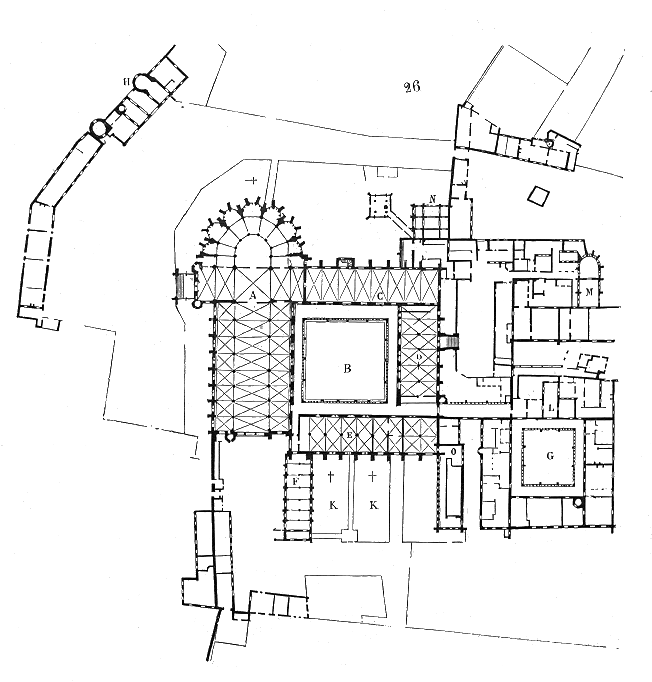
Despite the demolition, several substantial pieces of medieval architecture have survived on site: the dormitory, one gallery of the former cloister, plus the sacristy, chapter house and monks' hall. The dormitory, built between roughly 1200 and 1230, is considered one of the largest and most refined buildings of its kind anywhere in Europe — a long vaulted hall with ribbed ceilings, carved columns and two tiers of windows, still striking even in its partly ruined state.
How can you plan a visit?
The abbey grounds now serve as a natural starting point for a heritage walking route through Mériel. The surrounding L'Isle-Adam forest and the banks of the Oise river offer additional hiking and mountain-biking trails, with waymarked routes for both. A local heritage association looks after the site and keeps the ruins open to the public.
Frequently asked questions
Where exactly is Val Abbey located? It sits on the boundary between Mériel and Villiers-Adam in Val-d'Oise, about 30 km north of central Paris (coordinates 49.0786 N, 2.2264 E).
Can the ruins be visited? Yes. The site is open to visitors and is maintained by a local association dedicated to preserving the monument.
What actually survives from the medieval abbey? The most notable remains are the monks' dormitory from the early thirteenth century, one gallery of the cloister, the sacristy and the chapter house.
Why did the abbey fall into ruin in the first place? After losing its religious function, the buildings were demolished for building material in 1822 and 1845, with the stone reused for construction projects in Paris.
Nearby places

Earn badges for the places you visit
Download NextOnTrip, discover new places and check off your trails.