About this place
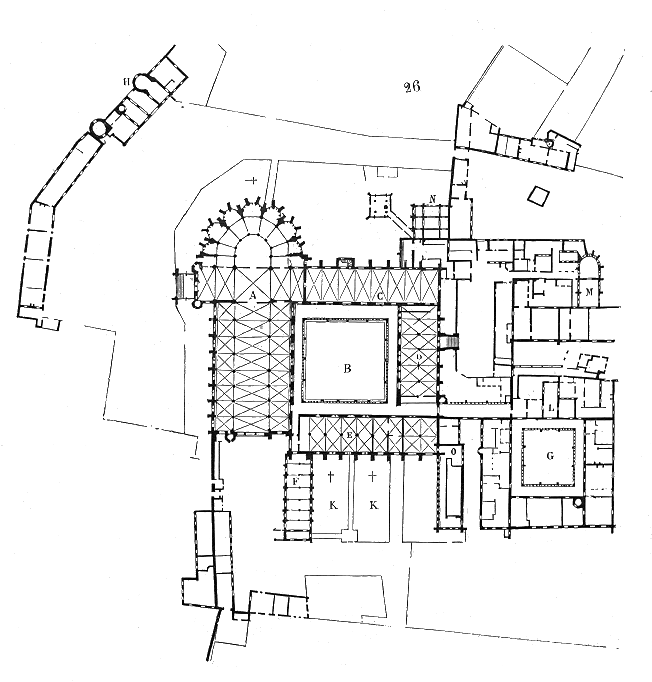
Prieuré Saint-Louis de Poissy, also known as the royal abbey of Poissy, refers to the surviving remnant of a former Dominican convent built in the early 14th century in the town of Poissy, in the Yvelines department west of Paris. The priory was founded to honor King Louis IX of France, better known as Saint Louis, shortly after his canonization in 1297, and the choice of location was deliberate: Poissy was where the future saint had been born and baptized.
Why was the priory built in Poissy specifically?
The foundation was ordered by Philip the Fair, grandson of Louis IX, not long after his grandfather's canonization. He picked Poissy precisely because it was Saint Louis's birthplace and baptismal town, and had the new convent erected on the very spot once occupied by the castle where Louis IX was born on April 25, 1214 — the old castle was torn down to make way for it. The formal foundation charter dates from July 1304, and the priory became operational that same year. The baptism itself had taken place a few days after the birth at the nearby collegiate church of Notre-Dame de Poissy, whose baptismal font was later venerated as a relic once Louis IX was canonized.
What happened to the priory over the following centuries?
The community quickly grew into one of the wealthiest convents in France, home to Dominican nuns. In September 1561, between the 9th and the 26th, its refectory hosted the Colloquy of Poissy, a theological conference bringing together Catholic and Calvinist representatives in an attempt to ease the religious tensions of the French Wars of Religion. The building itself did not escape disaster: on July 11, 1695, it was struck by lightning, and the vaults and roofs collapsed. Louis XIV ordered its reconstruction, entrusting the work to the architect Jules Hardouin-Mansart, who rebuilt it in a Gothic style.
What happened to the priory during the French Revolution?
The Revolution brought the institution to an end. The community was evacuated in 1792, and the buildings were dismantled and sold off in separate lots between 1790 and 1797. The demolition of the spires and any remaining royal emblems was put out to tender in December 1793, and the church itself finally disappeared from the townscape in the early 19th century.
What can visitors still see in Poissy today?
Of the entire monastic complex, only the gatehouse has survived. It was listed as a historic monument in 1933 and remains the sole tangible trace of the former priory. The gatehouse today houses the Musée du Jouet de Poissy, the town's toy museum. It stands in the town center, close to the collegiate church of Notre-Dame de Poissy where Louis IX was baptized, making it easy to combine both sites connected to the saint-king's history during a single walk through the old town.
Frequently asked questions
What was the Prieuré Saint-Louis de Poissy? It was a Dominican convent founded in 1304 by Philip the Fair to commemorate his grandfather, Louis IX of France.
Why was it built in Poissy? Because Louis IX was born there in 1214 and baptized there, and the new priory was raised on the exact site of the castle where he was born.
What took place at the priory in 1561? The Colloquy of Poissy, a meeting of Catholic and Calvinist theologians aimed at easing religious conflict in France, was held there from September 9 to 26.
What survives of the priory today? Only the gatehouse remains, listed as a historic monument since 1933 and now home to a toy museum.
Can the site be visited? Yes, the gatehouse and the museum inside it are open to visitors, though the rest of the original monastic complex no longer exists, having been demolished after the French Revolution.
Nearby places

Earn badges for the places you visit
Download NextOnTrip, discover new places and check off your trails.