About this place
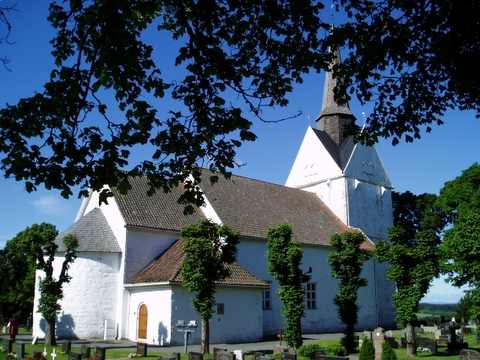
Tune Church (Norwegian: Tune kirke) stands at the southern end of Lake Tunevannet in the municipality of Sarpsborg, in Norway's Østfold region. It is one of the oldest places of worship in the area, and a spot where church history, archaeology and a pilgrim route all meet.
Why visit Tune Church?
The site has an unusually long past. A church stood here already in the Middle Ages, and it is mentioned in the Borgarting law, an old legal code for this part of Norway. That reference places the church no later than around 1100, and it served as a county church for the surrounding district. For a visitor, it is a quiet way to see how deeply settlement and Christianity were rooted in the valley by the lake.
What did the medieval church look like?
Local sources describe the first building as a Romanesque stone church with thick walls and a tower at the west end. A wooden stave church may have stood on the same spot before it. Little of the original fabric survives today, because materials from older buildings were reused in later construction. In the 19th century the old stone church was pulled down and a new one was built on the same site.
The fire and the present building
In 1908 fire destroyed the church almost to its core. The architect Heinrich Jürgensen designed the rebuilding, and the present long church dates from 1910. It is therefore an early twentieth-century building on ground with roughly a thousand years of church tradition. It belongs to the Church of Norway, in the Borg diocese.
The Tune Runestone
The church is tied to one of Scandinavia's best-known runic monuments. The Tune Runestone, a reddish granite boulder, was recorded in 1627 standing in the wall of the churchyard. It carries the longest preserved inscription in the Elder Futhark, the oldest runic alphabet. It is usually dated to the 4th or 5th century, though researchers do not fully agree on the exact range, with the Late Roman Iron Age and the early Migration Period both discussed. The original is now in the Museum of Cultural History in Oslo, but the area around the church is where it was found.
On the Pilgrim Way
The Pilgrim Way (Pilegrimsleden) passes through the churchyard, which makes the church a natural stop for walkers. Its calm setting by the water also suits a break during a day of sightseeing around Sarpsborg.
Frequently asked questions
Where is Tune Church? At the southern end of Lake Tunevannet, in Sarpsborg municipality, Østfold, Norway.
When was the current church built? In 1910, after the fire of 1908. The site has been a church site since the Middle Ages, though.
Can I see the Tune Runestone there? The original is in the Museum of Cultural History in Oslo. At the church you can see the place where the stone was found and where it stood in the 17th century.
Is the church on a pilgrim route? Yes, the Pilgrim Way runs through the churchyard.
Who designed the present building? The architect Heinrich Jürgensen.
Nearby places

Earn badges for the places you visit
Download NextOnTrip, discover new places and check off your trails.