About this place
Torre de Los Casares is a solitary defensive tower standing on a hilltop above Riba de Saelices, a small village in the province of Guadalajara, in Castile-La Mancha, Spain. It is the only surviving Berber tower in the entire province and one of the region's more intriguing, though still little-known, military landmarks.
What is this place?
The tower was built in the 9th or 10th century as part of a Muslim defensive network guarding the Salado river valley. It has a square floor plan and two levels covered by a false vault, with the entrance placed above ground level on the south side — a common feature of defensive architecture from this period, designed to make an assault more difficult. It stands on a slope where an earlier Arab settlement once existed, which is where its name comes from, tied to the old hamlet of "Los Casares."
Around the tower, archaeologists have found fragments of 11th-century pottery along with Arab coins minted in Zaragoza, confirming that the site supported continuous settlement over several centuries. After the Christian reconquest, the surrounding land became part of the territories of Atienza and Jadraque.
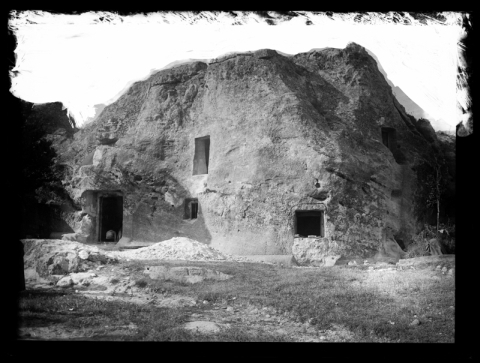
The tower forms part of a larger archaeological complex that also includes a prehistoric cave with Paleolithic rock engravings, known internationally among cave-art researchers, along with the remains of a Muslim-era settlement spread across the hillside below. The tower itself crowns the whole complex, dominating the surrounding landscape.
How do you get there?
Riba de Saelices lies in the northeastern part of Guadalajara province, in a scenic stretch of the Salado river valley surrounded by limestone hills, within the Molina de Aragón-Alto Tajo region. The village is reached via a local road connecting it to nearby towns in the area. From the village center, a marked path leads uphill to the tower — the walk takes around fifteen minutes, and sturdy footwear is recommended given the uneven terrain.
What will you see there?
The tower is in a state of progressive ruin, but its massive stone structure still makes an impression. From the viewpoint next to it, you get a sweeping view over the Salado valley and the surrounding hills — reason enough to make the climb even though the building itself is partially collapsed. Entry is free at any time, though visitors should move carefully around the walls given their condition.
It's worth pairing a visit to the tower with a stop at the nearby Cueva de los Casares, home to some of the oldest rock art on the Iberian Peninsula. Together, the cave, the settlement remains, and the tower form a single, coherent story spanning prehistory through the Islamic Middle Ages.
When should you visit?
Spring and autumn are the best times, with mild temperatures that make the uphill walk far more comfortable than under the summer sun. Summers in this part of Castile-La Mancha can get very hot, while winter sometimes brings frost and slippery patches along the path.
Frequently asked questions
Is there an entrance fee for the tower? No, access to Torre de Los Casares is free and possible year-round.
Can you go inside the tower? Given its ruined state and lack of safety features, visits are mostly limited to viewing the structure from outside and from the nearby viewpoint.
How long is the walk from Riba de Saelices? The marked trail from the village usually takes around fifteen minutes one way, depending on your pace.
Is there anything else worth seeing nearby? Yes — the Cueva de los Casares, with its Paleolithic cave art, sits right next to the tower and forms part of the same archaeological complex.
Nearby places

Earn badges for the places you visit
Download NextOnTrip, discover new places and check off your trails.