About this place
Thionville Synagogue stands in the town of Thionville, in the Moselle department of France's Lorraine region. It sits on Place du Rabbin Henri Lévy, a square named after a rabbi deported and murdered at Auschwitz in 1944 — a name that already hints at the weight of local Jewish history tied to this site.
What is the history behind this building?
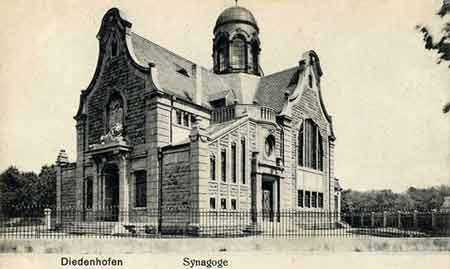
Jewish residents are documented in Thionville as far back as the 14th century, though the modern community took shape much later. A first synagogue was built in 1805. In 1882 it was replaced by a far grander building designed by Karlsruhe-based architect Ludwig Levy in a neo-Romanesque style, standing at what was then 31 avenue Clemenceau.
That 19th-century building did not survive the war. In July 1940, during the German occupation, the synagogue was set on fire. The ruins were later demolished, and the stone was reused for road construction — a fate shared by other destroyed Jewish sites in the region. The site then sat empty for more than a decade.
Reconstruction came in the 1950s. A new building went up in 1956–1957 on the same plot, attempting to echo certain forms of the earlier synagogue while being, architecturally, a building of an entirely different era.
What will you see on site?
The present-day synagogue is a good example of the modernist architectural language common in post-war reconstruction across eastern France. The building has a compact, square footprint that gives it a solid, almost fortress-like exterior presence. Rising above the structure is a dome topped with a Star of David — the most recognizable feature of the building, visible from the surrounding streets.
The contrast between the stark, geometric form and the traditional religious function is deliberate: post-war architects in the Moselle region frequently chose a modern formal vocabulary rather than replicating the historical patterns of the buildings that had been destroyed. The synagogue stands on rue Henri Lévy, in a quiet part of town within easy reach of Thionville's historic center.
How do you get there, and when should you visit?
Thionville sits in Lorraine, close to the borders with Luxembourg and Germany, and is well connected by train to Metz and Luxembourg City. The synagogue itself is within the town, an easy walk from the main sights of the old center, making it simple to fit into a broader visit.
As an active place of worship rather than a museum, the synagogue does not keep fixed visiting hours for tourists — it's worth checking locally before planning to see the interior. The exterior architecture, including the distinctive dome, is visible from the street year-round.
Frequently asked questions
Is the current building the original 19th-century synagogue? No. The original 1882 synagogue, designed by Ludwig Levy, was burned by German forces in 1940 and later demolished. The current building dates from 1956–1957 and stands on the same site.
Who was Henri Lévy, after whom the street is named? He was the rabbi of the Thionville community, deported and murdered at Auschwitz in 1944. The square and street by the synagogue honor him and the region's Holocaust victims.
What defines the architecture of the current synagogue? It's a modernist, square-plan building crowned with a dome topped by a Star of David — a style typical of French religious architecture rebuilt after World War II, standing in deliberate contrast to the earlier neo-Romanesque building.
Can visitors go inside the synagogue? It's an active place of worship, not a museum, so access depends on the community's schedule. It's best to check current information locally, for example with the Thionville tourist office, before visiting.
Nearby places

Earn badges for the places you visit
Download NextOnTrip, discover new places and check off your trails.