About this place
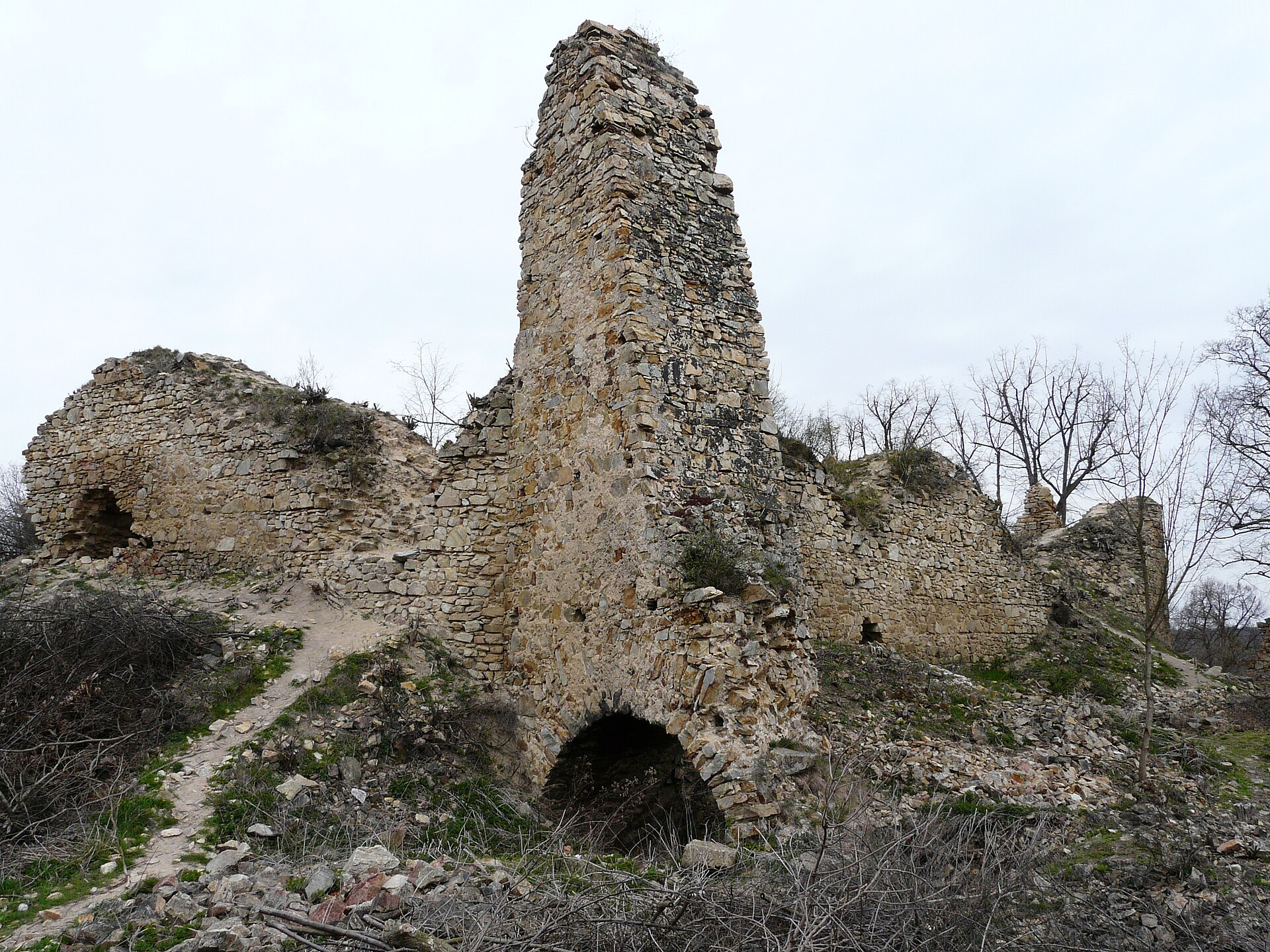
Templštejn is a surprisingly extensive castle ruin perched on a rocky spur above the Jihlava River, roughly 3 km from the centre of Jamolice in the Znojmo district of South Moravia. It stands out as one of the very few Moravian castles founded by the Knights Templar, and its story — a short-lived commandery, a devastating fire, and early-20th-century excavations that uncovered its final hours — makes it one of the more compelling stops in the region.
How did the Templars end up in Jamolice?
The Templars are first recorded in connection with Jamolice on 31 August 1279, with a further mention on 1 December 1281. The order established a church, a rectory and an early settlement there, forming a local commandery. The castle itself came slightly later: the first written record of Templštejn dates to 16 July 1298, and construction is generally placed between 1281 and 1298. Templar presence is documented again in 1301 and 1303, just a few years before the order's downfall.
Why did the Templars lose it so quickly?
In 1312 the pope dissolved the Knights Templar, and their property passed to other orders, chiefly the Hospitallers. Templštejn therefore changed hands not long after it was completed. By 1318 it belonged to Bertold Pirkner of Kutná Hora, and over the following decades ownership shifted repeatedly: Přibík of Šelmberk held it in 1349, and Jindřich of Lipá, Marshal of the Bohemian Kingdom, bought it in 1379 for 3,200 Prague pennies. The Lords of Lipá kept the castle the longest, around seventy years.
What does the castle look like today?
The oldest core, raised before 1298, forms a closed, irregular pentagon with rounded corners measuring roughly 40 by 30 metres, its blunt corner facing the approach road. The perimeter wall was about 2.2 metres thick and up to 12 metres high. Around 1470 a massive gable wall was added — 70 metres long, 5 metres thick and about 11 metres high — built specifically to withstand the growing threat of artillery. A mighty gate pillar, 2.5 metres thick, survives from the mid-15th century, with a passage barely 1.7 metres high, alongside the remnants of a western gate tower. The southern palace building held a large hall lit by three pointed-arch windows with deep splayed reveals, and stone slabs mark the former site of a fireplace, suggesting this was a comparatively luxurious residence. At the entrance to the core, a well was cut directly into the rock; it is now 7.5 metres deep (legend inflates it to 500 cubits and treasure chambers below, though it was actually backfilled for safety in 1883). A 25-metre-deep ditch separated the castle from the rest of the hill, crossed by wooden bridges that controlled access.
What actually destroyed the castle?
Templštejn was never taken by force. It survived until the mid-16th century, when a major fire brought its active life to an end. Excavations led by forester Štencl between 1900 and 1906 uncovered a layer of ash and burnt timbers along with stone balls and human bones, plus metal finds such as swords and horse fittings — evidence that the castle was fully furnished and inhabited at the moment of its destruction, not already abandoned. The last notable owner from the Lords of Lipá line, Pertold Bohobud, took part in the Bohemian Estates uprising of 1618–1620 and was sentenced to lose his head and right hand; the physical punishment was later pardoned, but he died in exile in poverty. The estate subsequently passed to the House of Liechtenstein (until 1908) and then the Kinsky family, until confiscation in 1945. In 2011, after the state forestry enterprise judged the ruin surplus property, it was bought by its present owner, Ing. David Hamza.
Frequently asked questions
Was Templštejn really a Templar castle? Yes. It is one of the few castles in Moravia founded by the Knights Templar, who were active in Jamolice from 1279 and built the castle between 1281 and 1298.
Was the castle ever conquered? No — records and excavations show Templštejn was never taken in battle. It was destroyed by a major fire in the mid-16th century while still fully inhabited.
How long did the Templars actually hold it? Only a few decades: from the founding of the Jamolice commandery in 1279 to the papal dissolution of the order in 1312.
What can visitors see on site today? Sections of the perimeter wall, the massive 15th-century gable wall, the gate pillar, remains of the southern palace with its pointed-arch windows, and the rock-cut well.
Where exactly is the castle located? The ruin sits about 3 km from the centre of Jamolice in the Znojmo district, on a rocky spur above the Jihlava River, not far from Moravský Krumlov.
Nearby places

Earn badges for the places you visit
Download NextOnTrip, discover new places and check off your trails.