About this place
Rabštejn Castle near Dukovany
Rabštejn is a ruined castle in the Vysočina (Highlands) Region, in the Třebíč district, perched on a narrow spur above the Jihlava river valley close to the village of Dukovany. What sets it apart from other regional ruins is its neighbor: the Mohelno reservoir, the lower basin of a pumped-storage plant that operates alongside the Dukovany nuclear power station. The ruins sit roughly halfway along the marked trail between Dukovany and Kramolín and can be visited freely, year-round, at no charge.
Who built the castle, and what's the earliest record of it?
Rabštejn was founded in the first half of the 14th century by the lords of Janovic. The oldest written reference dates to 1358 and records a sale: Vok of Holštejn and Drslav of Šelmberk bought the castle from Pešík of Janovic. That land-register entry remains the earliest confirmed evidence the fortress existed, and it's the fixed point historians use when dating everything that came after.
How did the castle end up in the hands of a robber knight?
Ownership passed through several hands before landing with the lords of Kunštát. A Hussite garrison held the castle during the Hussite Wars, and in the early 15th century Rabštejn became the base of Hynek "Suchý Čert" ("Dry Devil") of Kunštát, a robber knight who used the castle's defensible position to raid the surrounding countryside. Under his control the fortress turned into a staging point for bands attacking merchants and nearby villages, making it a serious problem for the Moravian nobility.
Why was the castle destroyed?
The scale of the damage caused by Rabštejn's garrison led the Moravian estates, meeting in assembly at Velké Meziříčí in 1440, to decide the castle should be bought out and torn down. Six years later, in 1446, the Moravian estates' army captured the fortress and carried out its destruction. By 1476, documents already describe Rabštejn as a "demolished castle," confirming the damage was permanent — the castle was never rebuilt.
What survives on site today?
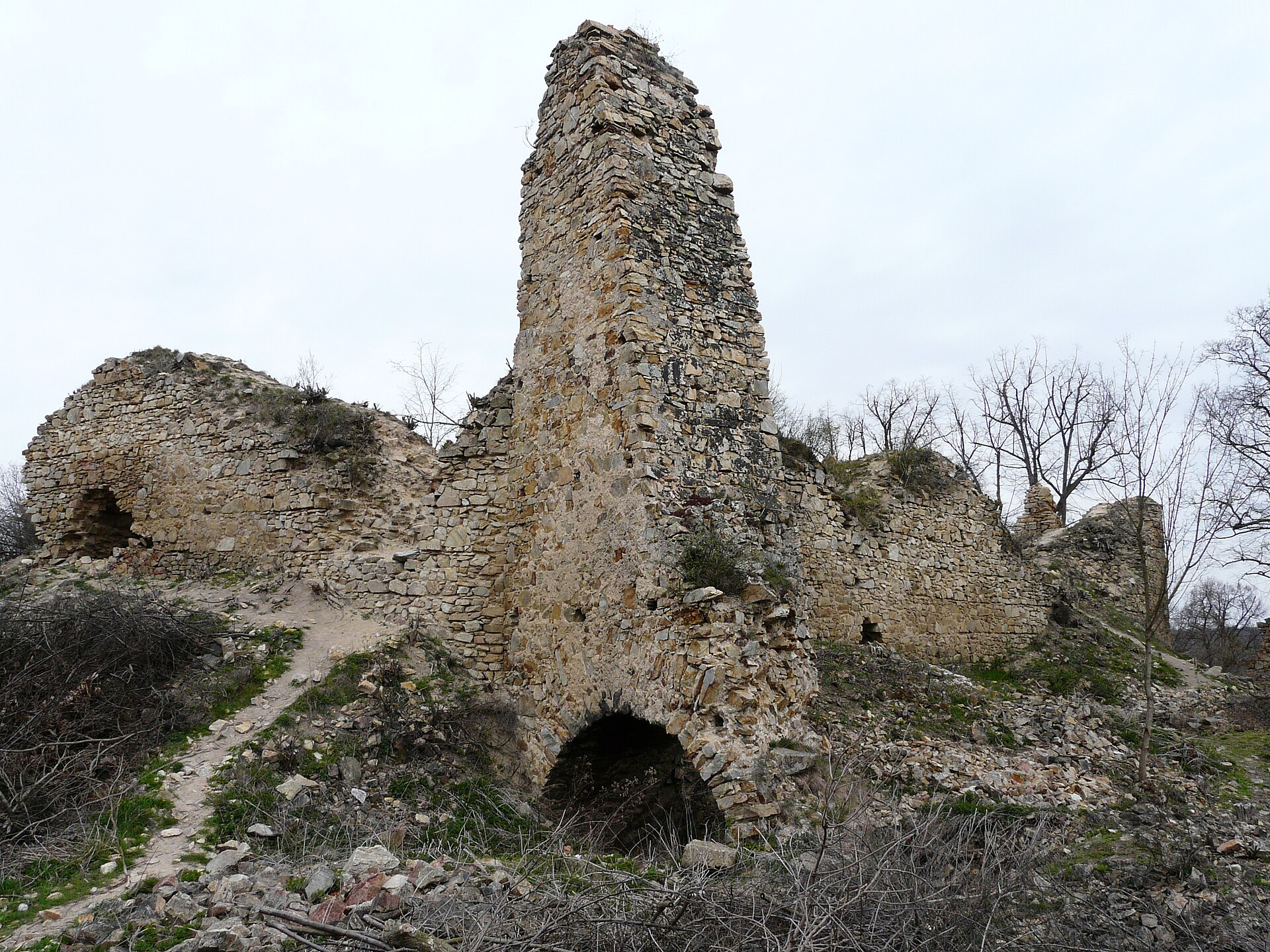
Of what was once a fairly extensive complex, only small fragments of masonry remain. Architectural surveys show the castle followed a rectangular double-palace layout roughly 40 by 24 meters, with walls up to two meters thick connecting the two residential buildings. An outer defensive ring of palisade, ditch and ramparts surrounded the whole site, and an additional eastern outwork was added in the early 15th century. In 2017 the grounds were the subject of a surface archaeological survey. The ruins are listed as a protected cultural monument and remain freely accessible to visitors.
How do you get there, and what pairs well with a visit?
Rabštejn stands at about 350 meters above sea level, above a bend of the Jihlava River, along a marked hiking trail (red or green waymarks) between Dukovany and Kramolín. A cycling route circling the Mohelno reservoir also passes nearby, making it easy to combine a walk to the ruins with a longer trip around the reservoir and the river valley.
Frequently asked questions
Where exactly is Rabštejn Castle located? On a spur above the Jihlava valley in the Třebíč district of the Vysočina Region, roughly halfway between Dukovany and Kramolín, close to the Mohelno reservoir.
When was the castle built and when was it destroyed? It was founded in the first half of the 14th century, with the first record dating to 1358. The Moravian estates' army destroyed it in 1446, following a 1440 decision by the assembly at Velké Meziříčí.
Could this castle be confused with another Rabštejn? Yes — there is a similarly named site, Rabštejnek, located in Rabštejnská Lhota in the Pardubice Region. That is a completely different castle in a different part of the Czech Republic.
Is there an entry fee for the ruins? No, the site is freely and permanently accessible, without charge.
What else is worth seeing nearby? The Mohelno reservoir and the cycling route around it, as well as the Jihlava river valley, visible from the hill where the ruins stand.
Nearby places

Earn badges for the places you visit
Download NextOnTrip, discover new places and check off your trails.