About this place
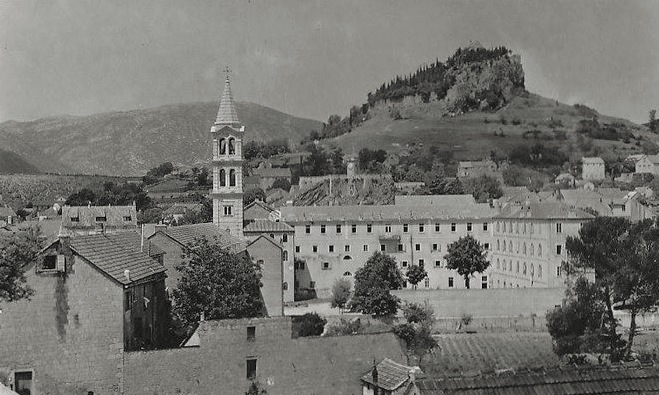
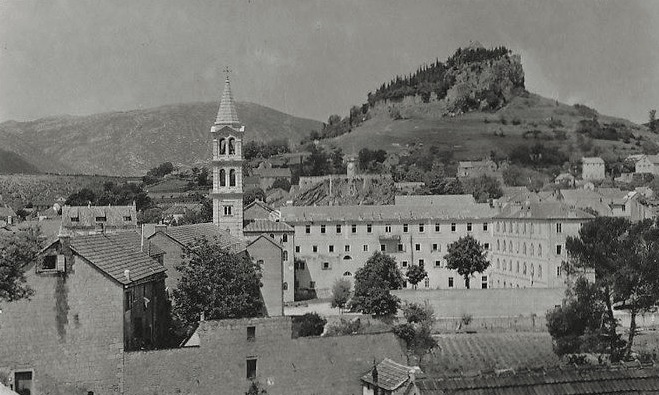
Tabija is the rocky hill rising above Trilj, in the Dalmatian hinterland, crowned by the ruins of the medieval Čačvina fortress. Locals have long used "Gradina" and "Tabija" interchangeably for this summit — the latter comes from Turkish and describes a fortified artillery outpost. The hill overlooks the Cetina river valley and has guarded one of the key inland routes through Dalmatia since prehistoric times.
Where does the name come from, and what exactly is Tabija?
A watchtower likely stood on this rocky spur as early as the 4th or 5th century, part of a late-antique defensive network protecting the hinterland behind Roman roads. During the Middle Ages, that tower was absorbed into the enlarged main keep of the fortress, and the hill itself came to be known as Tabija. The name has stuck to this day, even though it historically refers to the whole fortified complex known as Čačvina.
What can you actually see up there?
The fortress is made up of two towers linked by an elongated courtyard. The eastern tower — larger and better preserved — has an irregular, rounded outer profile but is octagonal inside, and still holds a preserved well; it's worth peering into if the ruin is accessible. The western tower is smaller and far more weathered. From the walls, the view opens onto the Cetina valley and the surrounding hills, which alone makes the climb worthwhile. At the foot of the hill stands an old 18th-century parish church, its bell tower built directly into the façade.
A bit of history
Čačvina ranks among the most important defensive points of inland Dalmatia, in continuous use from late antiquity through the early 18th century. It is first recorded in writing in 1371, when the fortress was commanded by castellan Perko Ježević. For decades afterward, until the early 15th century, it belonged to the powerful Nelipić family, rulers of the Cetina principality. The stronghold guarded a trade route linking Bosnia with Split and Klis, which gave it real strategic weight. In the late 17th century it fell into Ottoman hands, and from 1718 it came under Venetian control. Excavations have turned up evidence of intense military life on the hill, including a crossbow mechanism, numerous crossbow bolts, and clay molds used for casting firearm ammunition.
How to get there and when to visit
Tabija sits on a hill northeast of central Trilj; getting there means a walk uphill on uneven ground, so moderate fitness helps. The surrounding area is also popular with cyclists — a roughly 16-kilometer trail runs through nearby Gaz and past Čačvina. Spring and early autumn are the best times to visit, since temperatures are gentler than the height of the Dalmatian summer and the views from the walls are at their clearest. Bring water and sturdy shoes — there's no tourist infrastructure or shade on site.
Frequently asked questions
Are Tabija and Čačvina the same place? Yes — Tabija is the everyday, Turkish-derived name for the hill on which the Čačvina fortress stands. The two names are used interchangeably.
Can you go inside the ruins? The site is open and freely accessible, but the towers are unmarked ruins with no signposted route or on-site guide, so you visit at your own risk.
How long does it take to reach the top? Depending on fitness and starting point, the climb typically takes 20 to 40 minutes on foot from around Trilj.
What else is worth seeing nearby? An 18th-century parish church stands at the base of the hill, and the Cetina valley itself offers further cycling routes and river views.
Nearby places

Earn badges for the places you visit
Download NextOnTrip, discover new places and check off your trails.