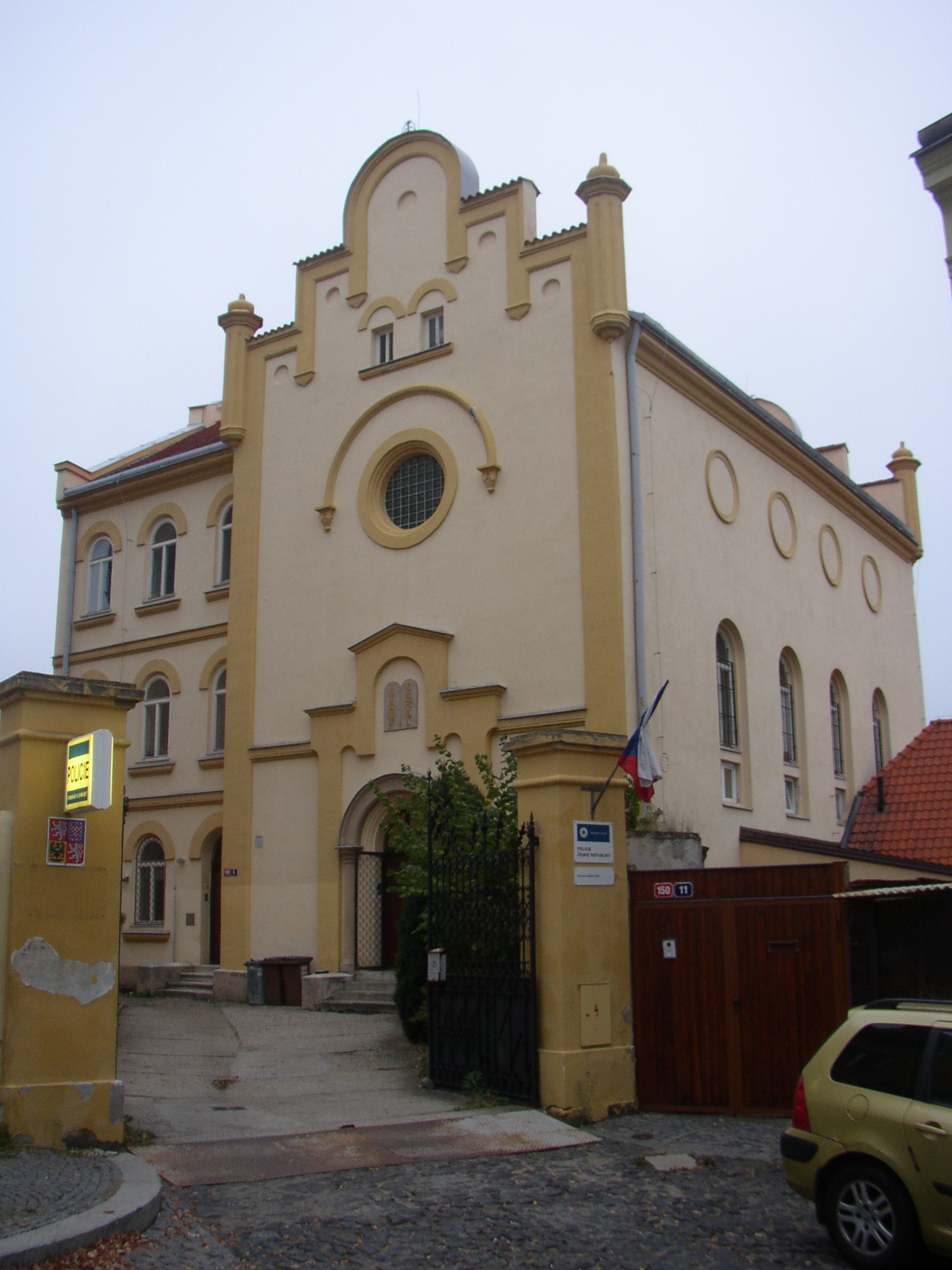
About this place
The Synagogue in Slaný is one of the few surviving physical traces of a Jewish community that shaped local life in this Central Bohemian town for well over a century. The building stands just a short walk from the main square (Masaryk Square), yet its current use has nothing to do with worship anymore — which is exactly what makes its story worth knowing before you look for it on a map.
When was the synagogue built, and why here?
The synagogue dates to 1865 and was designed in a Moorish style with Romanesque touches, a combination widely used across Central Europe at the time to visually set Jewish houses of worship apart from churches. Before this building existed, Slaný's Jewish community held services in far humbler surroundings — a prayer room set up inside an inn known as "U Templu," on what is now Kynského Street. As the congregation grew, that cramped room stopped being adequate, prompting the decision to build a proper synagogue closer to the town center.
Who prayed here, and how did the community change over time?
Slaný's Jewish community was never large, but it was active and, by local standards, notable. Toward the end of the 19th century, Rabbi Filip Bondy served the congregation and is remembered as the first rabbi here to introduce Czech into parts of the liturgy, at a time when Hebrew and German still dominated services. It's a small detail, but a telling one — it mirrors a broader shift in identity among Czech Jews during that era.
What happened to the building after World War II?
What happened after 1945 is arguably as important to this site's story as its construction. In early 1942, occupying German authorities deported 1,632 Jewish residents from the Slaný area, first to Terezín and from there to other concentration camps. Only 11 people returned to the town after the war. With the community reduced to a fraction of its former size, there was no way to sustain religious life, and the synagogue building itself began a long series of changes in use.
The building was listed as a cultural monument in 1958, yet just three years later it passed into state ownership, which in practice meant further departure from its original purpose. By 1965 it was being used as a warehouse, with part of the space converted into residential units. From 1974 it housed a branch of the State District Archive of Kladno, and since 2013 it has served as an office of the Czech police.
Has anything of the original interior survived?
Very little. The prayer hall was split into two additional floors and subdivided with partition walls, so the current layout bears almost no resemblance to the original design. The distinctive blue-painted barrel vault decorated with stucco stars, once a defining feature of the interior, no longer exists. Some of the more valuable ritual objects were rescued and now form part of the Jewish Museum in Prague's collections, but much else was lost for good — after the war, Czechoslovak authorities sold several Torah scrolls from this synagogue to a private collector in the United States, despite objections from Prague's official Jewish community.
Can visitors go inside today?
Given its current role as a police office, the synagogue isn't set up for regular visitor access to its interior. It's best treated as a stop on a walk through Slaný's Jewish heritage sites, one to admire from the outside rather than tour inside.
Frequently asked questions
When was the Slaný synagogue built? In 1865, in Moorish style with Romanesque elements, replacing an earlier prayer room housed in an inn called "U Templu."
What is the building used for today? Since 2013 it has housed a Czech police office; before that it served as a storage space, residential units, and from 1974 a branch of the state archive in Kladno.
What happened to Slaný's Jewish community during the war? In early 1942, 1,632 people were deported, first to Terezín and then to other concentration camps. Only 11 returned to Slaný after the war.
Can you visit the inside of the synagogue? Not in a typical tourist sense — the building now serves administrative functions (police), and most of its original interior decoration has not survived.
Nearby places

Earn badges for the places you visit
Download NextOnTrip, discover new places and check off your trails.