About this place
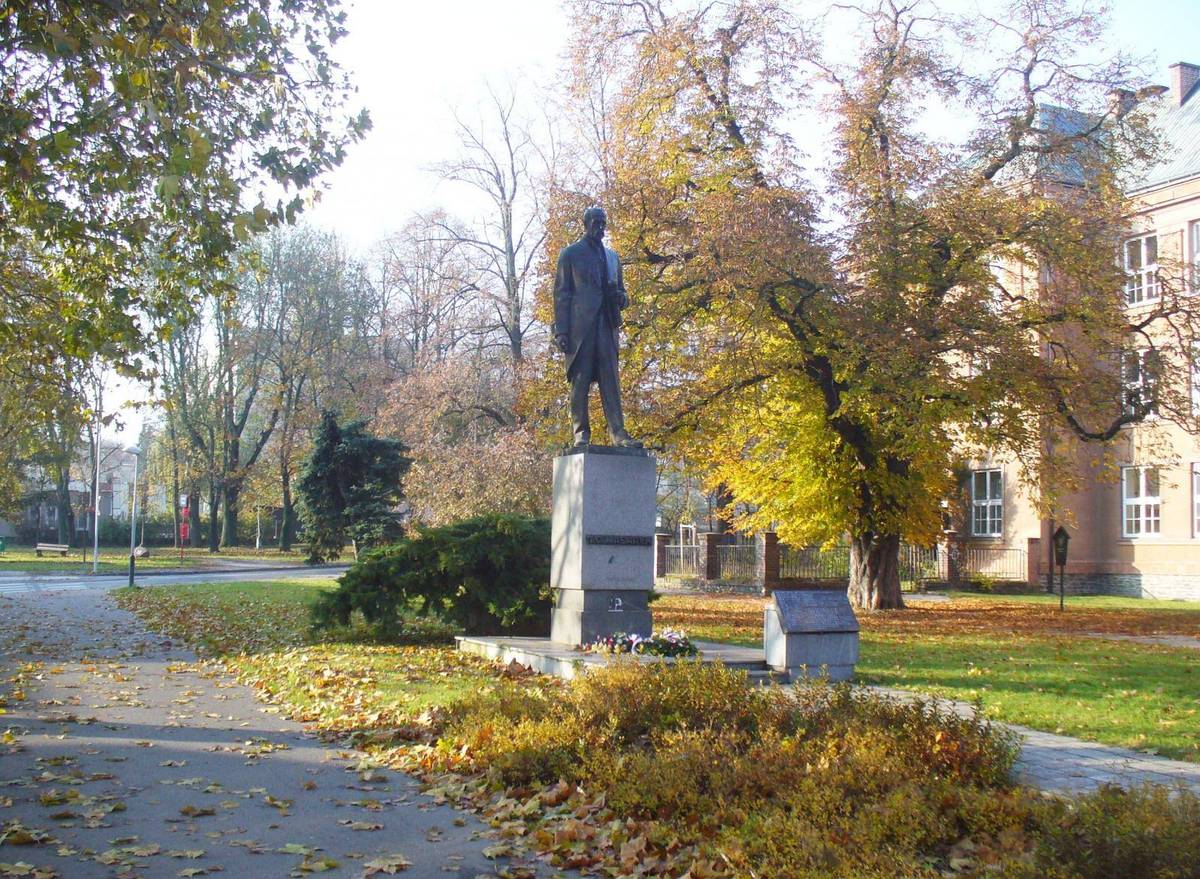
The statue of Tomáš Garrigue Masaryk in Kolín stands on Žižkova Street, right in front of the local grammar school building. It is one of many Czech monuments to the country's first president, and its turbulent history — three separate unveilings, a wartime destruction, and decades in hiding — mirrors the story of Czechoslovakia itself through the 20th century.
Who made the statue and when was it built?
The sculpture was created by Prague academic sculptor Jaroslav Hruška, with the architectural design by Vojtěch Kerhart. The foundation stone was laid on 28 October 1928, marking the tenth anniversary of Czechoslovak independence. A granite monolith weighing around 1.5 tonnes, meant to serve as the pedestal, was brought to Kolín by the Cingroš company from Plzeň on 12 October 1929, and the monument itself was unveiled on 28 October 1929.
What does the monument look like?
A larger-than-life bronze figure of Masaryk stands on a tall, rectangular pedestal of polished granite. The president is shown in civilian dress — a long coat, waistcoat, and tie — holding a rolled document in his left hand, with his right arm resting freely at his side.
What happened to the statue during World War II?
In June 1940, following the German occupation, the bronze figure was taken down and moved to the town museum for safekeeping. That did not save it: in 1943, the occupying authorities had the statue melted down for wartime material. The granite pedestal survived this period intact.
What happened to the monument after the war?
After the war, Jaroslav Hruška produced a new version of the statue, slightly different from the original. The monument was unveiled for a second time on 28 October 1947. This did not last either — in 1958, under the communist regime, residents of Kolín dismantled the statue themselves to keep it out of the authorities' hands, and it stayed hidden throughout the rest of the communist era.
When did the statue return to its place?
The third and final unveiling took place on 26 October 1990, after the fall of communism. On that occasion, a stone memorial plaque recounting the monument's turbulent history was also unveiled at the base of the pedestal. Notably, the reconstruction reused a pedestal that had previously supported a statue of Klement Gottwald in nearby Pečky (in place there from 1983 to 1990); the architect behind the restoration was Pavel Bohuslav Neumann.
Where exactly does the monument stand?
The monument is located on Žižkova Street in Kolín, directly in front of the town's grammar school building — easy to spot for anyone walking through this part of town on the way to or from the historic centre.
Is the monument worth seeing?
It is a modest but telling stop for anyone interested in 20th-century Czech history: its own story compresses the fate of the entire country into a single object — the birth of an independent republic, wartime occupation and the destruction of national symbols, postwar reconstruction, communist-era suppression of Masaryk's memory, and the eventual return to freedom after 1989. For visitors exploring Kolín, it makes for a brief but meaningful stop that pairs well with a walk through the town's historic centre.
Frequently asked questions
Where does the T. G. Masaryk statue in Kolín stand? On Žižkova Street, in front of the local grammar school building.
Who created the statue? Sculptor Jaroslav Hruška, with the architectural design by Vojtěch Kerhart.
When was the statue unveiled? Originally on 28 October 1929. After wartime destruction, it was unveiled again in 1947 and finally in 1990.
Why was the statue removed multiple times? The original bronze figure was melted down in 1943 on the orders of the German occupation authorities. The second version was dismantled and hidden by local residents themselves in 1958, out of fear it would be removed by the communist authorities.
Is the current statue the original from 1929? No — it is the second version, made by Jaroslav Hruška in 1946 after the original was destroyed during the war.
Nearby places

Earn badges for the places you visit
Download NextOnTrip, discover new places and check off your trails.