About this place
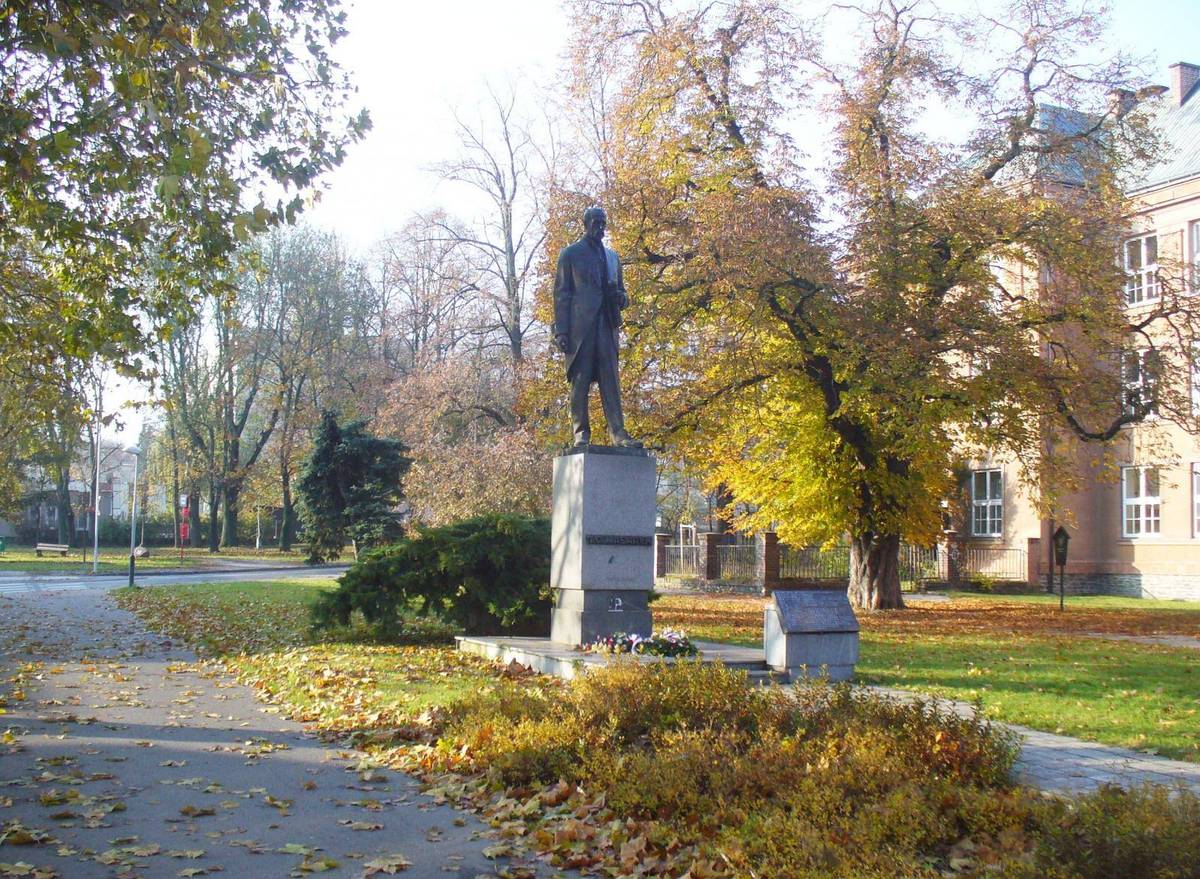
The Monument to Master Jan Hus in Kolín is one of the most unusual public sculptures in the Czech Republic — instead of a conventional robed figure, it shows Hus as a burning tree, split by a bolt of lightning. Today it stands on Husovo náměstí in the Kolín III district, right next to the Hussite church building, and for over a century it has sparked debate about what a monument to a religious reformer should actually look like.
Who designed the monument and when was it built?
The sculptor behind it is František Bílek, one of the leading Czech symbolist sculptors of the turn of the 20th century. The initiative came from the local Sokol organization, which approached the artist in 1909 with a request for a Hus monument. Bílek drew up the concept in 1911, and the sandstone carving itself was executed by stonemasons from Kolín under the supervision of Jan Drobník, with the sculptor overseeing and completing the work in 1914. The monument was ceremonially unveiled on 20 September 1914, originally on the northwest corner of what was then called Karlovo náměstí.
Why does the monument show a burning tree instead of a human figure?
This is the sculpture's defining feature. Rather than a literal portrait of Hus, Bílek created a tree-like form engulfed in flames — the artist himself described it as "a tree struck by the lightning of truth, which having burned did not burn away." It is a metaphor for Hus's death at the stake in Constance in 1415 and for the survival of his ideas despite the attempt to destroy them. The pedestal carries the inscription "STROM BLESKEM ZASAŽENÝ, KTERÝ NAVĚKY HOŘEL – 1914" ("a tree struck by lightning, which burned forever"). The finished monument stands 7 meters tall — Bílek had originally proposed a height of 15 meters, but a more modest scale was chosen in the end.
What happened to the monument during the German occupation?
In December 1941, on the order of the occupation authorities, the monument was removed from public space. A month earlier, in November 1941, two sculptors were commissioned to cut the figure into pieces to make it easier to dismantle and transport. The stone survived this ordeal, however, and could later be restored.
Where does the monument stand today, and when did it return?
After the war the statue was restored and reassembled. The rebuilt monument was unveiled again on 5 July 1949, this time on a square that had been renamed Husovo náměstí in honor of the reformer it depicts. It is there, next to the Hussite church building in the Kolín III district, that Bílek's work can still be seen today (GPS coordinates: 50°1'26.4"N, 15°12'9.9"E).
Who was Jan Hus, the man this monument commemorates?
Jan Hus (c. 1370–1415) was a Czech preacher and religious reformer, rector of Charles University in Prague, whose criticism of abuses within the Catholic Church put him on a collision course with church authorities. Summoned to the Council of Constance under a promise of safe conduct, he was nonetheless tried for heresy and burned at the stake on 6 July 1415. His death became a catalyst for the Hussite movement and one of the defining episodes in Czech national history — which is why monuments and squares bearing his name are so common across Czech towns, Kolín included.
Why does the Kolín monument matter in Bílek's body of work?
The Kolín sculpture ranks among František Bílek's most significant outdoor works, alongside his Hus monuments in Jabkenice, Tábor, and Přerov. What sets it apart is its bold, symbolic form — abandoning a realistic portrait in favor of an abstract metaphor of fire and tree, making it one of the most original historical monuments in the Czech Republic.
Frequently asked questions
Where exactly is the monument located? On Husovo náměstí in the Kolín III district, next to the Hussite church.
How old is the monument? It was unveiled in 1914, making it over a century old, though it has stood in a different location than originally since 1949.
What material is it made of? Sandstone.
Why was the monument moved? The German occupation authorities ordered its removal in 1941; after the war it was rebuilt on a new square, renamed Husovo náměstí.
Is this Bílek's only Hus monument? No — Bílek also designed Hus monuments in Jabkenice, Tábor, and Přerov, but the one in Kolín is considered one of the most symbolic thanks to its burning-tree form.
Nearby places

Earn badges for the places you visit
Download NextOnTrip, discover new places and check off your trails.