- Monuments
- Monument
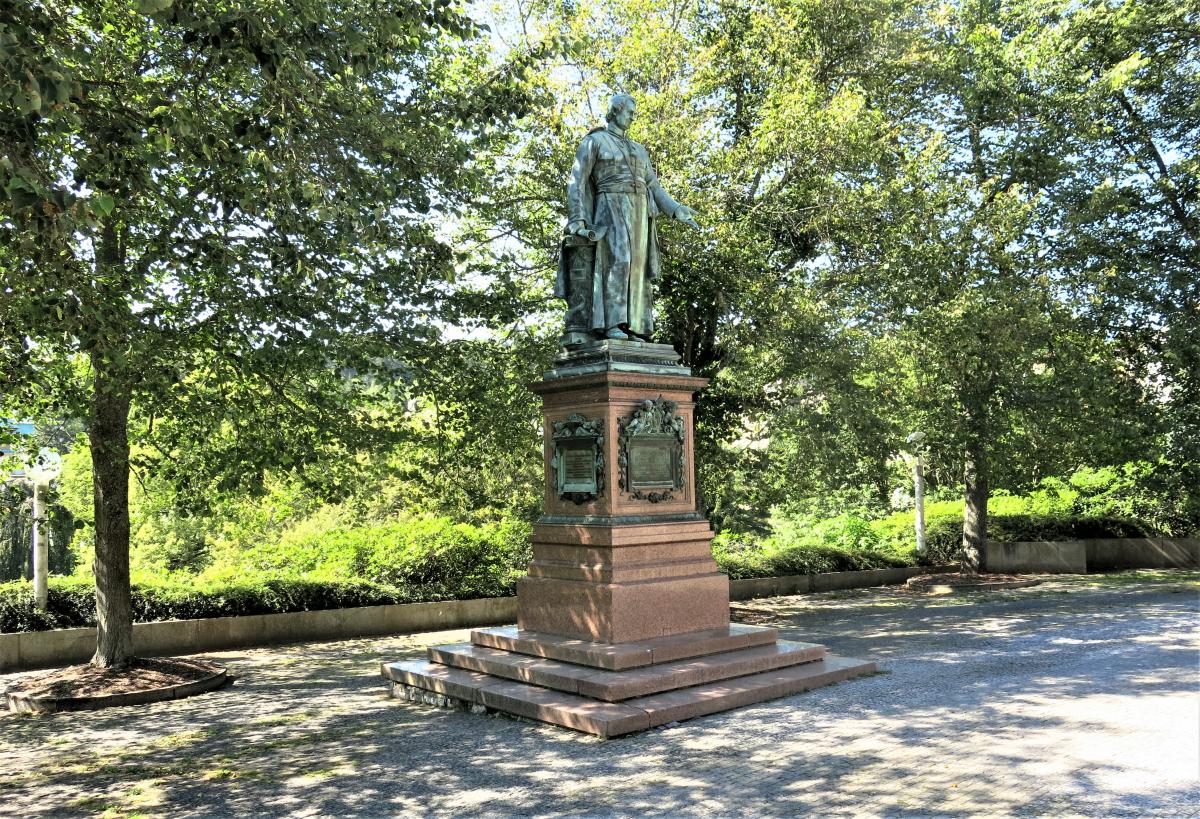
Statue of Karel Kašpar Reitenberger in Mariánské Lázně
About this place
The statue of Karel Kašpar Reitenberger stands on the colonnade near the Singing Fountain in Mariánské Lázně, surrounded by chestnut and Canadian poplar trees. It is a bronze figure of the Premonstratensian abbot from the Teplá monastery, whose actions in the first half of the 19th century led to the creation of one of the best-known Czech spa towns.
Who was Karel Kašpar Reitenberger?
Karel Kašpar Reitenberger was born on 29 December 1779. Between 1812 and 1827 he served as abbot of the Premonstratensian monastery in Teplá. He died on 21 March 1860.
He financed the draining of marshy land around the healing mineral springs near Teplá and oversaw the construction of the first buildings of the future spa, including a hospital and the Chapel of the Virgin Mary. Thanks to his efforts, Mariánské Lázně was officially declared a public spa on 6 November 1818. For this reason he is often described as one of the founders of the town, even though he never held any formal administrative office there.
What does the statue look like, and who designed it?
The monument was designed by the Vienna-based professor Karl Kundmann. The richly decorated pedestal, made of red Swedish marble, was carved by the Bavarian sculptor Erhard Ackermann of Weissenstadt, while the bronze casting of the abbot's figure was entrusted to Karel Turbarini. The figure, slightly larger than life-size, stands on a tall, elaborately ornamented base.
The pedestal carries four Latin plaques with the abbot's biographical dates and an inscription praising his role as the man who recognized the healing value of the local mineral springs in time.
When was the statue unveiled?
The monument was unveiled in 1879, on the exact centenary of Reitenberger's birth in 1779.
How did the statue survive the 20th century?
Few monuments to churchmen survived the entire 20th century in the Czech lands unscathed, and this one is an exception. It survived the metal collections organized during the Second World War, the postwar wave of removals of monuments with German associations in 1945, and the elimination of Catholic Church-related monuments during the socialist period (1948–1989). According to local historical sources, it may owe its survival to the Latin inscriptions on its pedestal, which were not immediately identified with the region's German-speaking past.
Where exactly does the statue stand?
The monument stands on the colonnade near the Singing Fountain (Zpívající fontána), one of the main attractions in the center of Mariánské Lázně, shaded by chestnut and Canadian poplar trees lining the promenade.
Frequently asked questions
Who was Reitenberger, the man depicted by the statue?
The abbot of the Premonstratensian monastery in Teplá from 1812 to 1827, credited as one of the founders of the Mariánské Lázně spa for financing the draining of land around the mineral springs and the construction of the first spa buildings.
When was the statue built?
In 1879, on the centenary of the abbot's birth.
Where exactly does the statue stand in Mariánské Lázně?
On the colonnade near the Singing Fountain, in the center of town.
What materials was the statue made from?
A bronze figure of the abbot standing on a richly decorated pedestal of red Swedish marble.
Who designed and made the statue?
The design came from Karl Kundmann, the pedestal was carved by Erhard Ackermann, and the bronze figure was cast by Karel Turbarini.
Why has the statue survived to this day?
It escaped destruction during the wartime metal collections, the postwar removal of German-associated monuments after 1945, and the elimination of church-related monuments under socialism — likely because its inscriptions were in Latin rather than German.
Nearby places

Earn badges for the places you visit
Download NextOnTrip, discover new places and check off your trails.