About this place
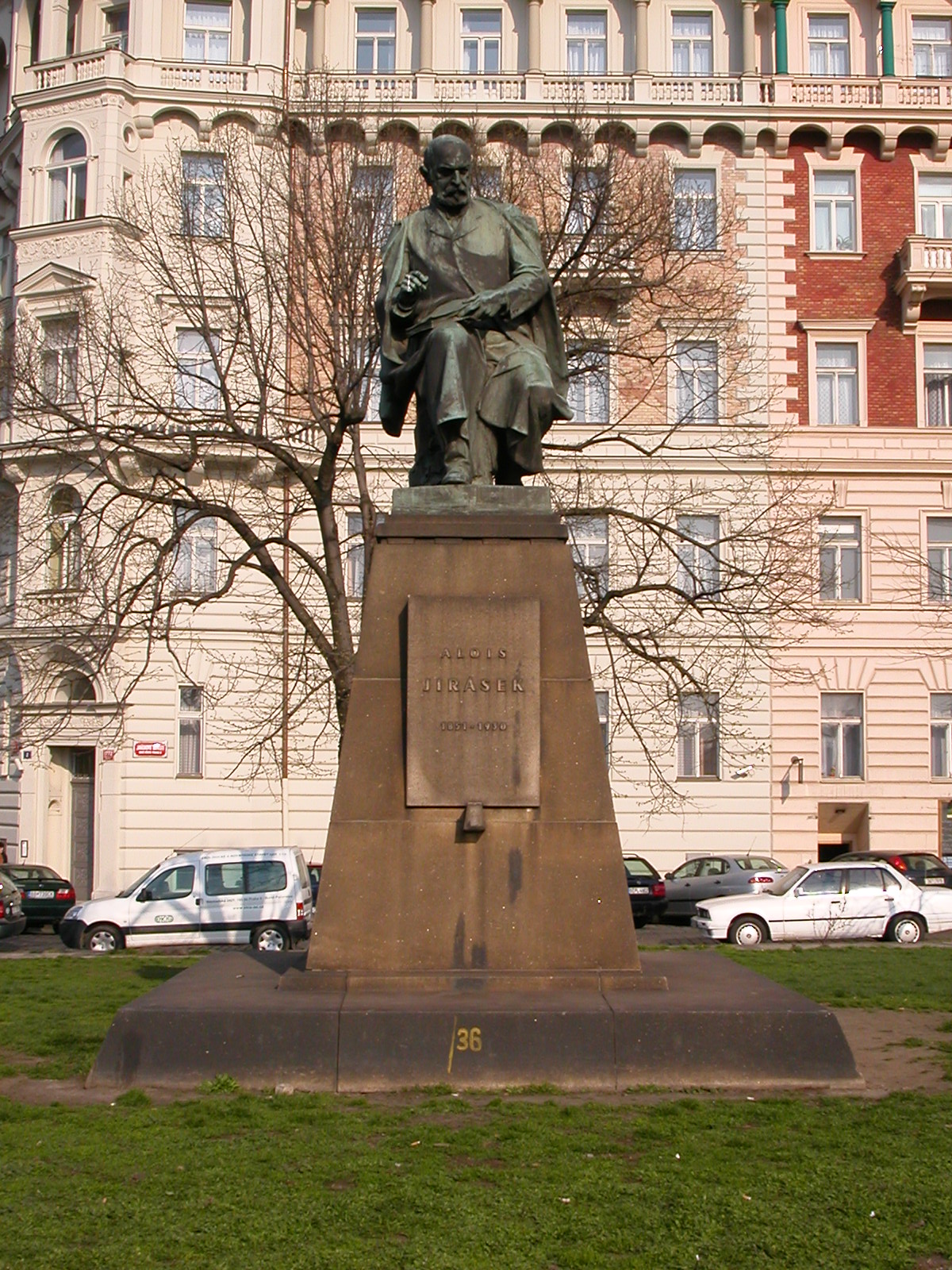
The statue of Alois Jirásek stands on Jiráskovo náměstí in Prague's New Town, a bronze figure tucked into a small park right in front of the house where the writer spent the final decades of his life. It's an easy monument to walk past without knowing who it honors — which is a shame, because Jirásek shaped the Czech national imagination more than most politicians of his era ever did.
Who was Alois Jirásek, and why does he have a monument in central Prague?
Alois Jirásek (1851–1930) was born in Hronov, a small town in northeastern Bohemia, and spent most of his adult life in Prague. He worked as a writer and playwright, but also as a politician and educator, blending literary work with public life in a way that was typical of the Czech national revival period. His body of work spans an unusually wide range of subjects: old Czech legends and folk tales, the Hussite era, and the events of the 19th-century national revival. These historical novels made him one of the central figures of Czech literature — an author whose books were taught in schools for generations, helping to shape a shared narrative of the Czech past.
Where exactly does the statue stand, and what does it look like?
The sculpture occupies a small park corner at the junction of Resslova street and Jiráskovo náměstí, just steps from the house where Jirásek lived from 1903 until his death in 1930. The location wasn't chosen at random — the monument was placed right next to the residence most closely associated with the final decades of his life. The figure itself depicts the writer at larger-than-life scale, seated and bent over his writing, a pose that emphasizes his identity as a man of letters rather than a public speaker or statesman. He sits atop a tall granite pedestal, which gives the piece a monumental presence despite the modest, intimate setting of the small square.
Who created the monument, and when?
The sculpture was made by Karel Pokorný, a respected Czech sculptor, working in collaboration with architect Jaroslav Fragner, who handled the architectural framing of the piece — including the design of the pedestal and how the monument was set into the square. The sculpture itself was completed in 1954, though its formal unveiling didn't take place until 1960. A gap of several years between completion and unveiling wasn't unusual for large bronze-and-granite public monuments of that era, especially given the postwar circumstances surrounding major construction projects.
Is it worth a detour to see it?
Jiráskovo náměstí sits along the natural route between Prague's New Town and Jiráskův most, so the statue tends to catch the eye of anyone walking the Vltava embankment toward Malá Strana or Vyšehrad. The square is quiet, free of the crowds that fill the Old Town, which makes it easy to take a moment to study the sculpture's details and read the short information plaque nearby. For anyone with an interest in Czech literature, it's a small but worthwhile stop; for everyone else, it's a good example of how Prague honors its writers in everyday neighborhood spaces rather than only on pedestals along the grand boulevards.
Frequently asked questions
Who was Alois Jirásek? A Czech writer, playwright, politician, and educator who lived from 1851 to 1930, known for historical novels covering Czech legends, the Hussite era, and the national revival.
Where does the statue stand? On Jiráskovo náměstí in Prague's New Town (Prague 2), at the corner of Resslova street, next to the house where the writer lived from 1903 until his death.
Who created the monument? Sculptor Karel Pokorný, in collaboration with architect Jaroslav Fragner.
When was it made and unveiled? The sculpture was completed in 1954 and formally unveiled in 1960.
What is it made of? Bronze, set on a tall granite pedestal.
Nearby places

Earn badges for the places you visit
Download NextOnTrip, discover new places and check off your trails.