About this place
Sant Romà de Massivert is a Romanesque church standing in the abandoned settlement of Massivert, within the municipality of el Pont de Suert, in the former district of Malpàs in the Lleida Pyrenees. Listed as a cultural asset of local interest, it is one of the few surviving physical traces of a village that disappeared as mountain valleys in the Alta Ribagorça region were depopulated.
What will you see there?
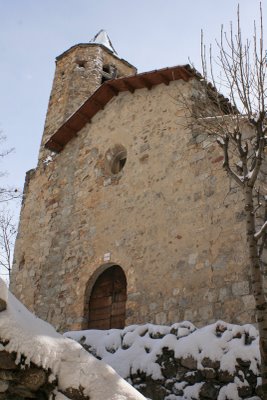
The church follows a simple single-nave plan covered with a barrel vault. To the east sits a semicircular apse with a quarter-sphere vault opening directly onto the nave — a layout typical of modest rural churches from this period. The apse holds a double-splayed window closed with a monolithic round arch, which once let light fall on the altar. The entrance is set into the west facade: a doorway built of roughly worked stone ashlar, topped by a small oculus that adds light to the nave.
The building's condition today is critical. The stone walls show clear cracking and detachment caused by time, lack of upkeep and the abandonment of the settlement, while the roof over both the nave and the apse has fractures and partial collapses that threaten further, more serious structural damage. Keep this in mind when planning a visit — this is a ruin, not a restored tourist site.
How do you get there?
Massivert sits at 1,323 metres above sea level, on the lower, left-hand side of the Erta valley. Access starts from Erta: follow a track to the crossroads between Prat de l'Hort and Tous, then take a path to the right after crossing a fence. The full approach takes roughly forty minutes on foot. This is a trip for those prepared for mountain terrain without marked tourist infrastructure — bring a map, water and sturdy footwear.
When is the best time to visit?
Given the altitude and terrain, summer and early autumn are the best times, when the path is passable and the Erta valley is free of snow. Access can be difficult or hazardous in winter and early spring.
History of the site
The earliest references to Massivert appear in the cartulary of the Santa Maria de Lavaix monastery. An early 10th-century document records a donation made by Guitiscle Guimar to Count Unifred I of Ribagorça, referring to land recorded as "Manciverti", generally taken as an early form of the settlement's name. This points to habitation here reaching back to the early Middle Ages, well before the current Romanesque church was built.
Like other settlements in this part of the Pyrenees, Massivert was eventually abandoned — a process that affected many mountain villages in Alta Ribagorça during the 20th century, as residents moved toward larger towns in search of work and better living conditions. The church remains the most visible trace of the community that once lived there.
Frequently Asked Questions
Can you go inside the church? Given the advanced structural damage, including cracks in the roof and walls, entering the interior can be risky. Viewing the exterior is possible, but caution is advised.
How long does it take to reach Massivert? From Erta, the walk takes about forty minutes, following a track and then a path after crossing a fence.
Are there other remains at Massivert? Massivert is an abandoned settlement — besides the Sant Romà church, remnants of village buildings survive, typical of depopulated villages across this part of the Pyrenees.
Is the route to the church signposted? It is not a fully marked tourist trail — orientation relies on landmarks such as the Prat de l'Hort–Tous crossroads, so carrying a map is recommended.
Nearby places

Earn badges for the places you visit
Download NextOnTrip, discover new places and check off your trails.