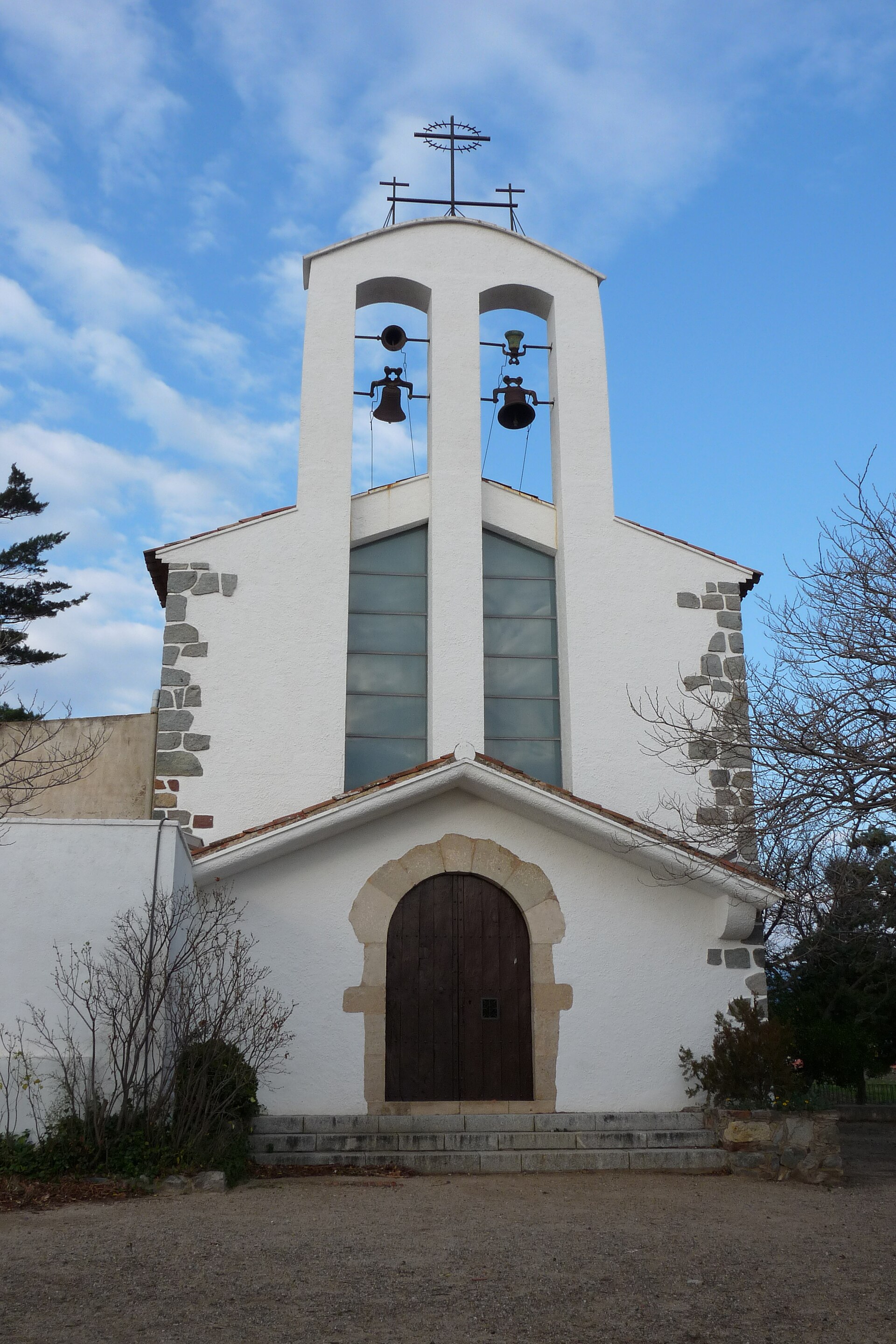
About this place
The Ermita de Sant Antoni de Pàdua is a small hilltop chapel in Maspujols, a village in the Baix Camp county of Catalonia. Listed in the Inventory of Architectural Heritage of Catalonia, it is one of the few historic structures preserved in this small community.
How do you get there?
The chapel sits on a rise just above Maspujols, reached by a cypress-lined path that starts a short, easy walk from the village center. The same path continues on to the local cemetery, which borders the chapel grounds. The site's coordinates are 41.181134, 1.043617 — useful if you're driving in from nearby Baix Camp towns such as Reus or Riudoms and want to set a precise destination.
What will you see on site?
The building has a single nave on a rectangular plan, built from rubble masonry with dressed stone blocks reinforcing the corners. The façade is rendered white from top to bottom and topped by a tall double bell gable — a classic Catalan espadanya — holding four bells, visible from the approach road well before you reach the building itself. The chancel ends in a rounded apse, and inside sits a modest altar.
The altar's centerpiece is a sculptural group depicting Saint Anthony of Padua, Saint Anthony the Abbot, and Saint Francis Xavier, carved by Ramon Ferran, a sculptor from nearby Reus. That local authorship gives the altar a distinctly regional character rather than an imported one.
The chapel's history stretches back to the eighteenth century: construction began in 1761, but the building wasn't finished and formally blessed until July 28, 1796 — a gap that points to a long, drawn-out building process. In the following decades the structure suffered damage during the Carlist Wars (1846–1849) and had to be rebuilt. It later fell into a near-ruinous state and underwent another major reconstruction, completed in 1963, which is largely why it stands in good condition today.
When should you visit?
The ermita keeps no fixed visiting hours the way larger monuments do — it's a small rural chapel, best seen during daylight hours when the sun brings out the white façade and the hilltop views over the Baix Camp countryside. It sees little tourist traffic, so any season works; autumn and winter give the cypress path a particularly quiet, contemplative feel. Pair the visit with a short walk through Maspujols itself, a small village where the chapel is one of the main points of interest.
Frequently asked questions
Do you have to walk to the chapel? Yes — the approach is a short walk up a cypress-lined path from the village center, manageable for most visitors.
Is the chapel open to visitors? As a small religious building, it doesn't keep regular opening hours; check local information in Maspujols before your visit, especially if you want to see the interior.
Why is the chapel named after Saint Anthony of Padua? It's dedicated to the Franciscan preacher and theologian Saint Anthony of Padua, a figure widely venerated across Catalan villages, many of which have chapels bearing his name.
Is it worth combining the visit with the cemetery? The Maspujols cemetery sits right next to the chapel, so visitors naturally pass it on the way, even though the two sites serve very different purposes.
Nearby places

Earn badges for the places you visit
Download NextOnTrip, discover new places and check off your trails.