- Sacred Monuments
- Religious monuments
Restes de l'església de Sant Genís de Tapioles
About this place
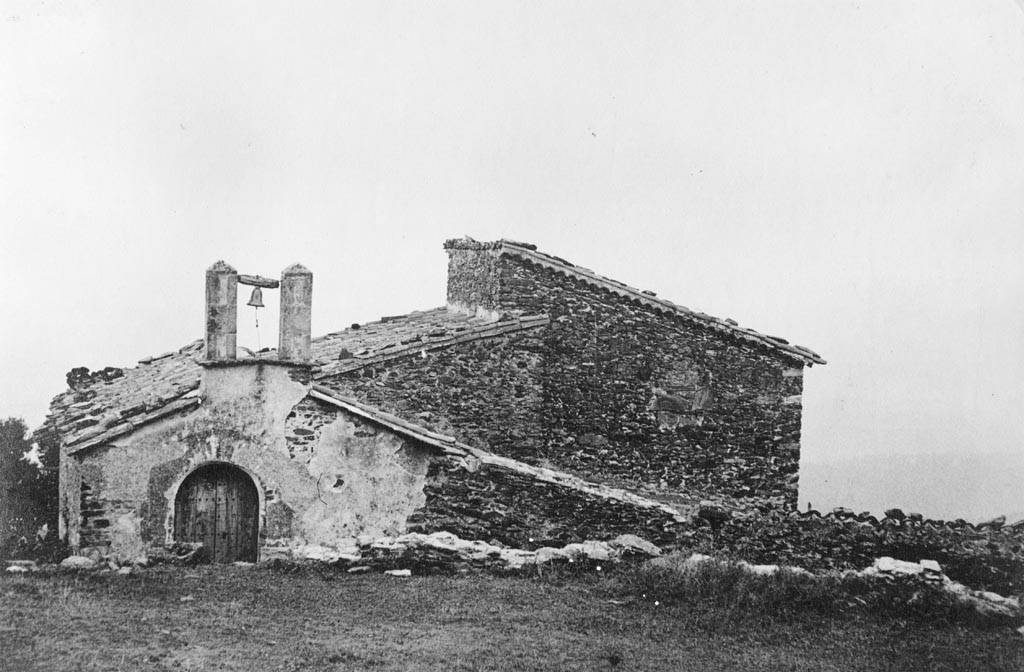
The remains of the church of Sant Genís de Tapioles sit in the municipality of Vallgorguina, in Catalonia's Vallès Oriental county. This modest but historically rich archaeological site preserves the foundations of an early medieval church, tucked into the wooded landscape of the Montnegre-Corredor massif, close to the chapel of Santa Eulàlia de Tapioles with which it once formed a single religious complex.
What exactly are these ruins?
The site holds the remnants of a small church that for centuries operated as a monastic cell attached to the nearby Santa Eulàlia de Tapioles. What survives today is the stone base of its walls, roughly 5 by 3 metres, uncovered and stabilised through archaeological work. This is a destination for visitors curious about regional history and early medieval archaeology, not a fully rebuilt monument.
What is the history behind Sant Genís de Tapioles?
The earliest documented reference to Sant Genís de Tapioles dates back to 878, when it appears as a monastic cell subordinate to the church of Santa Eulàlia de Tapioles. The site continues to appear in written sources for over a century afterward, with the last known mention found in a papal confirmation from 1002.
Archaeological research has shown that the location was inhabited long before the church itself was built. A first phase of occupation dates to the late Roman imperial period, followed by a second phase during the Visigothic era. The church proper was built around the mid-9th century and remained in use until roughly the 12th century, when it was abandoned. In the centuries that followed, knowledge of its exact location was gradually lost.
When were the ruins rediscovered?
The site was relocated in 1986, thanks to the efforts of the Vallgorguina Cultural Association, which brought renewed attention to this forgotten corner of local history. A proper archaeological excavation did not take place until 2003, when the foundations of the building were uncovered and consolidated, allowing the remains to be preserved and viewed on site as they exist today.
What can visitors actually see there?
What stands today is the exposed stone base of a small religious building. It is not a reconstructed church but an authentic, conserved archaeological trace, evidence of continuous human presence in this part of Catalonia from Roman times, through the Visigothic period, and into the early Middle Ages. The surrounding landscape is typical of the Montnegre-Corredor massif: wooded hills and trails characteristic of this stretch of Vallès Oriental.
Who is this site for?
Sant Genís de Tapioles will appeal mainly to visitors interested in history, archaeology, and hiking through Vallès Oriental who want to combine a walk through the Montnegre-Corredor natural landscape with the discovery of a lesser-known, authentic trace of Catalonia's past. It pairs naturally with a visit to the nearby chapel of Santa Eulàlia de Tapioles.
Frequently Asked Questions
What is Sant Genís de Tapioles? It is the archaeological remains of a small early medieval church in Vallgorguina, which functioned as a monastic cell linked to the chapel of Santa Eulàlia de Tapioles.
How old is the site? The church is first documented in 878, with the last known reference dating to 1002. The location itself was inhabited even earlier, during the late Roman and Visigothic periods.
When were the ruins rediscovered? The site was relocated in 1986, and a formal archaeological excavation was carried out in 2003.
What will I actually see on site? The uncovered and stabilised stone foundations of the building, measuring roughly 5 by 3 metres, an authentic archaeological remnant rather than a reconstructed structure.
Nearby places

Earn badges for the places you visit
Download NextOnTrip, discover new places and check off your trails.