About this place
Provodínské kameny is a striking group of rock formations rising above the village of Provodín in the Česká Lípa district of northern Czechia. Unlike most rock landscapes in the region, which are typically carved from sandstone, these formations have a volcanic origin — they are made of basalt that once formed the plug of an ancient volcano, pushing up through the surrounding claystones and siltstones interbedded with fine-grained sandstone.
Where does the name come from, and what should you look for?
The protected area consists of six separate rock outcrops. The largest and most recognizable of them carries two names: Lysá skála and Spící panna, meaning "Sleeping Maiden." The second name refers to the rock's silhouette — viewed from the direction of Česká Lípa, its outline resembles the profile of a sleeping girl's face, with a gentle curve suggesting a forehead, nose, and chin, especially striking against the sky at sunset. The whole group of rocks sits on a hill that itself bears the name Spící panna, roughly 1.5 kilometers north of Provodín.
Why is this place protected?
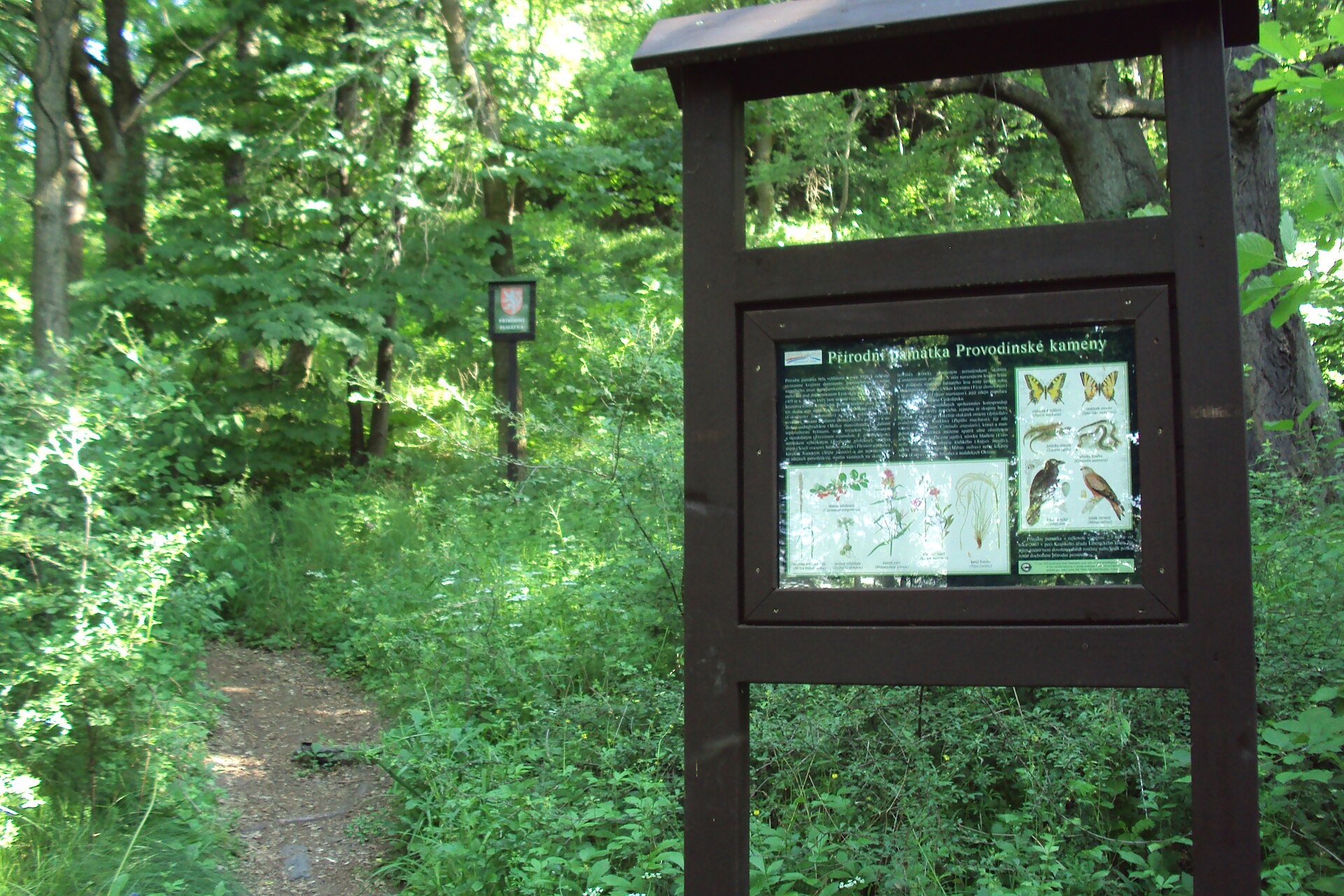
The natural value of Provodínské kameny goes beyond geology alone. The sun-warmed basalt walls create favorable conditions for thermophilic (heat-loving) plant communities — species that typically struggle to survive in the cooler climate of Central Europe but thrive here thanks to the rock's ability to absorb and radiate warmth. Alongside this unusual vegetation, the site also supports rare animal species that depend on the rocky crevices and sun-exposed surfaces as habitat. It's this combination of distinctive volcanic geology with a rare microclimate and the biodiversity it supports that led to the area's protection.
The formal history of conservation here dates back to the mid-20th century: the territory was declared a state nature reserve by the Ministry of Education and Culture on July 4, 1956. The protective status was later reaffirmed and updated by the Liberec Regional Authority on March 21, 2006, bringing the site's formal classification in line with modern nature conservation regulations.
How did the basalt rocks form?
The geological story of Provodínské kameny is one of volcanic activity that left behind a hard basalt core, while the softer sedimentary rock surrounding it eroded away over millions of years. The surrounding rock — claystones and siltstones with interlayers of fine-grained sandstone, belonging to formations spanning the Teplice-to-Březno sequence — is far less resistant to weathering than the dense, compact basalt. The result of this contrast is the landscape visible today: hard, weather-resistant basalt outcrops standing above gentler, partly forested terrain that has worn away around them.
Frequently asked questions
Are Provodínské kameny sandstone rocks, like most formations near Česká Lípa? No — this is one of the few rock formations in the area that isn't sandstone. The rocks are volcanic in origin and made of basalt, setting them apart from the sandstone labyrinths typical of the wider Česká Lípa region.
How many rocks make up the group? The protected area comprises six separate basalt rock formations, with Lysá skála, also known as Spící panna, being by far the most recognizable.
Where does the name "Sleeping Maiden" come from? It refers to the rock's shape — seen from the right angle, looking from the direction of Česká Lípa, the silhouette resembles the profile of a sleeping girl's face.
Since when has the area been protected? Protection dates back to 1956, when the site was declared a nature reserve by ministerial decree. Its status was updated in 2006 by the Liberec Regional Authority.
Where exactly is Provodínské kameny located? The rocks lie about 1.5 kilometers north of the village of Provodín, in the Česká Lípa district of northern Czechia.
Nearby places

Earn badges for the places you visit
Download NextOnTrip, discover new places and check off your trails.