About this place
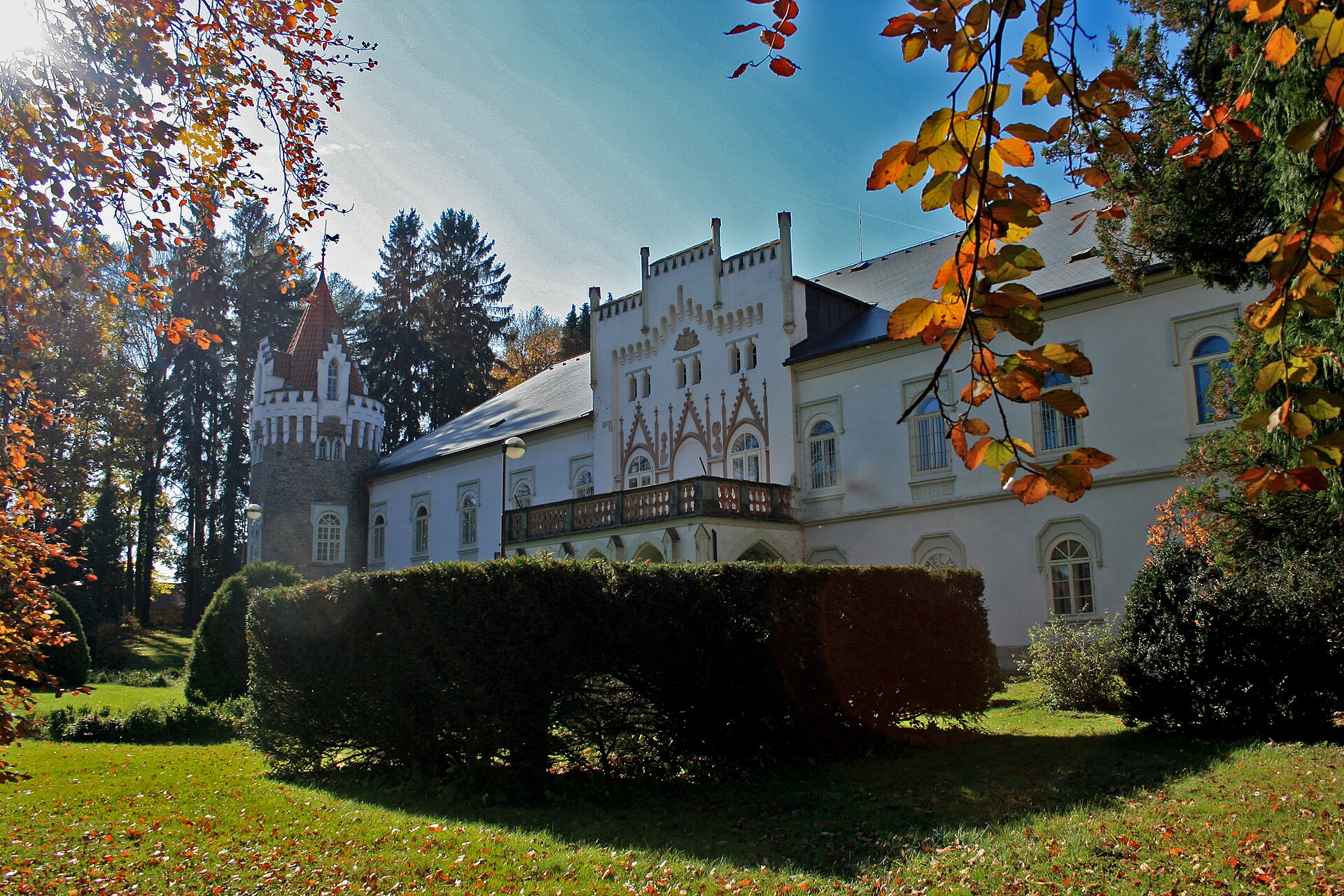
Pohled Castle stands on the right bank of the Sázava River in the village of Pohled, which also includes the settlement of Rouštany, a few kilometres east of Havlíčkův Brod in the Bohemian-Moravian Highlands.
Was Pohled Castle always a noble residence?
Not at all — the site began life as a convent rather than a castle. In the second half of the 13th century, Smil of Lichtenburg, a powerful nobleman who had built his fortune on silver mining around Jihlava and Havlíčkův Brod, backed the founding of a Cistercian convent dedicated to the Valley of the Blessed Virgin Mary, known in German as Frauenthal. The land for the foundation was granted to three daughters of Vítek of Klokoty, a nobleman connected to southern Bohemia, who intended to devote themselves to religious life there. The earliest written mention of the settlement itself dates to 1265, in a document of the archdeacon of Kouřim recording the laying of a cornerstone for a parish church.
How turbulent was the convent's early history?
Quite turbulent. During the reign of Otto of Brandenburg, who pressed his own claim to the Bohemian crown in the late 13th century, soldiers plundered the convent buildings, and reconstruction was only completed after 1300. A second blow came in 1329, when the still-wooden convent burned down entirely. Rebuilding, this time likely in stone, took nearly two decades and was finished around 1351. For centuries afterward, the convent functioned as a working community of Cistercian nuns in the region.
Why did the monastic community come to an end?
The centuries-long religious history ended with the Josephine reforms. On 20 March 1782, at eleven o'clock in the morning according to the record, the convent was dissolved by decree of Emperor Joseph II. A parish was established in Pohled at that time, and the buildings continued to house a community of Carmelite nuns for another ten years before religious use ended entirely. Since no buyer initially came forward for the dissolved estate, it was leased to a man named Jošt of Jihlava, who ran a cloth-making factory within the former convent walls.
When did the convent become a castle?
The turning point came in 1807, when Count Josef von Unwerth, whose family seat was at Mníšek pod Brdy, purchased the entire estate — Pohled, Termesivy and Rouštany together — for 230,050 guilders. It was Unwerth who converted the former convent into a residential château, giving the complex much of the character it retains today as a Baroque castle built on the foundations of a medieval monastery.
What makes Pohled worth a visit?
Pohled Castle is above all a story of transformation: from a fortified Cistercian convent, through an industrial interlude as a cloth factory, to an aristocratic residence. Visitors can trace layers of history stretching back to the 13th century, and the setting above the Sázava makes it a convenient stop when exploring the area around Havlíčkův Brod and the Bohemian-Moravian Highlands.
Frequently asked questions
Was Pohled Castle originally a monastery? Yes — the complex grew out of a Cistercian convent founded in the 13th century and dedicated to the Valley of the Blessed Virgin Mary.
When did the religious community end? The convent was dissolved on 20 March 1782 as part of Joseph II's reforms, though Carmelite nuns continued living there for another decade.
Who turned the convent into a castle? Count Josef von Unwerth, who bought the whole estate in 1807 and remodelled the buildings into a residential château.
Where exactly is the castle located? On the right bank of the Sázava River in the village of Pohled, which includes the settlement of Rouštany, in the Havlíčkův Brod district.
Nearby places

Earn badges for the places you visit
Download NextOnTrip, discover new places and check off your trails.