About this place
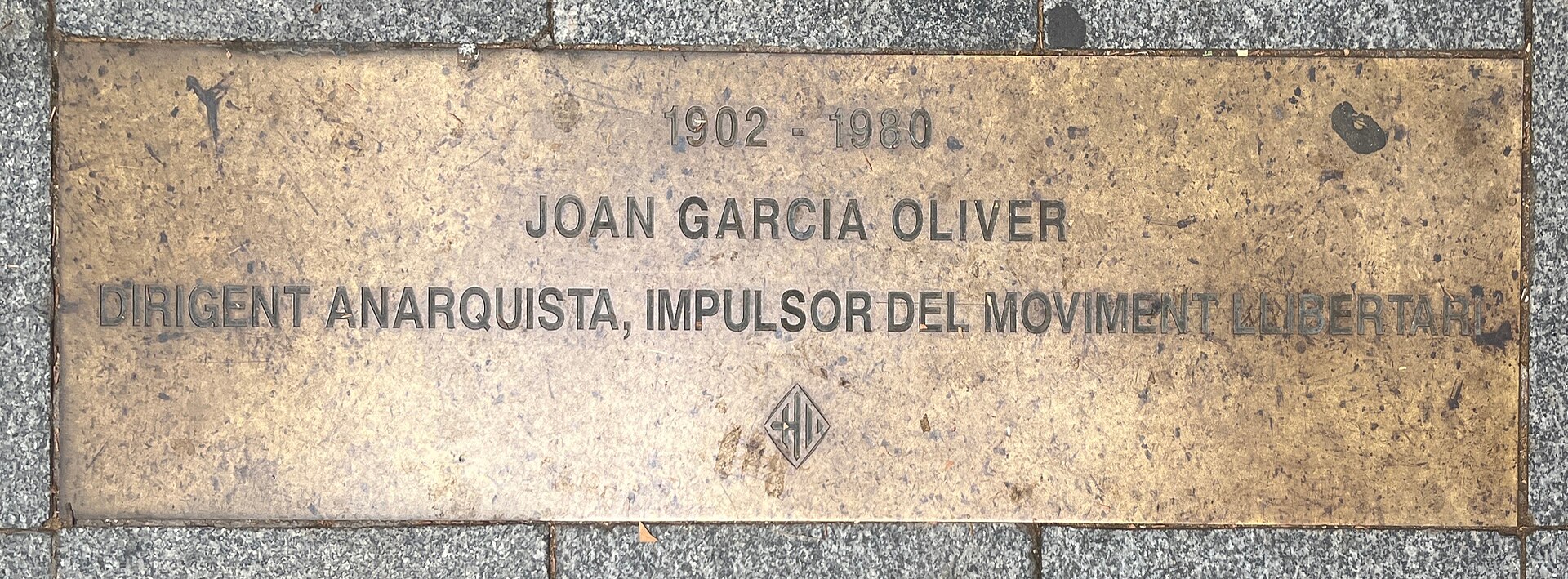
The memorial plaque to Joan García Oliver stands on Rambla del Poblenou in Barcelona, one of a set of brass plaques making up the Passeig de la Memòria — a memory trail dedicated to figures tied to the Sant Martí district.
Who was Joan García Oliver?
Joan García Oliver (1902–1980) was born in Reus, but it was Poblenou where he built his political life — he lived on Carrer Espronceda and belonged to the neighborhood's CNT Confederal Defense Committee. He was one of the most charismatic figures of Catalan anarcho-syndicalism: together with Buenaventura Durruti and Francisco Ascaso he founded the group Els Solidaris (Los Solidarios), and later the affinity nucleus known as "Nosotros" (or "los sin nombre"). That group played a central role in organizing the resistance that defeated the military uprising on the streets of Barcelona on 19–20 July 1936.
Why does he appear on Poblenou's memory trail?
The Passeig de la Memòria was created on the initiative of the Poblenou Neighbors' Association and the Historical Archive of Poblenou, which have been placing plaques across the district since 1999 to honor people who were born, lived, or worked there. The list of honorees remains open to new additions. García Oliver was included because of his local ties and his role in the district's union movement, not because he was born there. Each plaque measures roughly 30 cm by 1.2 meters and carries a short biographical note. The originals were bronze, but in February 2018 the plaques were stolen from the street — most were replaced in 2019, with the final three reinstalled in summer 2020, this time in brass and fitted with anti-theft anchoring.
What role did he play in Spanish history?
After the July 1936 victory, García Oliver joined the Republican government of Francisco Largo Caballero, taking over the Ministry of Justice on 4 November 1936 — one of four CNT-FAI anarchists to hold ministerial posts for the first time in the movement's history. In just under 191 days in office, he dismantled the old property registry system, annulled all pre-war criminal convictions on 10 November 1936, and appointed Melchor Rodríguez as director of prisons specifically to curb extrajudicial killings. He lost his ministerial post in May 1937, stepping down alongside the other CNT ministers after the so-called May Events in Barcelona. Following the Republic's defeat in 1939 he went into exile — first to France, then to Venezuela and Mexico, where he spent the rest of his life and wrote his memoirs, "El eco de los pasos" (The Echo of Footsteps).
How to get there and what else to see nearby
Rambla del Poblenou is the district's main promenade, easily reached from Poblenou or Llacuna metro stations on line L4. The García Oliver plaque is one stop along a trail worth walking in full, since it traces the history of working-class and anarchist Poblenou during the Republic, when the CNT was the majority union in the area's factories and workshops. Late afternoon is a good time to walk it, when the rambla fills with the neighborhood's café-and-shop rhythm; from there it's an easy continuation on foot to Poblenou beach, just a few hundred meters away.
Frequently asked questions
Where exactly is the plaque located? On Rambla del Poblenou, as part of the Passeig de la Memòria trail that runs through the heart of the Sant Martí district.
Was García Oliver born in Poblenou? No — he was born in Reus, but he lived in Poblenou and was active in the local CNT Defense Committee, which is why he is honored on this trail.
What is he best known for? As a co-founder of Los Solidarios/Nosotros and a key figure in the defense of Barcelona in July 1936, and later as Minister of Justice in the Republican government (1936–1937).
Is this the original 1999 plaque? Not necessarily — several plaques along the trail, this one likely among them, were replaced after a theft in 2018; the current pieces are brass and better secured against theft.
Nearby places

Earn badges for the places you visit
Download NextOnTrip, discover new places and check off your trails.