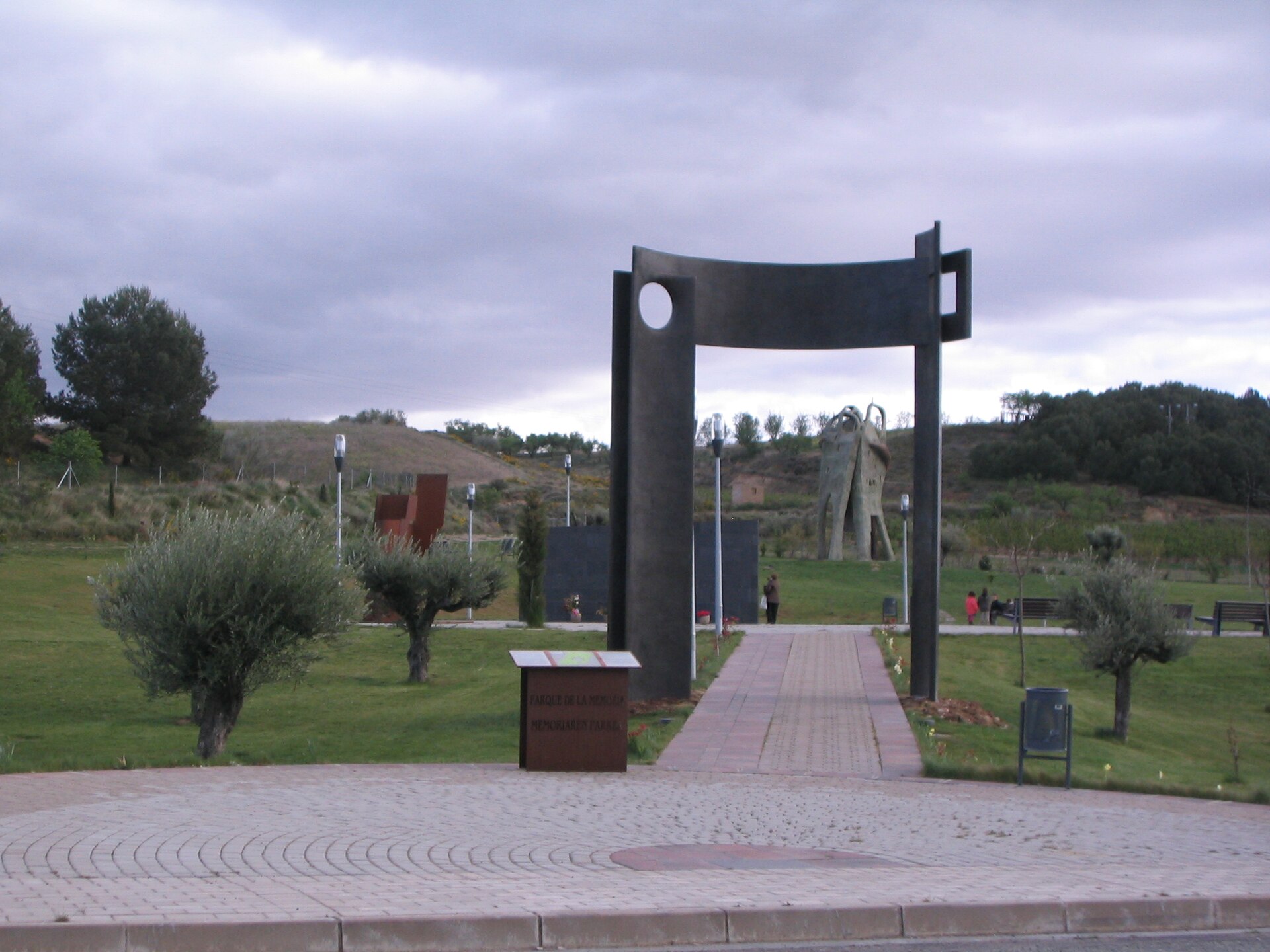
About this place
Parque de la Memoria is Navarre's principal memorial to the victims of the Spanish Civil War, located in the town of Sartaguda on the banks of the Ebro river. The park stands in a place that became, for the entire region, a symbol of the repression carried out by Francoist forces after the military coup of July 18, 1936 — the very reason Sartaguda is still known today as "the village of widows."
What will you see there?
The centerpiece of the park is a long memorial wall inscribed with the names of more than 3,400 people murdered across Navarre in the early months of the civil war. It was the first monument of its kind dedicated to the victims of Francoist repression anywhere in Spain, which alone makes it a singular site on the country's memorial map.
Covering over 6,000 square meters, the park is more than just a wall of names. It also houses three distinct sculptures, each by a different artist: "Atariaren Besarkada" by José Ramón Anda, "Los Acribillados de la Santa Cruzada" by Joxe Ulibarrena, and "Como Hoz Atávica y Mortal" by Néstor Basterretxea. Each piece approaches the themes of suffering, loss, and memory differently — ranging from abstract forms to direct references to the executions themselves.
Why did Sartaguda suffer so heavily?
Sartaguda was one of the towns hit hardest by the repression that followed the outbreak of the civil war. So many of its men were shot that for decades the town was remembered as a place where almost every family had lost a father, husband, or son. The park exists precisely so that this memory would not fade as the generation of direct witnesses passed away.
When was the park created, and by whom?
The park was formally inaugurated on May 10, 2008, in a ceremony attended by thousands of people, including many relatives of the victims. The initiative came from local associations — the Asociación Pueblo de las Viudas de Sartaguda and the Asociación de Familiares de Fusilados de Navarra (AFFNA36) — which had campaigned for years for a dignified memorial to the victims of repression across all of Navarre, not just Sartaguda itself.
How do you get there, and when should you visit?
Sartaguda sits in central Navarre, in the Ebro valley, close to towns such as Lodosa and Andosilla, which makes it easy to combine a visit with other stops in the area. The most convenient way to arrive is by car — the park occupies open, easily accessible municipal land. Admission is free and the park is open year-round; it is best visited on a quiet day, allowing time to read the names on the wall and take in each sculpture individually. This is a place that calls for reflection rather than a rushed visit.
Keep in mind that this is a site of memory, not a conventional tourist attraction — visitors should approach it with the seriousness a memorial to victims of atrocity deserves.
Frequently asked questions
How many names appear on the memorial wall? The central wall bears the names of more than 3,400 people killed in Navarre after July 1936.
Who created the sculptures in the park? The park holds three works, by José Ramón Anda, Joxe Ulibarrena, and Néstor Basterretxea, each addressing repression and loss in a different artistic style.
Why is Sartaguda known as "the village of widows"? Because of the exceptionally high number of men from the town who were executed during the Francoist repression at the start of the civil war.
Is admission to the park free? Yes, the park is open to the public at no charge and can be visited independently at any time of year.
Nearby places

Earn badges for the places you visit
Download NextOnTrip, discover new places and check off your trails.