About this place
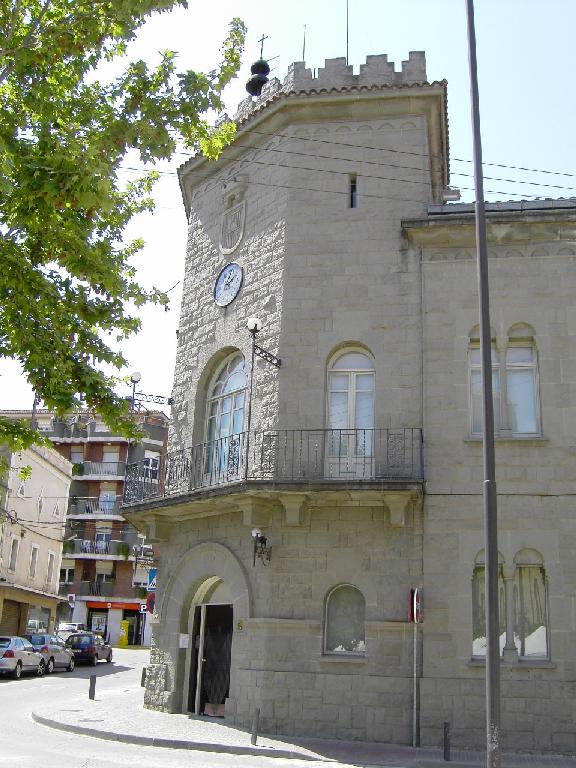
The Parets del Vallès town hall (Ajuntament de Parets del Vallès) sits at the heart of Parets del Vallès, a town in the Vallès Oriental district, Barcelona province. It is one of the few buildings in town formally protected as local heritage, and its distinctive corner tower with two old bells is a familiar landmark for anyone walking through the historic centre.
How do you get there?
Parets del Vallès lies a short distance north of Barcelona, well connected by both road and commuter rail to the wider metropolitan area. The town hall stands right in the historic centre, at a corner where two streets meet, so it's easiest reached on foot from the main square or the pedestrian high street where most local shops and services cluster. Visitors coming from Barcelona can use the regional commuter train that links the Vallès Oriental towns to the city, then walk a few minutes into the centre from the station.
What will you see?
The building went up in 1949 to a design by architect Joaquín José García de Alcañiz, who at the time served as the municipal architect for nearby Granollers and had already designed several other buildings in Parets, including Villa Helga and the Sant Jaume church. For the town hall, he drew inspiration from the El Rincón palace in Aldea del Fresno.
The result is a neo-Romanesque building set on a corner plot, with a chamfered façade aligned to follow both streets. The layout runs a ground floor and first floor along the wings, rising to two extra storeys in the corner section. The roof is mixed: the side wings are covered in Arabic tile, while the tower-like corner section has a flat roof edged by a crenellated parapet resting on a bold cornice.
The tower is the building's signature feature — three visible faces, each pierced by a pointed arch. Hanging inside those arches are two forged bells cast in 1863, which previously belonged to the now-defunct Linera factory and, before that, to the Sant Esteve church. Those bells are part of what makes the tower such a recognisable point on the town's skyline.
In 1986 the complex was expanded, with the adjoining Can Pau building converted into extra municipal offices. As a result, today's town hall blends the original 1949 façade with a newer administrative wing, without losing the character of the historic corner building.
The town hall is listed as a cultural asset of local interest, meaning its façade, tower and architectural details are under heritage protection.
When should you visit?
The exterior can be admired year-round, and the building photographs best in the afternoon light, when the sun picks out the tower's detailing and crenellations. It's easy to combine a visit with a walk through the surrounding historic centre and a look at the nearby Sant Jaume church, designed by the same architect. If your trip coincides with local town festivities, it's worth checking the events schedule beforehand, since the adjacent square tends to be especially lively on those days.
Frequently asked questions
Who designed the Parets del Vallès town hall? Architect Joaquín José García de Alcañiz designed the building, completed in 1949, drawing inspiration from the El Rincón palace in Aldea del Fresno.
What is the most distinctive feature of the town hall? Its corner tower, with three faces, pointed arches and two forged bells from 1863 that originally belonged to the Sant Esteve church.
Is the town hall building protected? Yes, it is listed as a cultural asset of local interest, which protects its façade and architectural elements.
Can visitors go inside the town hall? The building is in active administrative use, so interior access is limited to office hours and official business — the exterior architecture, however, can be viewed at any time.
Nearby places

Earn badges for the places you visit
Download NextOnTrip, discover new places and check off your trails.