About this place
The Monument to the Battles and Victory over Fascism (Památník bojů a vítězství nad fašismem) is a tall, three-part pylon standing in the Municipal Park of Český Krumlov — one of the few structures in town that speaks directly to the history of the Second World War. It isn't medieval or baroque like most of the city's landmarks, but it's worth a look both as a record of how communist-era Czechoslovakia commemorated the fight against Nazism and as a case study in how a single construction project can permanently reshape a historic park.
Where exactly is the monument?
The monument stands inside the Municipal Park (Městský park), which occupies the area of the river's former third Vltava meander, in the Plešivec district. It's a quiet, green part of the city, sitting just outside the walls of the UNESCO-listed historic core but still within easy walking distance of it.
Who designed it, and when was it built?
The design was created by S. Zadražil in 1987. Construction, however, didn't happen until 1989 — and it went ahead despite objections from heritage conservation professionals, who warned that the project would seriously disrupt the park's original historic layout.
What does the monument look like?
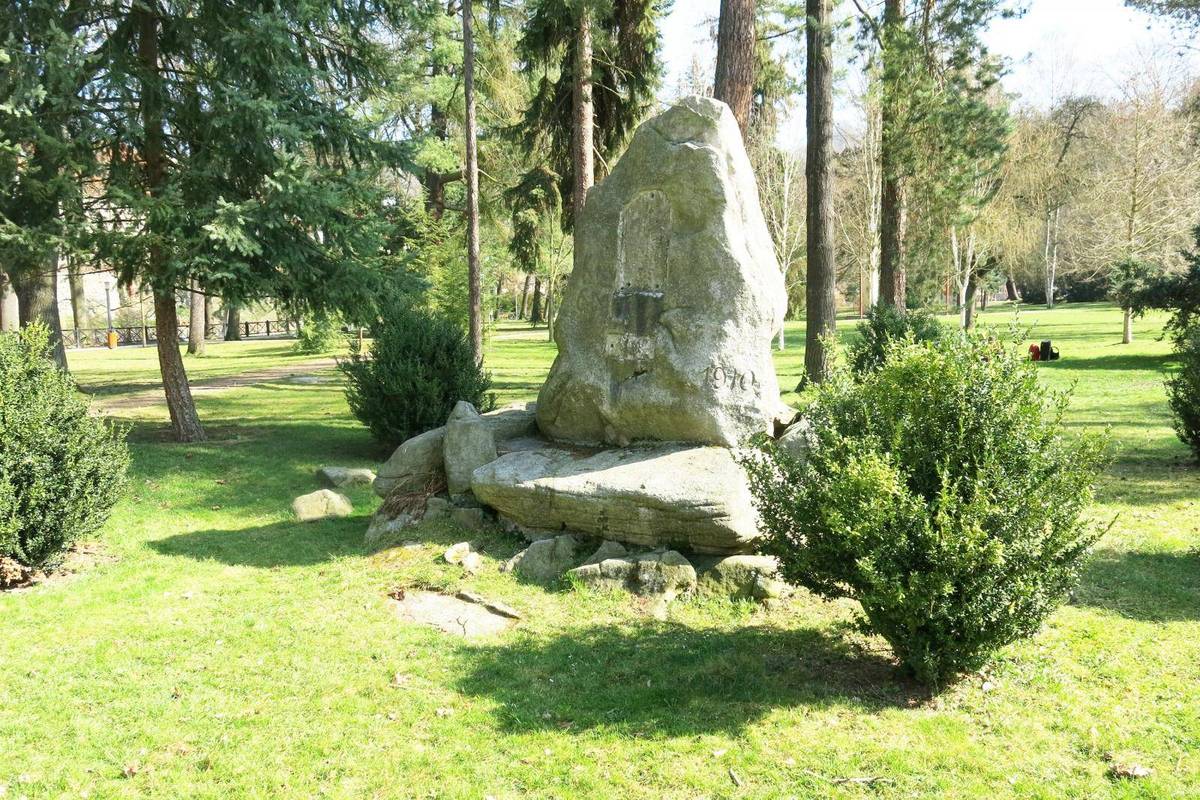
The centerpiece is a tall, three-part pylon, clad in panels of white Račany limestone. It stands on a platform paved with marble slabs and surrounded by six horizontally arranged blocks, also clad in marble. The front face carries a carved stone sculpture of a raised, clenched fist, symbolizing resistance to fascism, while the reverse side is decorated with an abstract peace symbol.
What do the inscriptions on the monument mean?
The side faces of the pylon carry two distinct sets of inscriptions. One lists cities associated with victorious battles of the Second World War — Moscow, Stalingrad, Warsaw and Berlin. The other names Nazi concentration camps: Auschwitz, Mauthausen and Terezín (Theresienstadt). Pairing military victories with sites of mass killing in this way was a typical feature of socialist-era historical commemoration in the 1980s.
Why was the monument's construction controversial?
Building the monument in 1989 went against the recommendations of heritage conservationists. Its construction fundamentally altered the layout of the Municipal Park, disrupting the original historic composition of the grounds and the network of footpaths that had existed there before. The monument is still cited today as an example of an ideologically motivated intervention in a protected green space, rather than one driven by landscape design considerations.
What should you know before visiting?
The monument isn't on the main tourist circuit of Český Krumlov — most visitors head straight for the castle and the old town, bypassing the Municipal Park in Plešivec altogether. It appeals more to travelers interested in 20th-century Czech history and socialist-era monument architecture than to those looking for a standard sightseeing stop. That said, a walk through the park itself, laid out on the site of the river's former meander, can make for a pleasant addition to a visit to the city — especially for anyone wanting to see Český Krumlov beyond its best-known streets.
Frequently asked questions
What does the monument in Český Krumlov commemorate? The fight against fascism and the Allied victory in the Second World War, represented through a pairing of victorious-battle cities and Nazi concentration camps.
Where exactly is the monument located? In the Municipal Park (Městský park) in the Plešivec district of Český Krumlov, on the site of the river's former third Vltava meander.
Who designed the monument, and when was it built? S. Zadražil created the design in 1987; the monument itself was built in 1989.
What is the monument made of? A three-part pylon clad in white Račany limestone, standing on a marble-paved platform surrounded by six marble-clad blocks.
What inscriptions appear on the monument? The names of cities linked to Second World War victories (Moscow, Stalingrad, Warsaw, Berlin) and the names of Nazi concentration camps (Auschwitz, Mauthausen, Terezín).
Why is the monument's construction considered controversial? Because it was built against the advice of heritage conservationists and permanently changed the historic layout and footpath network of the Municipal Park.
Nearby places

Earn badges for the places you visit
Download NextOnTrip, discover new places and check off your trails.