About this place
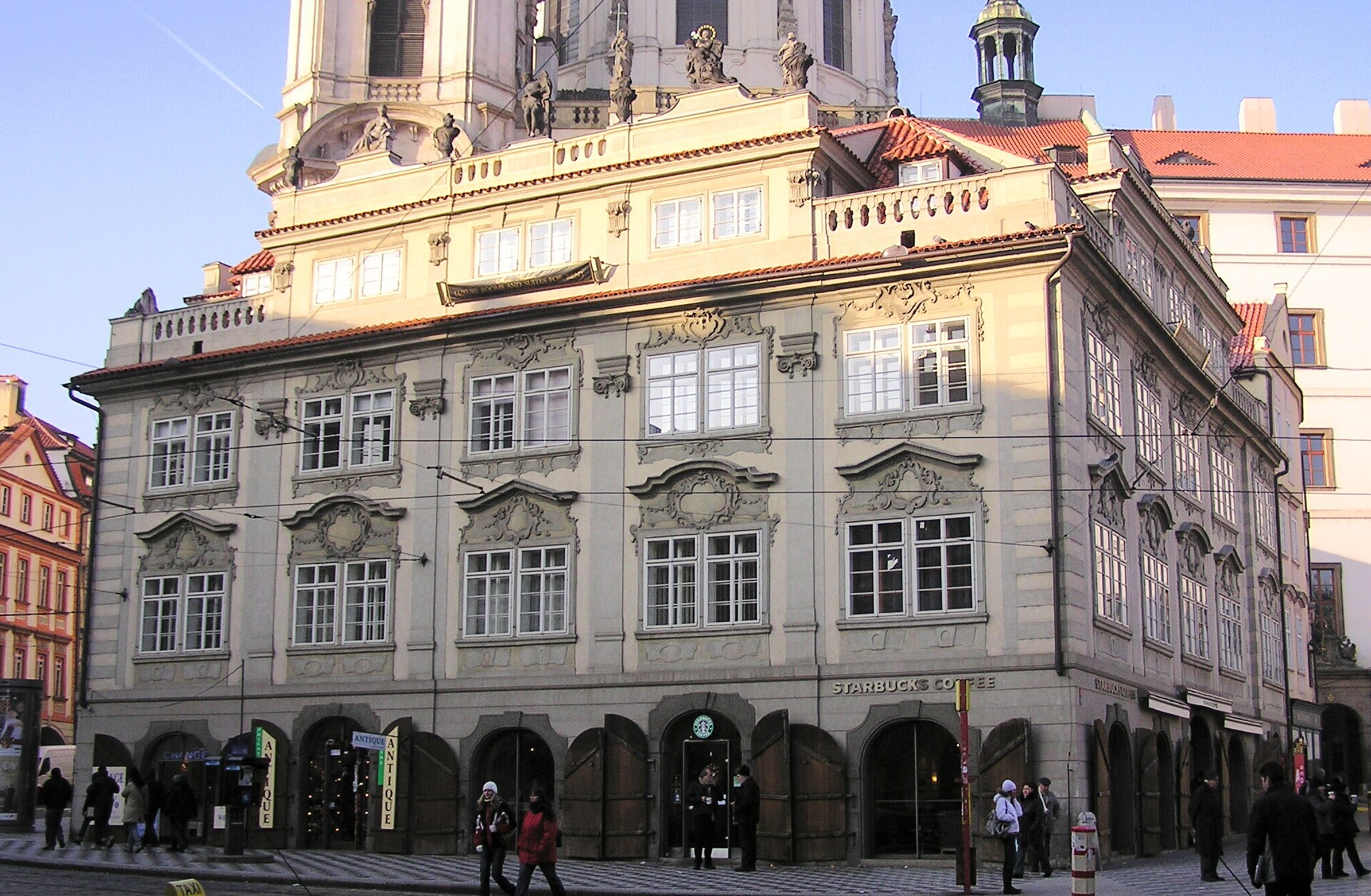
Smiřický Palace is a Renaissance residence standing at the corner of Malostranské náměstí and Sněmovní street in Prague's Malá Strana, right next to the Church of St Nicholas. The building holds a particular place in Czech history as the site where, in May 1618, a group of noblemen finalised the plan to throw imperial officials out of a window at Prague Castle — the event known as the Second Defenestration of Prague, which opened the Thirty Years' War.
Where did the palace on Malostranské náměstí come from?
The plot forming the eastern part of today's palace was acquired by Jaroslav Smiřický by 1572. Decades later, in 1603, the then owner Zikmund Smiřický obtained permission to extend the house with a corner rotunda and a round tower — the very features that still give the building its distinctive silhouette. Construction continued in stages until 1613, and in 1612 the neighbouring Chlapovský house was absorbed into the family estate, enlarging the whole complex. The result was an imposing four-winged building around an inner courtyard with corner towers, a ground-floor arcade facing the square, and four storeys above — a residence befitting one of the wealthiest noble families in the Bohemian lands of the time.
Why is this palace tied to the Defenestration of Prague?
On Tuesday, 22 May 1618, the leaders of the Protestant estates' opposition to Habsburg rule held a secret meeting inside the palace. Their host was Albrecht Jan Smiřický, one of the leading figures of the Bohemian Protestant nobility. During the meeting, the group worked out the details of their plan against the imperial governors residing at Prague Castle — a plan that, the very next day, 23 May 1618, led to two imperial governors and their scribe being thrown out of a chancellery window at Prague Castle. That act, remembered as the Second Defenestration of Prague, became the immediate spark for the Bohemian Revolt and, in turn, for the Thirty Years' War, one of the deadliest conflicts in European history.
What happened to the palace after the estates' defeat?
Because the Smiřický family had sided with the anti-Habsburg uprising, their property was confiscated by the crown after the estates' defeat at the Battle of White Mountain in 1620. The palace subsequently changed hands several times, passing through the Wallenstein, Pernstein and Sitzendorf families among others. After 1763, when the building was bought by Pavel Montág, who carried out a renovation between 1764 and 1765, it began to be known as "U Montágů" — a name that ran alongside the older Smiřický name for decades afterward.
What role does the palace serve today?
In 1895 the building passed into the ownership of the Regional Committee of the Kingdom of Bohemia, and it has been tied to a parliamentary function ever since. Today, Smiřický Palace is one of the seats of the Chamber of Deputies of the Czech Parliament. A thorough renovation was carried out between 1993 and 1996, after which the building retained some of its original Renaissance painted wooden ceilings alongside sections of later Baroque vaulting — physical traces of the different eras layered into its long history. The palace is listed as a Czech national cultural monument.
Frequently asked questions
Can visitors go inside Smiřický Palace? As a working seat of the Chamber of Deputies, the building is open to visitors only occasionally, typically during open days or events organised by the parliament, rather than as a regular sightseeing attraction with fixed opening hours.
Why is the palace sometimes called "U Montágů"? The name comes from Pavel Montág, the owner who renovated the building after 1763. For a time it was used alongside the older name referring to the Smiřický family.
What exactly happened at the palace on 22 May 1618? A secret meeting of the leaders of the Bohemian estates' opposition took place there, at which they finalised the plan to throw imperial officials out of a chancellery window at Prague Castle the following day — the act known as the Second Defenestration of Prague.
How do you get to the palace? It stands on Malostranské náměstí in Malá Strana, right beside the Church of St Nicholas, within a few minutes' walk of Charles Bridge.
Nearby places

Earn badges for the places you visit
Download NextOnTrip, discover new places and check off your trails.