About this place
Na horách is a small but botanically significant nature monument located in the municipality of Křešín, in the Příbram district of the Central Bohemian Region of the Czech Republic. Covering just 4.53 hectares, this modest protected area shelters one of the region's more notable populations of rare grassland and steppe-type plant species.
Why is this site protected?
The main reason for the site's protection is its rich population of the meadow pasqueflower (Pulsatilla pratensis) and the green-winged orchid (Anacamptis morio), sometimes referred to locally by its older name, "cuckoo orchid." Both species bloom in early spring, drawing botany enthusiasts and nature photographers to the site. The flora also includes common juniper (Juniperus communis), along with other plants typical of dry, nutrient-poor xerothermic grasslands. Part of the site overlaps with a Natura 2000 area of the same name, underlining its importance on a European scale.
What is the history behind this place?
The land that now forms the nature monument has a long history of human use. As far back as the Middle Ages, the surrounding hills were associated with iron ore extraction, evidence of early mining activity in this part of the Brdy region. In the 19th century, the estate came under the administration of Count Rudolf of Vrbna, during whose stewardship sheep farming expanded significantly in the area. This extensive grazing, carried out over decades, shaped the open character of the landscape and helped maintain the grasslands where the protected plants thrive today.
As late as the early 20th century, the site was still used as sheep pasture, with only the summit area covered by forest. Once grazing ceased, the land gradually began to overgrow with trees and shrubs, and mowing for hay to feed forest game became only occasional — a trend that for a time threatened the survival of the valuable grassland communities.
The nature monument was formally established in 1997 specifically to halt this forest succession and preserve the unique plant communities that developed as a result of centuries of extensive pastoral management.
What can visitors expect to see?
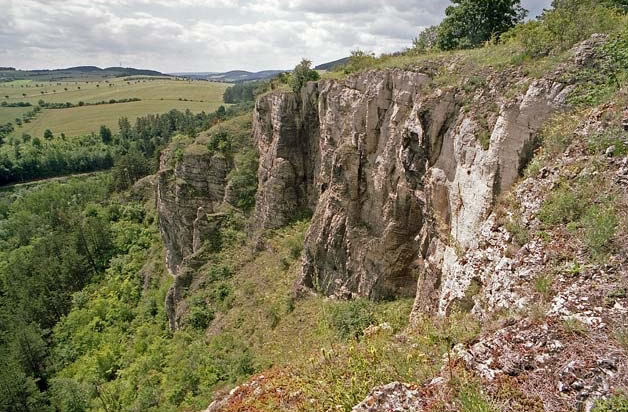
Na horách is above all a destination for those interested in botany rather than built tourist infrastructure — there are no lookout towers or castles here, but rather an authentic fragment of the natural landscape of the Brdy hills. The best time to visit is early spring, when the meadow pasqueflower blooms, painting the slopes in characteristic shades of violet, followed shortly after by the flowering of the green-winged orchid. The compact size of the reserve makes it easy to explore thoroughly within an hour, offering a quiet walk suited to careful observation of nature.
The surrounding area of Křešín also offers other natural attractions typical of the Brdy and Podbrdsko region, making Na horách a worthwhile stop on a longer hiking route through the nearby hills.
Frequently asked questions
Where exactly is the Na horách nature monument located? It lies within the cadastral territory of the Křešín municipality in the Příbram district of the Central Bohemian Region, roughly 5.5 km southeast of Hořovice.
How large is the protected area? The nature monument covers 4.53 hectares.
When is the best time to visit Na horách? Early spring is ideal, when the meadow pasqueflower and green-winged orchid are in bloom.
Since when has the area been protected? It received nature monument status in 1997.
Which plant species are the most valuable here? Primarily the meadow pasqueflower (Pulsatilla pratensis) and the green-winged orchid (Anacamptis morio), along with common juniper.
Nearby places

Earn badges for the places you visit
Download NextOnTrip, discover new places and check off your trails.