About this place
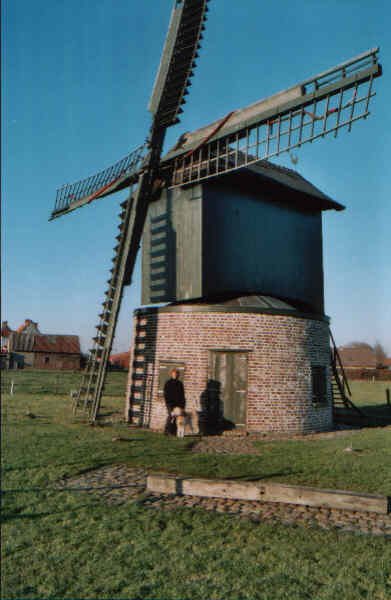
Muizelmolen is a stone tower windmill in Hulste, a district of Harelbeke in the province of West Flanders, Belgium. It stands on Muizelstraat, at the highest point of Hulste, right on the watershed between the Lys (Leie) and Mandel rivers — a location that made it an ideal spot for capturing wind for centuries.
What is the history behind this mill?
The story of a mill on this site goes back to 1799, when local farmer Joseph Vandaele built a wooden windmill here to grind grain. That original structure did not have a peaceful existence: in 1817 a neighbor named Verhelle, driven by jealousy toward the miller at the time, Joannes Delaere, deliberately set the mill on fire.
The mill that stands today was rebuilt on the same site in 1840 by Joannes Loncke, who chose to construct it in stone rather than wood — a decision that gave the new building far greater durability than its predecessor.
What was the mill used for?
From its construction, the Muizelmolen served primarily as a grain mill, fitted with two millstones and a husking mechanism for processing cereal. For a period, up until 1920, it also operated as an oil mill, pressing oil from oilseeds — a common dual role for rural windmills of the era, which needed to diversify their output to remain economically viable. Grain milling continued for much longer: the mill ground its last batch of grain in 1974, meaning it remained in active use for well over a century after its 1840 reconstruction.
Has the windmill been restored?
Yes. After industrial milling ceased in the 1970s, the structure required conservation work to prevent deterioration. A restoration was carried out between 1994 and 1995, stabilizing the building and returning it closer to its historical appearance. As a result, the Muizelmolen survives today as a well-preserved example of the rural industrial heritage that once defined much of the West Flanders countryside.
Why is the Muizelmolen worth a visit?
Windmills like this one were once a defining feature of the landscape across this part of Belgium, but many disappeared as agricultural mechanization advanced through the 20th century. The Muizelmolen, thanks to its restoration, offers a tangible look at how 19th-century grain processing infrastructure worked and how a miller's daily routine would have unfolded. Its position on elevated ground, chosen deliberately for exposure to consistent wind, also illustrates the practical logic millers followed when siting these structures.
Frequently asked questions
When was the current mill built? The present stone structure dates from 1840, built by Joannes Loncke.
Was there an earlier mill on this site? Yes. An earlier wooden mill was built here in 1799, but it was destroyed by an arson fire in 1817.
Until when was the mill in use? It operated as an oil mill until 1920 and continued grinding grain until 1974.
Can the mill be visited today? The structure was restored between 1994 and 1995 and remains standing as a heritage landmark representing the traditional milling history of the Hulste-Harelbeke area.
Nearby places

Earn badges for the places you visit
Download NextOnTrip, discover new places and check off your trails.