About this place
Moulin de Patouillet is a wooden pivot windmill standing in the village of Charcé-Saint-Ellier-sur-Aubance, part of the commune of Brissac-Loire-Aubance in the Maine-et-Loire department. It is one of only two surviving mills of its kind in the entire Anjou region.
What makes this windmill unusual?
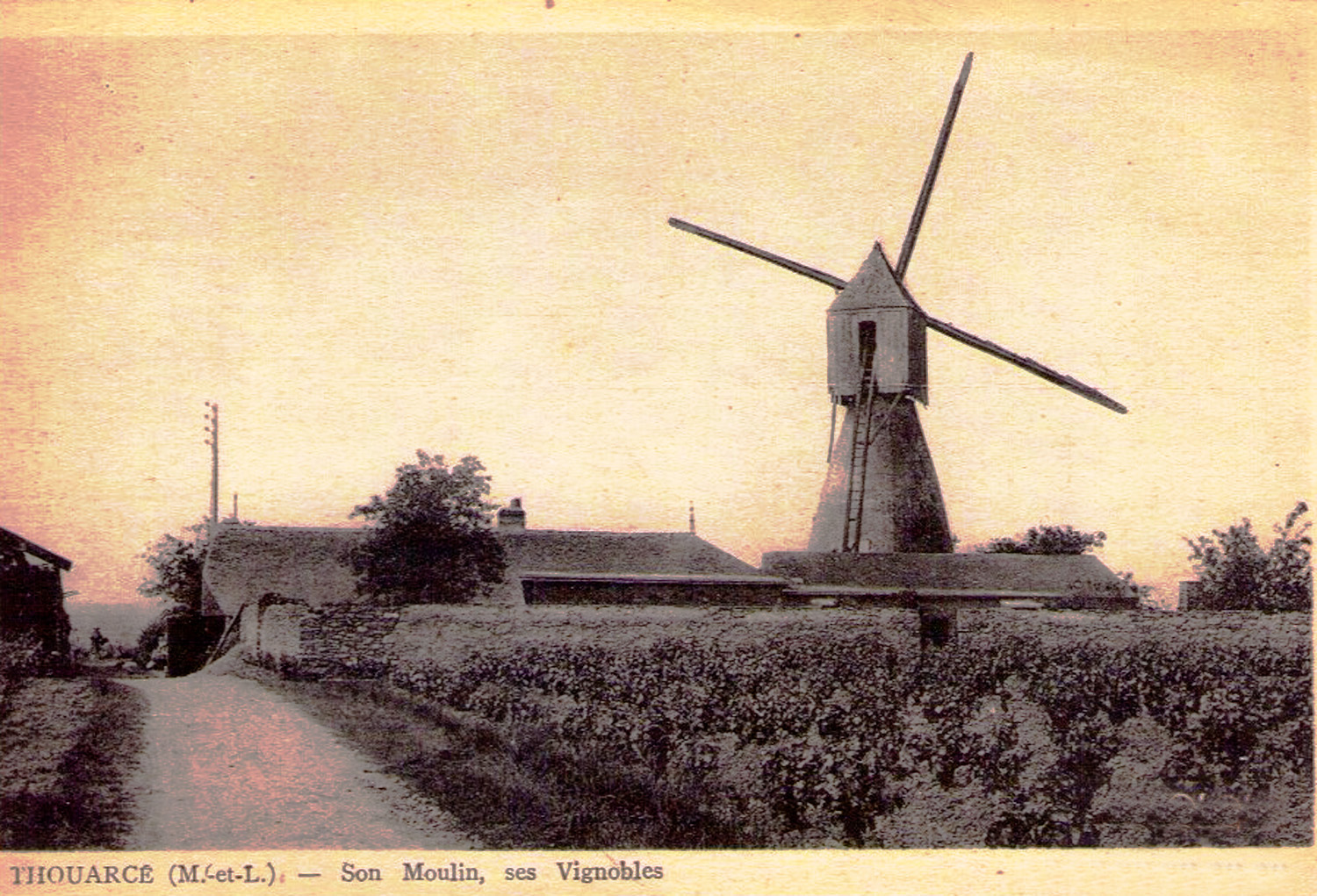
Moulin de Patouillet belongs to a local mill type known as a "moulin-chandelier," a variant of the post mill specific to Anjou. Rather than a fixed cabin with only the sails moving, the entire wooden cabin rotates around a massive vertical post, referred to locally as the "chandelier" or "bourdon." The cabin sits raised on a small masonry base called a "cavette," which lifts it high enough to catch stronger wind and doubles as storage space. A ladder provides access inside, where two pairs of millstones were housed, and the sails were fitted with a Berton mechanism to help adjust their pitch.
How did the mill end up here?
The structure was originally built in the last quarter of the 19th century in the commune of Gennes. In 1893, Louis Martin, who owned a nearby water mill also called Patouillet, had it dismantled and rebuilt right beside his water mill so the windmill could keep the grinding going whenever water levels ran too low. It operated for twenty-seven years before shutting down in 1920 and was gradually left to decay. By the early 1980s, little remained of the original structure beyond its wooden frame — the outer cladding had disappeared, though the millstones and part of the mechanism had survived despite decades of exposure to the weather.
How was it brought back?
Reconstruction took place in 1981 at the Compagnons du Devoir workshop in Angers, and the restored mill was formally inaugurated on 8 July 1982. The project used a technique that was novel at the time: the sails were rebuilt from laminated, glued wood. The cabin was returned to operating under wind power in 1984. The mill has been listed as a historic monument since 28 March 1977, recognising its place in the region's heritage.
Does the mill still grind flour?
Not fully. The restoration begun in the 1980s was never completed — the millstones lack the "archures," the surrounding casing needed for proper grinding, which leaves the mechanism unable to function for that purpose. The owner overseeing the work died before the final stage could be finished. Today the mill stands as a rare surviving example of the Anjou chandelier windmills: out of the 200 to 300 that operated across the region in the early 19th century, only two remain.
How can you visit Moulin de Patouillet?
The mill sits a few kilometres east of Brissac-Quincé, right next to the older water mill that inspired its construction and that it was built to support. Visits are possible on weekends, but only by prior arrangement with the person looking after the site. It makes a worthwhile stop for anyone interested in traditional milling techniques and the industrial heritage of Anjou, especially combined with a visit to Brissac-Loire-Aubance and its château.
Frequently Asked Questions
What is a moulin-chandelier? It's the local name for a type of post mill where the whole cabin and mechanism rotate around a central vertical post to face the sails into the wind.
How many of these mills survive in Anjou? Only two remain, out of the 200 to 300 that were active across the region in the early 19th century.
Can visitors go inside Moulin de Patouillet? Yes, but only on weekends and by prior appointment with the site's caretaker.
Is the mill still used for grinding grain? No — the millstones are missing the casing needed for grinding, so the mechanism cannot be used for that purpose today.
Nearby places

Earn badges for the places you visit
Download NextOnTrip, discover new places and check off your trails.