About this place
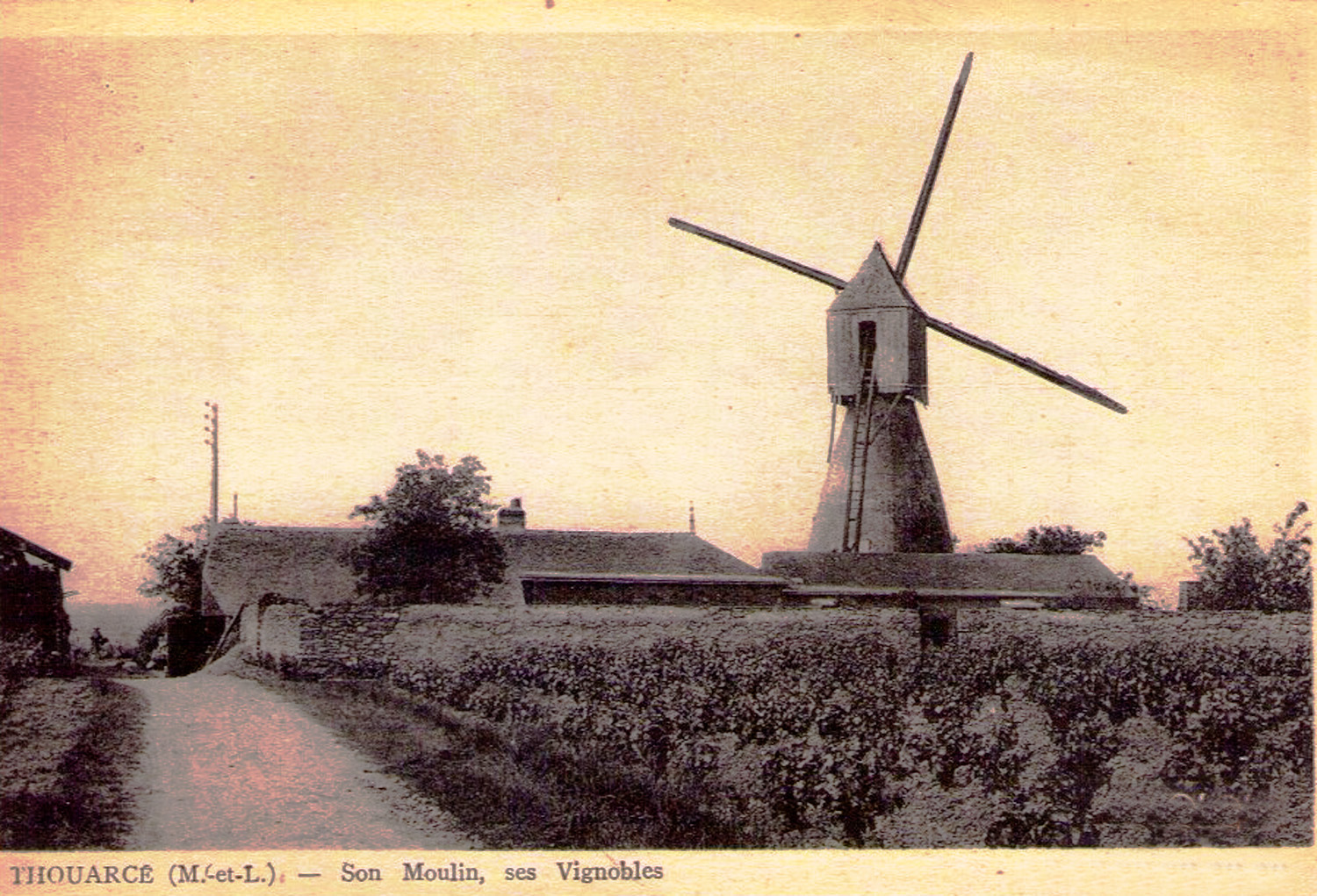
Moulin de la Montagne is a preserved cavier-style windmill standing among the vineyards east of Thouarcé, one of five villages merged in 2016 into the commune of Bellevigne-en-Layon, in the Maine-et-Loire department. It sits on a low rise beside the chemin de la Montagne, near the hamlet of Le Petit-Bonnezeaux, roughly 20 km south of Angers, right in the middle of the Layon valley wine country.
What makes this windmill unusual?
The mill belongs to the moulin-cavier type, a design specific to the Anjou region. Instead of a wooden structure rising the full height of the building, its base is a conical stone tower with a hollowed-out chamber inside, once used to store grain and flour. Perched on top is a movable wooden cabin — locally called the calotte — that carried the machinery and sails and could be rotated to face the wind from any direction, without having to turn the whole tower.
The sails followed the Berton system, patented in 1845, which used self-adjusting shutters to cope with changing wind strength. Inside, two pairs of millstones ground the grain into flour.
How old is the mill and what happened to it?
Moulin de la Montagne was built in the 19th century and stayed in use until 1914, when its miller was called up to fight in the First World War. With no one left to run it, the mill stopped producing flour and never resumed commercial milling.
During the Second World War, the tower — known locally as Beauregard, the same name given to the nearby plateau — was used by German troops as an observation post. As they withdrew in August 1944, they partially destroyed the structure.
The wider commune of Thouarcé once counted more than twenty water and wind mills across the 19th century; most have since fallen into ruin, which makes Moulin de la Montagne one of the better-preserved survivors of that milling heritage.
Is it protected, and can visitors go inside?
The mill was listed as a monument historique on 30 July 1980. It underwent restoration in the mid-1980s and reopened as a preserved heritage site in 1986. It remains privately owned and is no longer a working mill — its value today is as a piece of rural architecture rather than an active business.
Because it sits on private land, the interior is not open on a regular basis. The exterior, however, is easy to admire from the footpaths that cross the vineyards around Thouarcé, including the route up to the Beauregard plateau and the walking trail linking the area's other windmills, such as Moulin de la Pinsonnerie in Faye-d'Anjou.
Frequently asked questions
How old is Moulin de la Montagne? It dates from the 19th century and counts among the best-preserved cavier-type windmills around Thouarcé.
What is a moulin-cavier? It is an Anjou-region windmill type built around a conical stone tower with a rotating wooden cabin on top that carried the sails and turned to face the wind.
Why did the mill stop working? Production ended in 1914 when the miller was drafted into the First World War and never returned to run the mill.
What happened to it during the Second World War? The tower, known as Beauregard, was used by German forces as a lookout post and was partly destroyed when they retreated in August 1944.
Can visitors go inside the mill? No — it is private property, so the interior is not regularly open to the public, though it can be viewed from outside along the nearby vineyard footpaths.
Where exactly is the mill located? Along the chemin de la Montagne, east of central Thouarcé, within the commune of Bellevigne-en-Layon, close to the hamlet of Le Petit-Bonnezeaux.
Nearby places

Earn badges for the places you visit
Download NextOnTrip, discover new places and check off your trails.