About this place
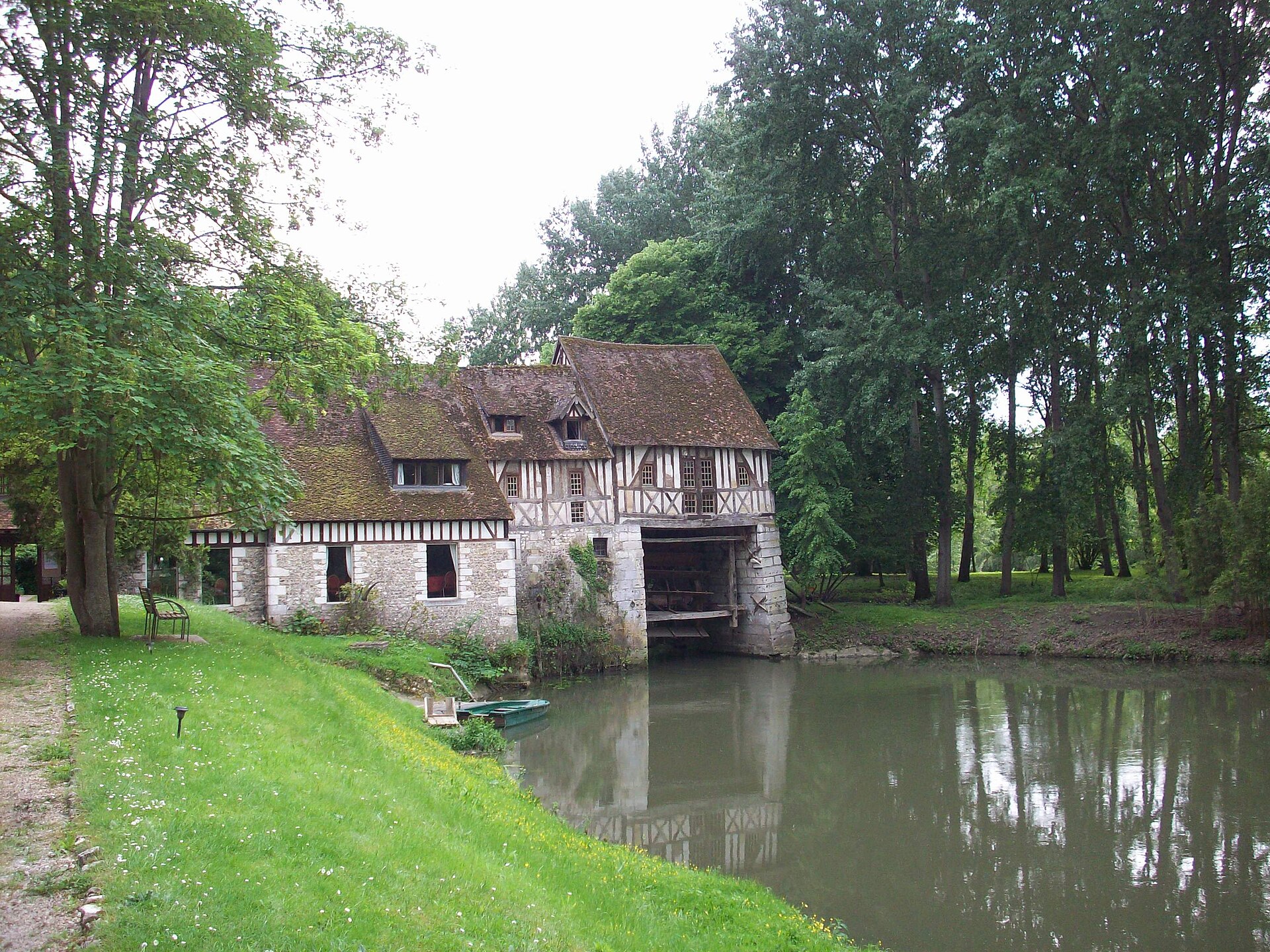
Moulin d'Andé is a historic watermill turned arts centre in the village of Andé, Normandy, on a branch of the Seine between Paris and Rouen. For more than sixty years it has hosted writers, filmmakers and musicians, making it as much a cultural landmark as an architectural one.
How old is the mill and what makes its structure unusual?
The building dates back to the medieval period and is considered one of the last surviving examples in Western Europe of a "hanging wheel" mill (roue pendante), a mechanism that has been preserved largely intact. The mill operated commercially for centuries until milling stopped in the 19th century, after the construction of the Poses dam altered water levels along this stretch of the Seine. The building was listed as a French historic monument in 1995, and its adjoining rock garden received the same protected status in 2008.
How did a working mill become an artists' residence?
The turning point came in the mid-20th century, when the property passed to Suzanne Lipinska. In 1962, together with writer Maurice Pons, she founded the Moulin d'Andé association to support the arts, letters and crafts through creative residencies. From that point on, the former outbuildings, stables and barn were converted into meeting rooms, guest quarters and a theatre set up inside the orangery, giving the mill a second life as a working cultural venue rather than a static monument.
Which artists and filmmakers are linked to Moulin d'Andé?
The mill's reputation rests heavily on its ties to French cinema. François Truffaut first came to Andé to discuss adapting one of Maurice Pons' short stories with him, a collaboration that produced the short film "Les Mistons." He later returned to shoot scenes for "The 400 Blows" and "Jules and Jim," two films central to the French New Wave. Other filmmakers associated with the mill include Louis Malle and Alain Cavalier. Among writers, Georges Perec wrote his novel "La Disparition" while staying there, and the mill also welcomed Richard Wright and Eugène Ionesco. Musicians who spent time at Andé include violinist Ivry Gitlis.
What can visitors see at the mill today?
Moulin d'Andé has operated continuously since the 1960s as a venue for artist residencies, concerts and workshops, hosting more than a hundred concerts a year alongside a summer international music academy. Since 1998 it has also housed CÉCI, a centre dedicated to screenwriting. Visitors can see the original milling hall with its preserved mechanism, the orangery-turned-theatre, and the rock garden built between 1908 and 1915 by Italian craftsmen — an arrangement of artificial stone formations set into the natural riverside landscape.
How do you get there and what should you know before visiting?
Andé sits in the Eure department in Normandy, positioned conveniently for a stop between Paris and Rouen. The mill's address is 65 rue du Moulin. Because the site functions as an active cultural centre rather than a conventional museum, access to the interior and grounds depends on the event calendar, so checking the current programme before travelling is worthwhile.
Frequently Asked Questions
Can you visit Moulin d'Andé like a regular historic site? It is a working arts centre first, so visits to the mill and its garden are usually tied to specific events, concerts or open days rather than fixed museum opening hours.
Which Truffaut films were shot at Andé? Scenes from "Les Mistons," "The 400 Blows" and "Jules and Jim" were filmed in and around the mill, all key works of the French New Wave.
Who founded the cultural centre at the mill? Suzanne Lipinska and writer Maurice Pons created the Moulin d'Andé association in 1962 to run it as a residency for artists across disciplines.
What is notable about the mill's garden? Its rock garden (parc de rocailles), built between 1908 and 1915, combines artificial stone formations with natural vegetation along the Seine and is itself a protected historic site.
Nearby places

Earn badges for the places you visit
Download NextOnTrip, discover new places and check off your trails.