About this place
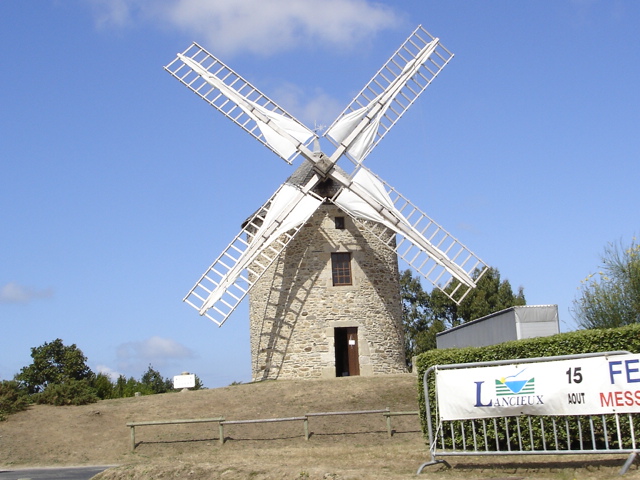
Moulin à vent de Lancieux stands right in the centre of Lancieux, a seaside village in Côtes-d'Armor a short drive from Dinard and Saint-Malo. Also known as Moulin de Buglais or Moulin des Bénédictins, it is the only survivor of the three windmills the parish once had, and today it's one of the village's clearest landmarks.
Who built the mill, and when?
The mill was raised in the 16th century by Benedictine monks from the abbey of Saint-Jacut-de-la-Mer. A date of 1758 is carved into the inner lintel above the entrance door, most likely marking a major rebuild rather than the mill's original construction. During the French Revolution, the abbey's holdings at Saint-Jacut were seized as national property and put up for sale. A local resident, François Lhotellier, bought the mill for 1,500 livres. Several millers ran it over the following decades, the last being a Mr. Chapelle, before it fell silent for good.
What does it look like, and what is it built from?
The mill has the round plan and sharply tapering base typical of Breton tower windmills. Its walls are made of rubble stone — granite, slate, gneiss, and stone quarried at Saint-Cast — all materials available locally along this stretch of coast. A conical roof covered in chestnut wood shingles tops the structure, giving it its distinctive, slightly rugged silhouette.
How long did it grind grain, and what happened after?
The mill still ran on wind power in 1926, when a gas engine was added to back it up on calm days. During the Second World War (1939–1945) it was driven by a steam engine instead. Milling stopped for good in 1947. It was listed as a monument historique on 9 September 1975, and the municipality of Lancieux bought it in 1973, remaining its owner ever since.
Can visitors see inside the mill?
The exterior was restored in 1976 under the supervision of the Bâtiments de France authority, with work carried out by Jean Peillet. In 1990, the interior machinery was brought back into working order too: the hopper, the sifter (bluterie), and two original pairs of millstones — one for grinding wheat and the other for feed grains. Thanks to that work, the mill isn't just a decorative tower; it still holds a complete, historic milling mechanism.
Why is it worth a stop in Lancieux?
The mill sits on rue de la Mairie, close to the village centre, so it's easy to combine a visit with time on Lancieux's beaches, known for views out to Fort la Latte and the island of Cézembre. It's a rare chance to see, up close, how Breton milling worked centuries ago, without having to travel to the region's larger, more touristy mill sites.
Frequently asked questions
What other names does this windmill go by? It's also called Moulin de Buglais and Moulin des Bénédictins, both nods to its Benedictine origins and its location in the area known as Buglais.
When did the mill stop working? It ceased milling in 1947, after decades of operation that had been supported first by a gas engine (from 1926) and then, during the war, by a steam engine.
Does the internal machinery still exist? Yes. After the 1990 restoration, the mill has a working hopper, sifter, and two pairs of millstones used for different types of grain.
Is the mill a protected historic monument? Yes, it was listed as a monument historique on 9 September 1975 and remains the property of the Lancieux municipality.
Nearby places

Earn badges for the places you visit
Download NextOnTrip, discover new places and check off your trails.