About this place
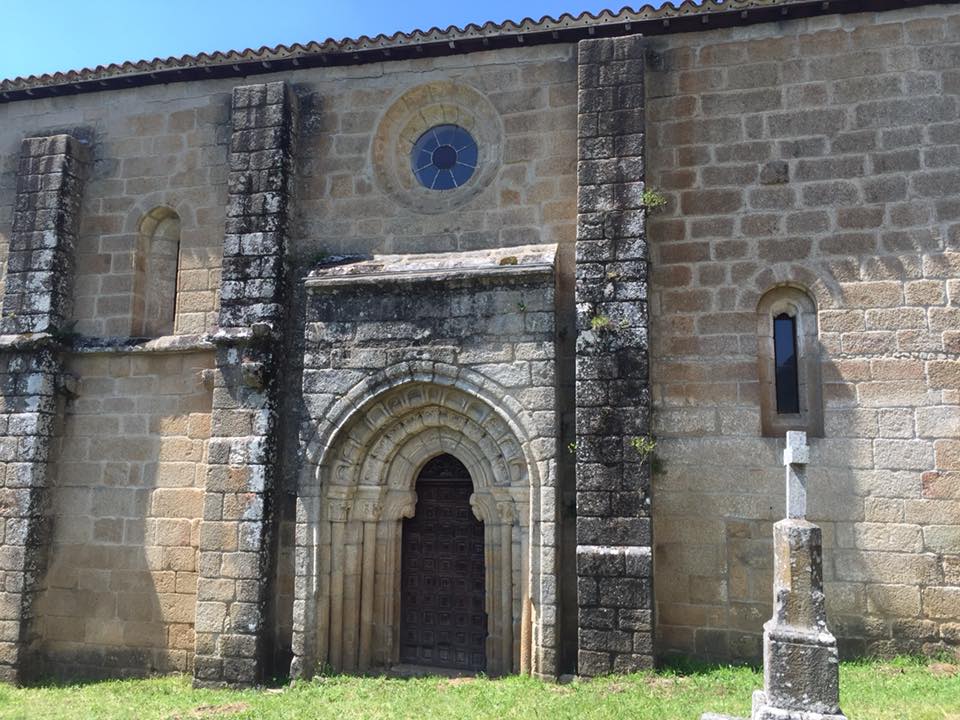
Mosteiro de Santo Estevo de Atán is a Romanesque church standing on the left bank of the Miño River, in the parish of Atán within the municipality of Pantón, right in the heart of the Ribeira Sacra. Of the monastery that once stood here, essentially only the church survives, surrounded by terraced vineyards sloping down toward the waters of the Os Peares reservoir.
Where does this place come from?
Tradition links the origins of Santo Estevo de Atán to Odoario, Bishop of Lugo, placing its foundation in the early days before Galicia was fully absorbed into the Asturian-Galician kingdom. The earliest traces of hermit settlement in this area date back to the Suevian period, though the monastery the church once belonged to no longer exists — it either fell into ruin or was dismantled over time, leaving only the parish church standing. Historians note that despite the strong local tradition tying the site to an ancient monastery, solid archaeological proof of that continuity is still lacking.
What will you see on site?
The current building was raised at the turn of the 12th and 13th centuries, during the transitional period between Romanesque and Gothic. The church has a single nave under a gabled roof and a rectangular apse closed off by a barrel vault — a layout typical of the rural churches scattered across Ribeira Sacra: simple in massing but rich in the carved stonework of its portals and windows. Inside, a metal grille from an earlier, pre-Romanesque temple has survived, a rarity for the region. The walls also carry fragments of mural paintings from the 15th and 16th centuries, a later decorative layer that shows the church remained in continuous use for centuries.
The building sits in landscape typical of Ribeira Sacra — the steep slopes of the Miño valley covered in vineyard terraces, overlooking the waters of the Os Peares reservoir, which flooded part of the valley's lower ground decades ago. That combination of architecture and scenery is why Santo Estevo de Atán is often singled out as one of the best-preserved, and least crowded, Romanesque gems in the region.
How to get there and when to visit?
Atán lies within the municipality of Pantón, in Lugo province, along the roads connecting Ribeira Sacra with the Miño valley. A car is the most practical way in — winding local roads cut through vineyards and viewpoints overlooking the river canyon. It's worth combining a visit here with the dozen-plus other Romanesque churches scattered across Pantón, or with a boat trip on the Os Peares reservoir or a stretch of the Miño. Spring and autumn are the best seasons to come, with mild temperatures and vineyards at their most photogenic — green in spring, dressed in harvest colors come autumn.
The site holds the highest level of heritage protection in Spain: it was declared a national monument (monumento nacional, now equivalent to Bien de Interés Cultural) by decree on 23 August 1975, confirming its historical and architectural value on a national scale.
Frequently asked questions
Did any monastery buildings survive besides the church? No, essentially only the parish church remains today; the rest of the monastic complex has disappeared from the landscape.
What architectural style does the church represent? Romanesque in its transitional phase toward Gothic, typical of the turn of the 12th to 13th century in the Ribeira Sacra region.
What's the most notable feature inside? A surviving metal grille from an earlier, pre-Romanesque temple, along with 15th- and 16th-century mural paintings.
Is the site legally protected? Yes, since 1975 it has held national monument status (now equivalent to Bien de Interés Cultural), Spain's highest heritage protection category.
Nearby places

Earn badges for the places you visit
Download NextOnTrip, discover new places and check off your trails.