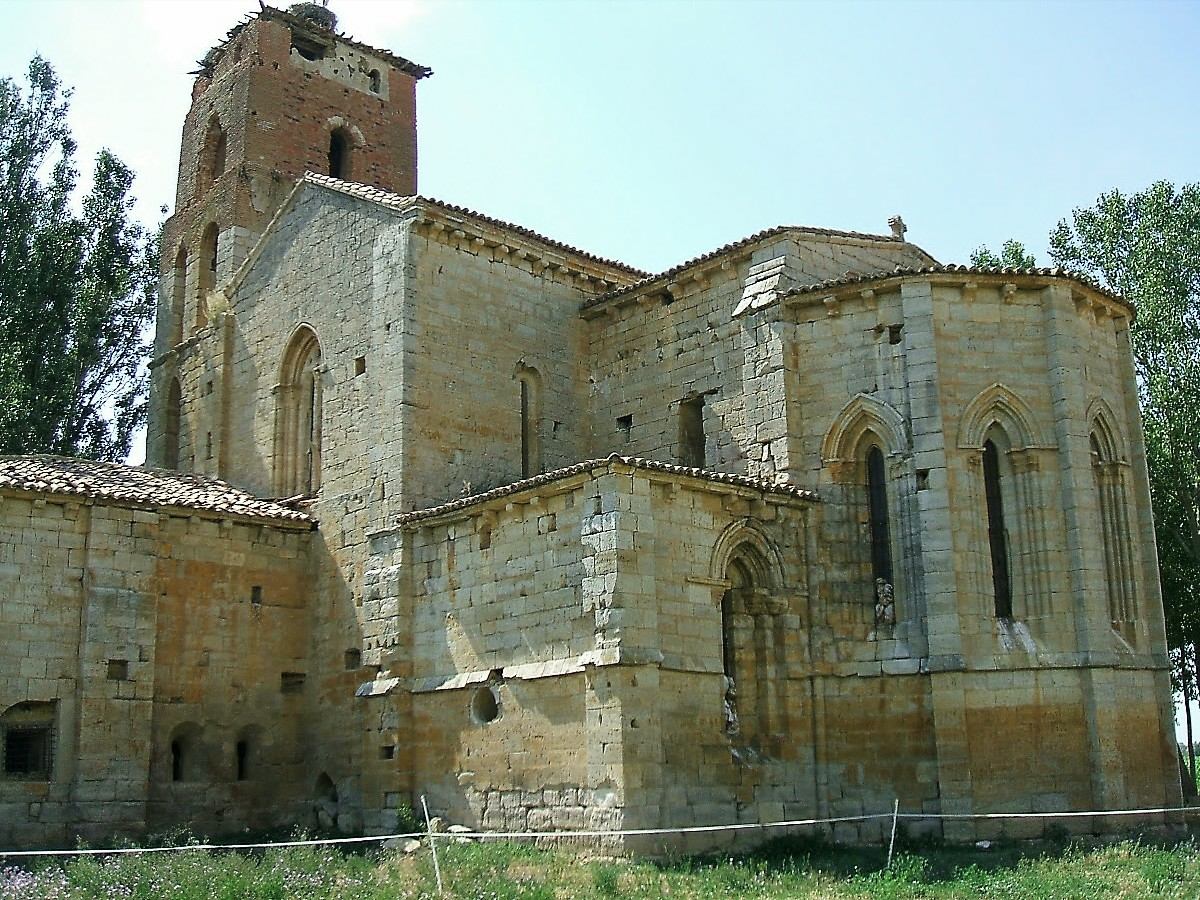
About this place
Monastery of Santa Cruz de Ribas (also known as Santa Cruz de la Zarza) is a partly ruined Premonstratensian monastery standing in the Carrión river valley, roughly midway between Monzón de Campos and Ribas de Campos, within the Tierra de Campos district of Palencia province, in Castile and León.
Where is it and how do you get there?
The ruins sit on the open plain of Tierra de Campos, in the low-lying stretch of the Carrión valley, a short drive north of the provincial capital, Palencia. The two neighboring villages — Monzón de Campos on one side, Ribas de Campos on the other — flank the site, making it an easy stop for anyone exploring the area by car. Tierra de Campos is known for its vast wheat fields and dense concentration of Romanesque and Mudejar churches, and the Camino de Santiago passes through nearby towns along the same river, including Carrión de los Condes a little further downstream — a detail that turns the whole valley into a natural route for travelers interested in medieval religious architecture.
What order built the monastery?
The monastery belonged to the Premonstratensian order, also called the Norbertines after its founder, St. Norbert of Xanten, who established the order in France in the 12th century before it spread rapidly across Europe, including the Iberian Peninsula. Like the Cistercians, Premonstratensian communities favored austere, unadorned buildings, a restraint still visible in the surviving structure above the Carrión.
What architectural style does the building show?
Santa Cruz de Ribas was raised in a transitional style bridging Romanesque and Gothic — a period when thick walls and rounded arches, hallmarks of Romanesque building, began giving way to the pointed arches and lighter structural solutions associated with Gothic architecture. This blend is common among Castilian monasteries built around the turn of the 12th and 13th centuries, when masons kept older, proven techniques while gradually absorbing new ideas arriving from France.
Why is the monastery in ruins today?
Available sources do not point to a single event behind the site's current condition, but its description as "semi-ruined" points to a long, gradual decline, a fate shared by many Spanish monastic houses abandoned following the 19th-century disentailment and secularization of church property. Even so, the surviving walls still let visitors make out the building's original layout and scale.
Is the site protected as heritage?
Yes. The monastery is listed in Spain's heritage register as a Bien de Interés Cultural (BIC), under reference number RI-51-0000811. This is the highest level of cultural heritage protection in Spain, reserved for sites of outstanding historical and architectural value, and it covers both the structure itself and its immediate surroundings.
When is the best time to visit?
Given the open, rural setting, spring and early summer are the most rewarding seasons, when the fields of Tierra de Campos turn green and mild weather makes walking the Carrión valley more comfortable. Autumn offers a quieter alternative, with fewer visitors on the surrounding country roads. The site works well as part of a longer route through Palencia province, paired with a stop in each of the neighboring villages, Monzón de Campos and Ribas de Campos.
Frequently asked questions
What was the Monastery of Santa Cruz de Ribas? A Premonstratensian monastery built in the Carrión river valley, today preserved only in part, as a ruin.
Where exactly are the ruins located? Roughly midway between Monzón de Campos and Ribas de Campos, within the Tierra de Campos district of Palencia province, in Castile and León.
What architectural style does the building represent? A style that bridges Romanesque and Gothic, combining the massive walls typical of Romanesque construction with pointed-arch elements associated with Gothic building.
Is the monastery listed as a protected heritage site? Yes, as a Bien de Interés Cultural under reference number RI-51-0000811 — Spain's highest category of heritage protection.
Nearby places

Earn badges for the places you visit
Download NextOnTrip, discover new places and check off your trails.