About this place
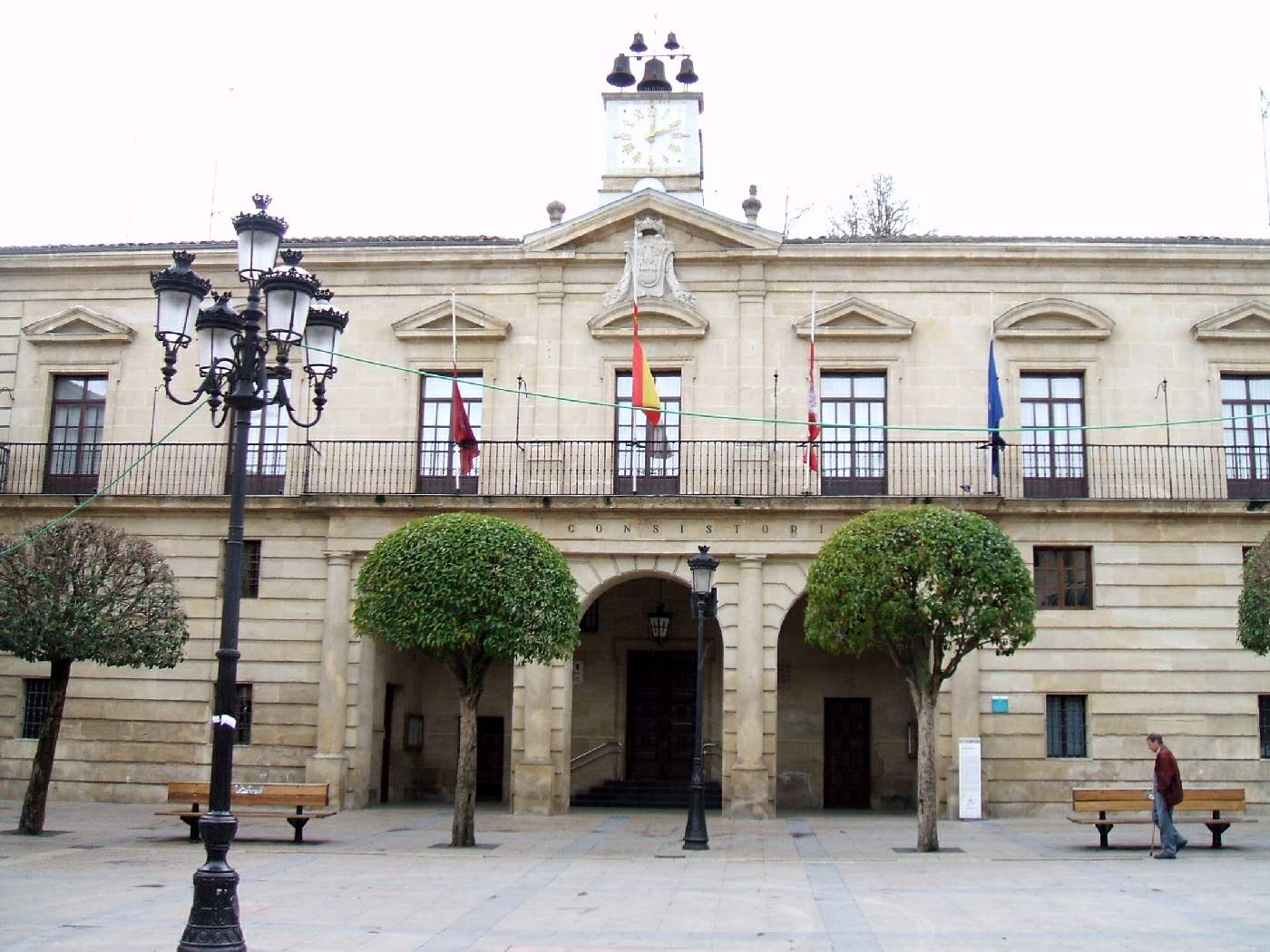
Miranda de Ebro Town Hall (Ayuntamiento de Miranda de Ebro) is a neoclassical municipal building standing at the heart of this town in Burgos province, right by the Ebro river. Its stone facade, fronted by a triple-arched portico and topped with pediments, has marked the center of old Miranda for well over two centuries, and it's impossible to miss for anyone walking through the historic core.
Why does this town hall exist here?
The story behind the building starts with disaster. In June 1775, a violent flood on the Ebro swept away the medieval bridge connecting the town's two halves — and with it the tower built on one of the bridge's piers, which until then had housed the town's government offices. Losing that seat of power forced the town to plan and build an entirely new town hall, this time set safely back from the riverbank.
What does the building look like, and who designed it?
Construction of the new town hall ran through 1788, based on a design by Francisco Alejo de Aranguren and Santos Ángel de Ochandategui. The plans were reviewed by Ventura Rodríguez, one of the leading figures of Spanish neoclassical architecture at the time, which explains the facade's disciplined, academic look. Work on site was overseen by Javier Ignacio de Echeverría and finished by Domingo de Urizar; the whole project ended up costing 190,000 reales.
The ashlar stone facade is organized in two clearly different registers. The ground floor is rusticated and opens onto the street through a portico of three wide arches, originally the main access point from the square. The upper floor has seven window openings, alternating semicircular and triangular pediments above each one; the central and largest pediment carries the town's coat of arms, a clear signal that this is a seat of civic authority rather than a private residence.
How do you get there, and what's worth seeing nearby?
The town hall sits within Miranda de Ebro's compact old town, a short walk from the newer bridge that replaced the one destroyed in 1775. It makes a natural starting point for exploring the rest of the historic center on foot — narrow stone streets, the riverside promenade, and the squares where most of the town's daily life plays out. Miranda de Ebro sits on a major road and rail junction between Burgos, Vitoria-Gasteiz, and La Rioja, so reaching it by car or train from any of those cities usually takes under an hour.
Because the building is an active seat of local government, its interior isn't generally open to visitors — the main appeal is the facade and the square in front of it, best seen in the afternoon light, when the rustication and pediment details stand out most clearly.
When is the best time to visit?
Spring and early autumn are the most comfortable seasons for exploring Miranda de Ebro on foot — temperatures stay mild and the town isn't overrun with visitors, which makes it easier to photograph the facade without a crowd in front of it.
Frequently Asked Questions
Can you go inside the town hall? The building functions as a working municipal office, so public access is limited to office hours and official business — for most visitors, the visit amounts to viewing the facade from the square.
When was the town hall built? The current building dates to 1788, built after a 1775 flood destroyed the town's earlier seat of government, which had stood on the medieval bridge over the Ebro.
What architectural style does the building represent? It's a textbook example of late-18th-century Spanish academic neoclassicism, with a symmetrical facade, a rusticated ground floor, and pediment-crowned upper windows.
What else is worth seeing near the town hall? The Ebro riverside and the narrow streets of the old town are both within easy walking distance and pair naturally with a stop at the town hall.
Nearby places

Earn badges for the places you visit
Download NextOnTrip, discover new places and check off your trails.