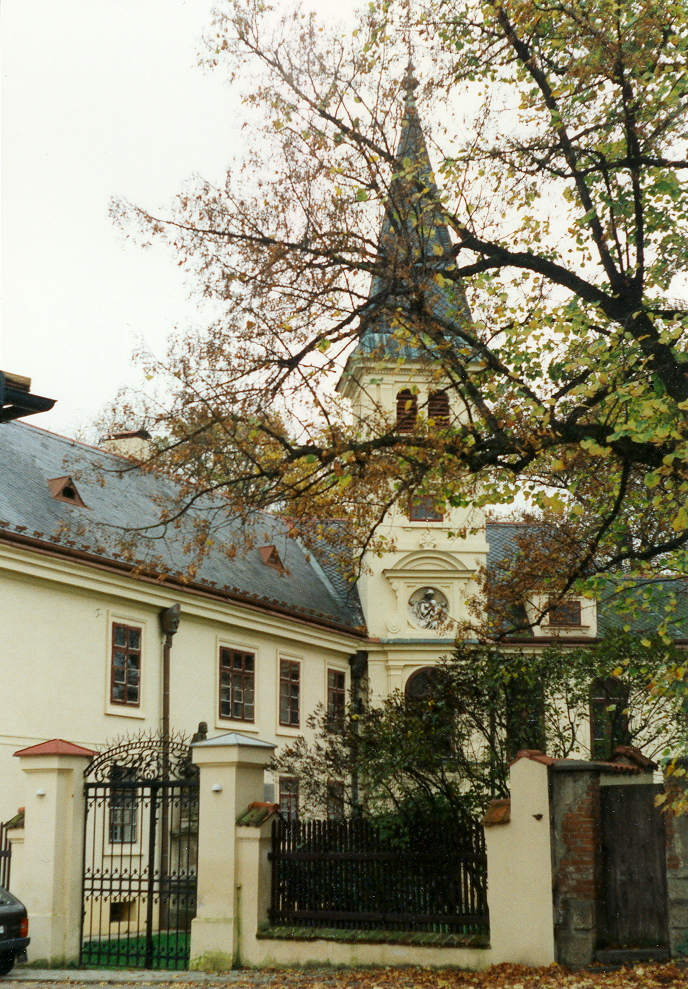
About this place
Lužany Castle is a 19th-century chateau in the Plzeň Region, about 3 km south of the town of Přeštice, best known as the life's work of architect and philanthropist Josef Hlávka and as the place where Antonín Dvořák composed one of his masses. The building itself is not open to casual visitors today, but its history and ties to leading figures of Czech culture make it one of the more compelling sights in the region.
How did the castle get its current shape?
The village of Lužany was already recorded in 1175, and a wooden stronghold stood on the site of today's chateau by 1245. In 1583 the Příchovský family of Příchovice built a single-storey Renaissance manor house here — the date is still carved into the keystone above the main entrance. Early in the 19th century the building received Baroque alterations, but the form visitors would recognise today only took shape decades later.
What role did Josef Hlávka play?
In 1867 the Lužany estate was bought by Josef Hlávka, a Vienna-based architect and building contractor who had made his fortune on major construction projects across the Habsburg monarchy. Under his ownership, in 1886–1887, the chateau underwent a thorough rebuild: Hlávka tore down part of the older Renaissance-Baroque structure and replaced it with a two-storey, Y-shaped building topped by a dominant six-storey tower, executed in Neo-Renaissance style with rich stucco decoration and much of its original interior furnishing preserved. As a separate wing he added a chapel dedicated to the Virgin Mary, St Wenceslaus and St Anthony.
What is the castle's connection to Antonín Dvořák?
To mark the chapel's consecration in 1887, Antonín Dvořák composed his Mass in D major, still known today as the "Lužany Mass." The composer was a regular guest of Hlávka's at the estate, alongside other leading cultural figures of the era — poet Jaroslav Vrchlický, writer Julius Zeyer, and sculptor Josef Václav Myslbek, whose works still adorn the interiors and grounds. A memorial plaque to Dvořák was unveiled at the castle in 1951.
What is inside the castle today, and can it be visited?
Under the terms of Josef Hlávka's will, the chateau has belonged since 1908 to the foundation that bears his name (the Hlávka Foundation), which supports Czech science and culture. It has been listed as a Czech cultural monument since 1963. Today the building serves as the foundation's headquarters and hosts academic conferences, seminars and award ceremonies; it is not intended for general tourist visits. Professional groups may arrange a visit directly with the foundation's board. Hlávka's original apartment survives on the first floor, and part of the building houses exhibits on his life and legacy.
What is notable about the grounds?
The chateau stands on the left bank of the Úhlava River, surrounded on three sides by a landscape park adjoined by a Renaissance kitchen garden. The park contains rare tree specimens, including a ginkgo, a tulip tree and a bald cypress — remnants of the 19th-century fashion for collector's plantings in aristocratic parks.
Frequently asked questions
Where exactly is Lužany Castle located? In the village of Lužany, Plzeň-South District, Plzeň Region, about 3 km south of Přeštice, on the left bank of the Úhlava River.
Who rebuilt the castle into its current form? Architect and philanthropist Josef Hlávka, who owned the estate from 1867 and gave the building its Neo-Renaissance, Y-shaped form in 1886–1887.
Which Dvořák work is connected to the castle? The Mass in D major, known as the "Lužany Mass," composed for the consecration of the castle chapel in 1887.
Can the castle be visited? It is not open to individual tourists — it serves as the seat of the Hlávka Foundation and a conference venue; visits by professional groups require prior arrangement with the foundation's board.
Who owns the castle today? Since 1908 it has belonged to the foundation established under Josef Hlávka's will to support Czech science and culture; since 1963 it has been protected as a Czech cultural monument.
Nearby places

Earn badges for the places you visit
Download NextOnTrip, discover new places and check off your trails.