About this place
Litvínov Castle
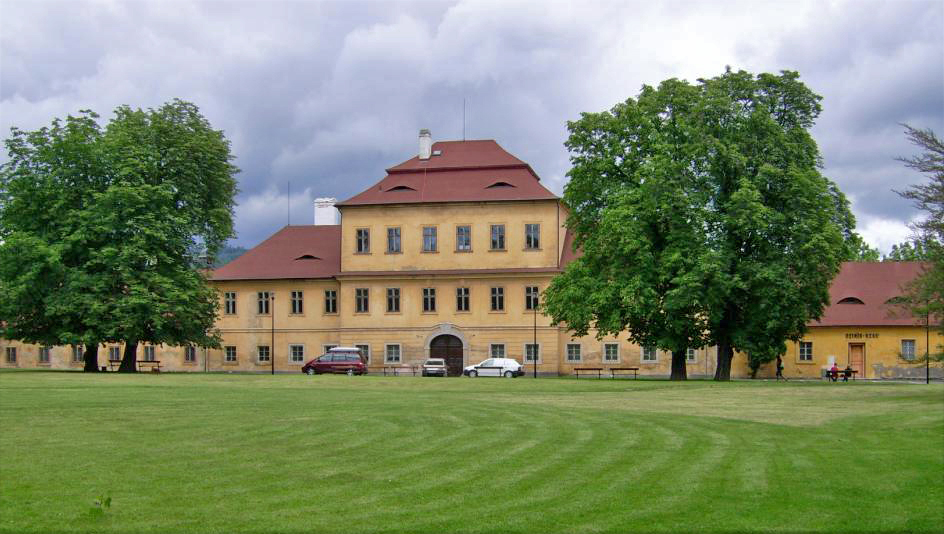
Litvínov Castle (Zámek Litvínov, also known as the Wallenstein Chateau) is a Baroque residence at the center of Litvínov in the Ústí nad Labem Region of the Czech Republic. Built on the site of a medieval fortified manor by the Waldstein (Valdštejn) family, the four-wing building enclosing a courtyard now serves the town as a museum, exhibition venue and representative hall, set within an eight-hectare English-style park.
How far back does the site's history go?
The earliest record of a fortified residence here dates to 1505. At the time it belonged to the knights of Johnu, who in 1589 sold the village together with the stronghold to Jan Václav of Lobkowicz. From the Lobkowicz family the estate eventually passed to the Waldsteins, and it was under their ownership that the old fortified manor began its transformation into a noble residence. Already before 1727, under Jan Josef of Waldstein, a manor house stood on the site of the former stronghold, built by Giacomo Antonio Canevalle.
Who gave the chateau its present Baroque form?
The building owes its current Baroque appearance to František Josef Jiří of Waldstein, who between 1732 and 1743 had the manor house rebuilt into a proper chateau. Its distinctive look came from architect František Maxmilián Kaňka, one of the leading names in Czech Baroque architecture of the period. The result was a compact four-wing structure enclosing a closed courtyard, a layout typical of aristocratic residences of the era, and one that Litvínov has preserved largely intact ever since.
What is worth noticing in the rear gateway?
A striking reminder of the site's earliest owners survives in the rear passage of the chateau, where four Renaissance tombstones of the lords of Johnu are set into the wall. They date from 1542, 1558, 1566 and 1571, and the figures carved on them follow the relief style typical of Renaissance funerary art. They are a rare physical link to the family that held the estate long before the Baroque chateau seen today was ever built.
Where does the surrounding park come from?
The chateau's original formal garden was abolished, and in its place an English-style landscape park was laid out in 1878, covering roughly eight hectares today. Its informal, naturalistic composition sits in deliberate contrast to the regular Baroque façade of the building and remains a popular place for locals to walk.
How did the chateau survive the 20th century and become a museum?
After 1945 the estate was nationalized. Over the following decades the building housed the economic administration of the former manorial estate, and later it was used by Litvínov's State Forests Administration. Starting in 1960, part of the building was gradually adapted to house a town museum and archive. A turning point came in 2006, when the Ústí nad Labem Region donated the chateau to the town of Litvínov. Following an extensive reconstruction, it reopened to the public in February 2015. Today it combines its museum role with exhibition, commercial and representative functions for the town.
Frequently asked questions
Who built the Baroque chateau in Litvínov? František Josef Jiří of Waldstein had it rebuilt into its present Baroque form between 1732 and 1743, with the architectural design credited to František Maxmilián Kaňka.
What stood on the site before the chateau? A fortified manor (tvrz) belonging to the lords of Johnu, first recorded in 1505.
What are the tombstones in the rear gateway? Four Renaissance tombstones of the lords of Johnu, dated between 1542 and 1571, set into the chateau's rear passage.
When did the chateau reopen after reconstruction? After the Ústí nad Labem Region donated it to the town in 2006 and a lengthy renovation, it reopened to visitors in February 2015.
How large is the park surrounding the chateau? The English-style park, laid out in 1878 on the site of the former chateau garden, covers about eight hectares.
Nearby places

Earn badges for the places you visit
Download NextOnTrip, discover new places and check off your trails.