About this place
Lávový suk (the "Lava Plug") is a striking, if little-known, trace of volcanic activity in the Low Jeseník Mountains, hidden inside a disused basalt quarry near the village of Stará Libavá, within the cadastral territory of Norberčany, west of the hill Červená hora. The site is sometimes referred to together as Lávový suk Červená hora, after the hill that was once an active stratovolcano.
What exactly is exposed in the quarry?
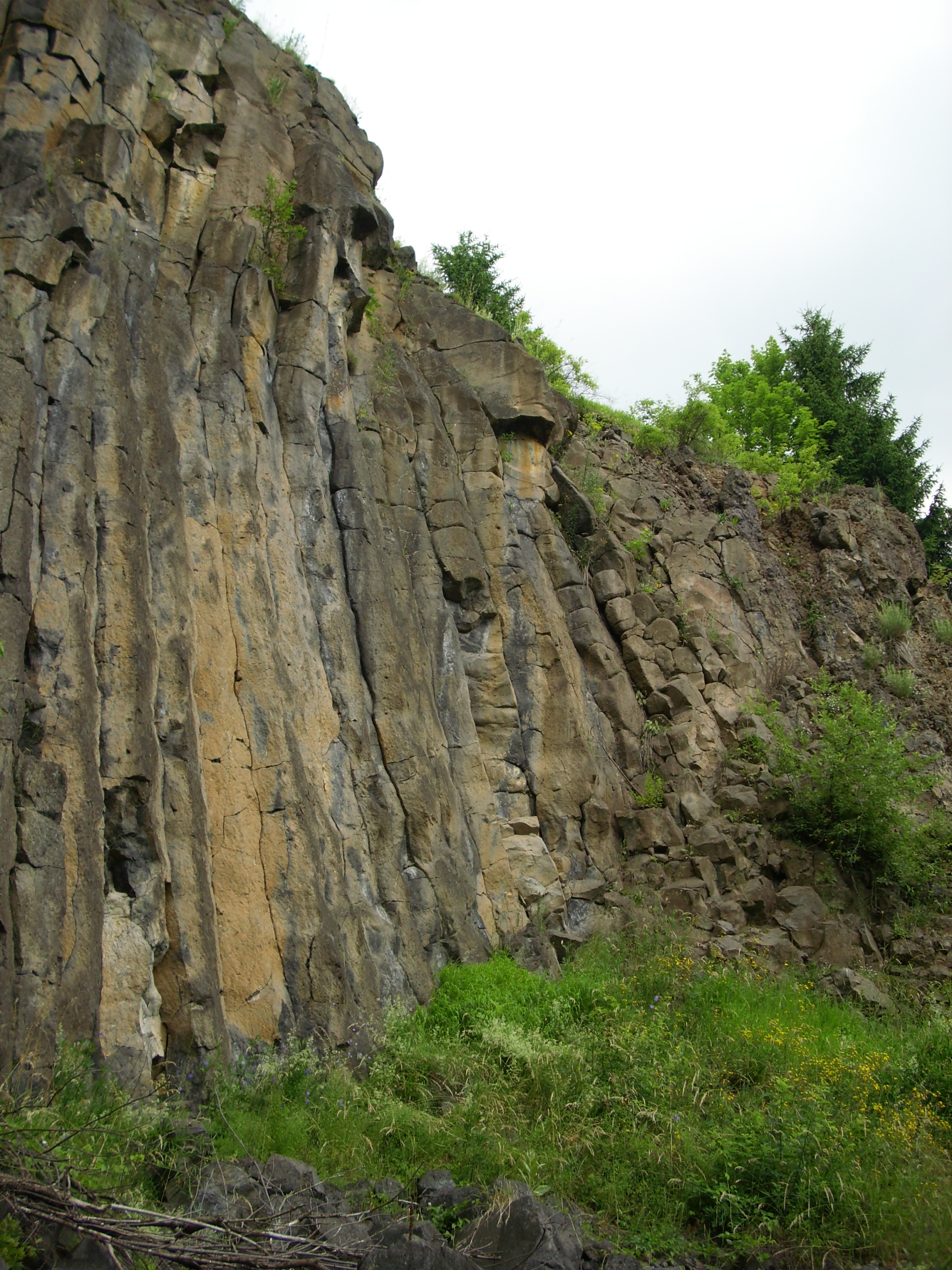
At the center of the former quarry stands an intact lava plug – a solidified volcanic conduit made of exceptionally hard basalt. In this spot, the rising lava never quite reached the surface; it hardened just below it, forming a dense, weathering-resistant core. Once the surrounding, more easily quarried rock had been extracted, this core remained standing on its own, a tough block rising among the quarry walls.
A defining feature of the basalt here is its spheroidal jointing: the rock breaks apart into rounded, onion-like layers, a typical result of slow, gradual cooling and subsequent weathering of lava. Dark green olivine, a mineral commonly associated with volcanic basalts, has also been found in the rock.
The quarry walls surrounding the plug reach roughly 20 meters in height in places. Part of these walls consists of clay slate that was altered by the heat of the rising magma: through contact metamorphism, it turned into reddish-brown porcellanite, visible up to about 15 meters from the contact zone with the volcanic rock.
Why was Červená hora a volcano?
The hill Červená hora (749 m above sea level) is a denuded remnant of a former stratovolcano, active during the period of Cenozoic volcanism that shaped much of the Low Jeseník range. Fossilized fragments of the original volcanic structure survive here to this day: a relic of the diatreme (the volcanic pipe itself), a lava flow, and pyroclastic sediments. The Lávový suk is precisely such a relic — a hardened core that has withstood both erosion and quarrying far better than the softer rock that once surrounded it.
Can visitors get there?
The quarry sits on private land, but its owner does not prevent visitors interested in geology from entering. The ground is uneven, rocky, and in places steep, so the site is not suitable for strollers or for anyone expecting an easy walk. For enthusiasts of geology and the volcanic history of Central Europe, however, it remains one of the more compelling, if under-visited, spots in the region.
Najczęstsze pytania / Frequently asked questions
What makes Lávový suk different from an ordinary piece of volcanic rock? It is not a random fragment of lava but an entire preserved volcanic conduit — lava that solidified on its way toward the surface, leaving behind a dense, hard core that outlasted the erosion and quarrying of the rock around it.
Is it the same place as Červená hora? Lávový suk lies in a former basalt quarry west of the hill Červená hora, once an active stratovolcano. The two are often mentioned together as "Lávový suk Červená hora," but it is the lava plug itself, not the hilltop, that forms the main attraction.
Is entry free? The land is privately owned, but the owner does not restrict access for visitors. Given the uneven, rocky terrain, sturdy footwear is recommended.
What else is worth noticing besides the lava plug itself? Look out for the spheroidal jointing of the basalt, traces of olivine, and the reddish-brown porcellanite formed where the heat of the magma altered the surrounding clay slate — all visible on the quarry walls.
Nearby places

Earn badges for the places you visit
Download NextOnTrip, discover new places and check off your trails.