About this place
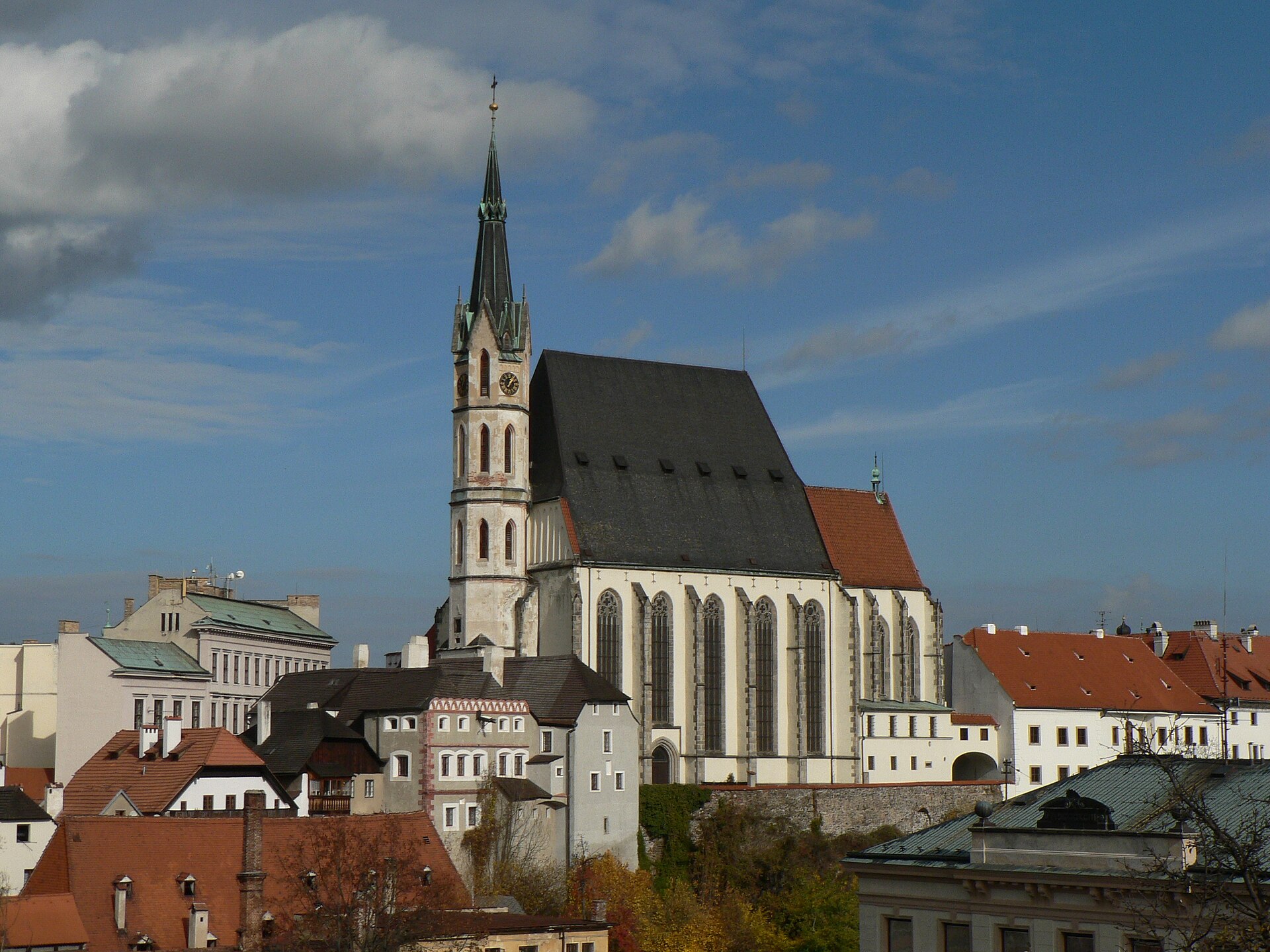
Church of St. Vitus in Český Krumlov
The Church of St. Vitus is a Gothic parish church standing at the heart of Český Krumlov, in the South Bohemian Region. Together with the town's historic centre, it is listed as a UNESCO World Heritage Site, and alongside the castle it forms the town's second great architectural landmark — its tall tower is visible from almost every corner of the old town. The church belongs to the Český Krumlov deanery of the Diocese of České Budějovice.
How old is the church, and who built it?
A church first stood on this site as early as 1309, though the building visitors see today is considerably younger. The present Gothic church was raised between 1407 and 1438 and consecrated in 1439 by the Bishop of Passau, Leonard of Laiming. Its history has been bound up from the start with the two noble families who ruled Krumlov over the centuries, the Rosenbergs and the Schwarzenbergs. It was under the Schwarzenbergs, who made the town their residence between 1725 and 1726, that a new chapel of St. John of Nepomuk was added to the church. In 1995, the building was declared a National Cultural Monument.
What does the church look like, and why does its silhouette stand out?
Inside, a hall-type triple nave rests on slender pillars, a form typical of South Bohemian late Gothic architecture. Net vaults in the Parler tradition cover both the naves and the elongated, pentagonally closed presbytery, which took the Church of St. Giles in Milevsko as its model. Two-storey sacristies flank the presbytery on either side, while the Chapel of the Resurrection and the Chapel of St. John of Nepomuk were added onto the church, and a north-side vestibule with an entrance portal precedes the main door. On the west front rises the tower — rectangular, Romanesque-style windows mark its lower level, an octagonal shape takes over higher up, and its topmost storey, added only in 1893–1894, is pseudo-Gothic.
What is worth seeing inside?
On the north side of the presbytery stands a richly decorated stone sanctuary niche from 1500. The early Baroque high altar, the work of J. Worath between 1673 and 1683, carries altar paintings by M. Leuthner depicting the Coronation of the Virgin Mary and St. Vitus, both painted in 1683. Next to it stands a Rococo side altar of St. Paul from 1773, along with neo-Gothic altars added at the close of the 19th century, in 1897 and 1898. The choir loft holds a small Baroque organ, brought here from the Church of St. Lohelius in Krumlov's Latrán district, alongside a considerably larger neo-Gothic organ. At the entrance to the Chapel of St. John of Nepomuk, two Renaissance tombstones of red marble, dating from the last quarter of the 16th century, mark the resting place of Vilém of Rosenberg and his third wife, Anna Maria of Baden.
Why does the church matter to the town?
For more than six centuries the church has served as Krumlov's main parish church, and its tower, second only to the castle tower, acts as a landmark visible from nearly every street of the old town. Its history, tightly interwoven with the Rosenberg and Schwarzenberg families, makes it not just a place of worship but a witness to the town's most significant moments.
Frequently asked questions
When was the present Church of St. Vitus built? Construction ran from 1407 to 1438, and the church was consecrated in 1439.
Did an earlier church stand on the same site? Yes, a church was first founded here in 1309.
What architectural style does the building represent? South Bohemian late Gothic, featuring a hall-type triple nave, net vaulting, and a tower topped in the 19th century by a pseudo-Gothic upper storey.
Who is buried inside the church? The Chapel of St. John of Nepomuk holds Renaissance tombstones of Vilém of Rosenberg and his wife Anna Maria of Baden.
Is the church a protected monument? It has been a National Cultural Monument since 1995 and, together with Český Krumlov's historic centre, is inscribed on the UNESCO World Heritage list.
Nearby places
-

Statue of Saint John of Nepomuk on the head of Edvard Beneš Bridge in Český Krumlov
Czeski Krumlov
-
Chapel of Saint Martin
Český Krumlov
-
Statue of Saint Joseph on the bridge over the bear moat in Český Krumlov
Czeski Krumlov
-
Synagogue in Český Krumlov
Český Krumlov
-
Statue of Saint Anthony of Padua on the Cloak Bridge in Český Krumlov
Czeski Krumlov
-
Statue of Saint Wenceslaus on the Cloak Bridge in Český Krumlov
Czeski Krumlov
Earn badges for the places you visit
Download NextOnTrip, discover new places and check off your trails.