About this place
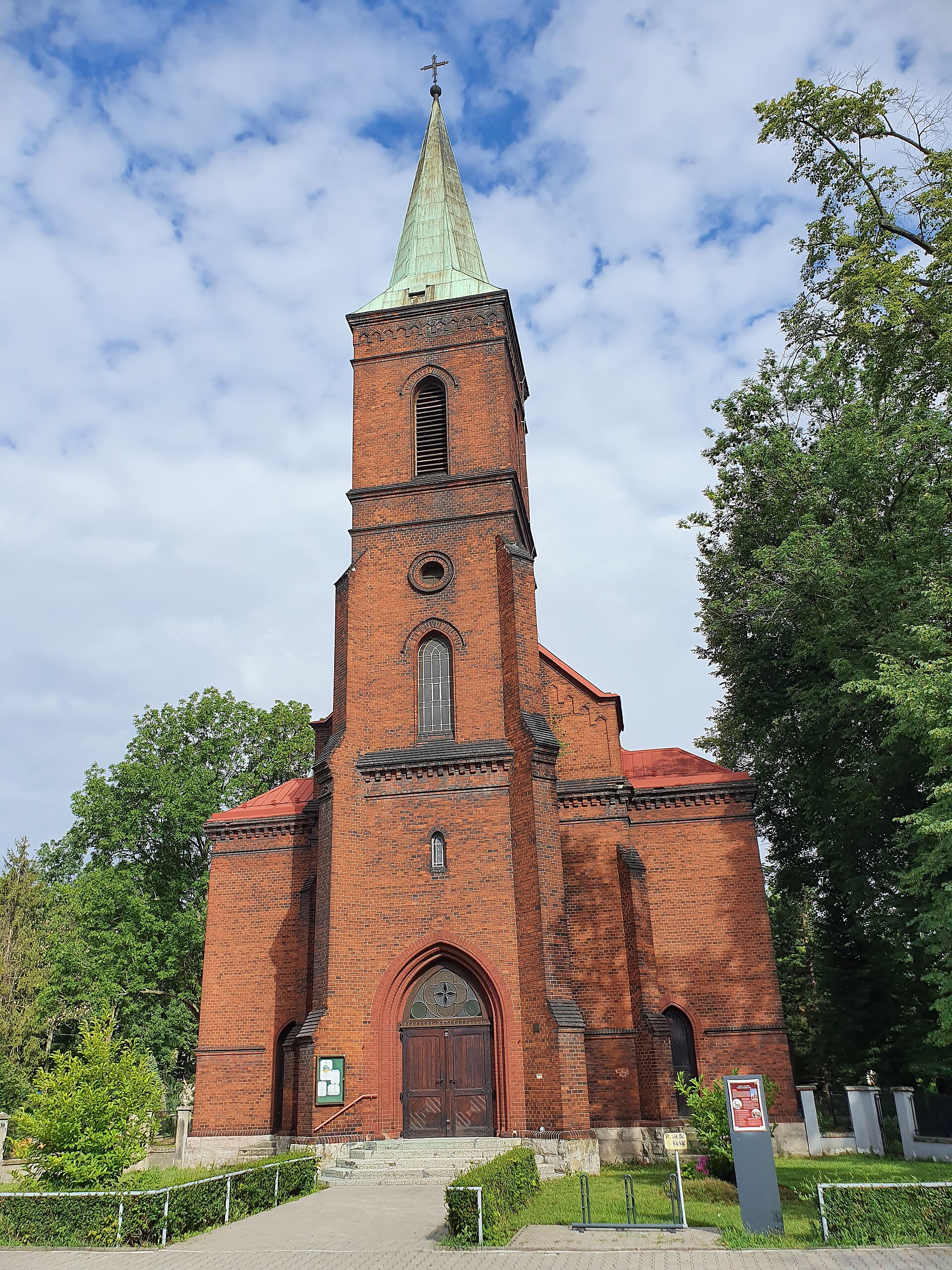
The Church of the Sacred Heart of the Lord is a historic Neo-Gothic Roman Catholic church standing in the Nový Bohumín district of Bohumín, in the Moravian-Silesian Region of the Czech Republic, in the historical territory of Cieszyn Silesia, close to the town's railway station. It serves as the parish church of the Sacred Heart Parish in Nový Bohumín and remains one of the most recognisable religious landmarks on this stretch of the Polish-Czech borderland.
When was the church in Nový Bohumín built?
The idea of erecting a Catholic church near the Bohumín railway station first surfaced in 1877, but the town council only gave its formal approval on 26 December 1889. The foundation stone was consecrated on 12 September 1892, and contemporary reports describe the construction as proceeding very slowly. The main structure was completed in the autumn of 1894, and the cross on the tower was consecrated on 27 September of that year. Services began on 24 November 1895, though the solemn consecration, performed with a bishop present, did not take place until 7 June 1896, when it was carried out by the Prince-Bishop of Wrocław, Georg Kopp.
What architectural style does the building represent?
The church was designed by architect Josef Berger in the Neo-Gothic style, in the brick-Gothic variant: its walls are built of unplastered red brick, most likely supplied from the brickworks of Prince Karl V of Lichnowski in Krzyżanowice. The building measures 41 metres in length, 13 metres in width, and 15 metres in height at the nave, while its single slender tower reaches 53 metres including the cross — a landmark visible from a considerable distance around the railway station.
What is worth seeing inside?
The interior holds wooden Neo-Gothic altars brought from Innsbruck, along with a gilded, armoured tabernacle decorated with a wheat-sheaf motif. The original pulpit also came from Innsbruck, from the Colli workshop. Notable furnishings include a marble baptismal font with a copper cover and a relief of the Baptism of Christ in red and white marble, dating from 1928. A more recent addition is the sacrificial table from 1970, the work of František Běhálek. The original bells were confiscated during the world wars; the four bells heard today were cast in 1957 at the Kovolit Česká foundry in Brno and bear the names Václav (170 kg), Hedvika (310 kg), Maria (430 kg) and Josef (730 kg).
How did parish life around the church change over time?
Standing beside a major railway junction, the parish was multilingual from the outset: until 1896 services were held in German and Polish, and Czech was added in 1921. This trilingual tradition reflects the turbulent history of the Silesian borderland, where Polish, Czech and German influences overlapped. Since 23 September 2002, the church has been listed in the Czech register of cultural monuments under number 51945/8-4077, confirming its historical and architectural significance.
Frequently asked questions
How tall is the church tower? The tower, including the cross, reaches 53 metres, making it the tallest point in this part of Nový Bohumín.
Who consecrated the church? The solemn consecration was performed on 7 June 1896 by the Prince-Bishop of Wrocław, Georg Kopp.
How long did construction take? Two years passed between the consecration of the foundation stone in 1892 and the completion of the building in 1894, although the original idea for the church dates back to 1877.
Is the church a protected monument? Yes, it has been listed in the Czech register of cultural monuments since 2002.
Which parish does the church belong to? It is the parish church of the Sacred Heart Parish in Nový Bohumín.
Nearby places

Earn badges for the places you visit
Download NextOnTrip, discover new places and check off your trails.