About this place
Klukovická jeskyně (Klukovice Cave) is a limestone cave in Prague, regarded as the largest cave within the city. It lies inside the Prokopské údolí Nature Reserve (Prokop Valley) in the southwestern part of Prague, in the Prague 5 – Jinonice/Hlubočepy area, above the now-disused Klukovice public swimming pool (Klukovické koupaliště).
Where exactly is it?
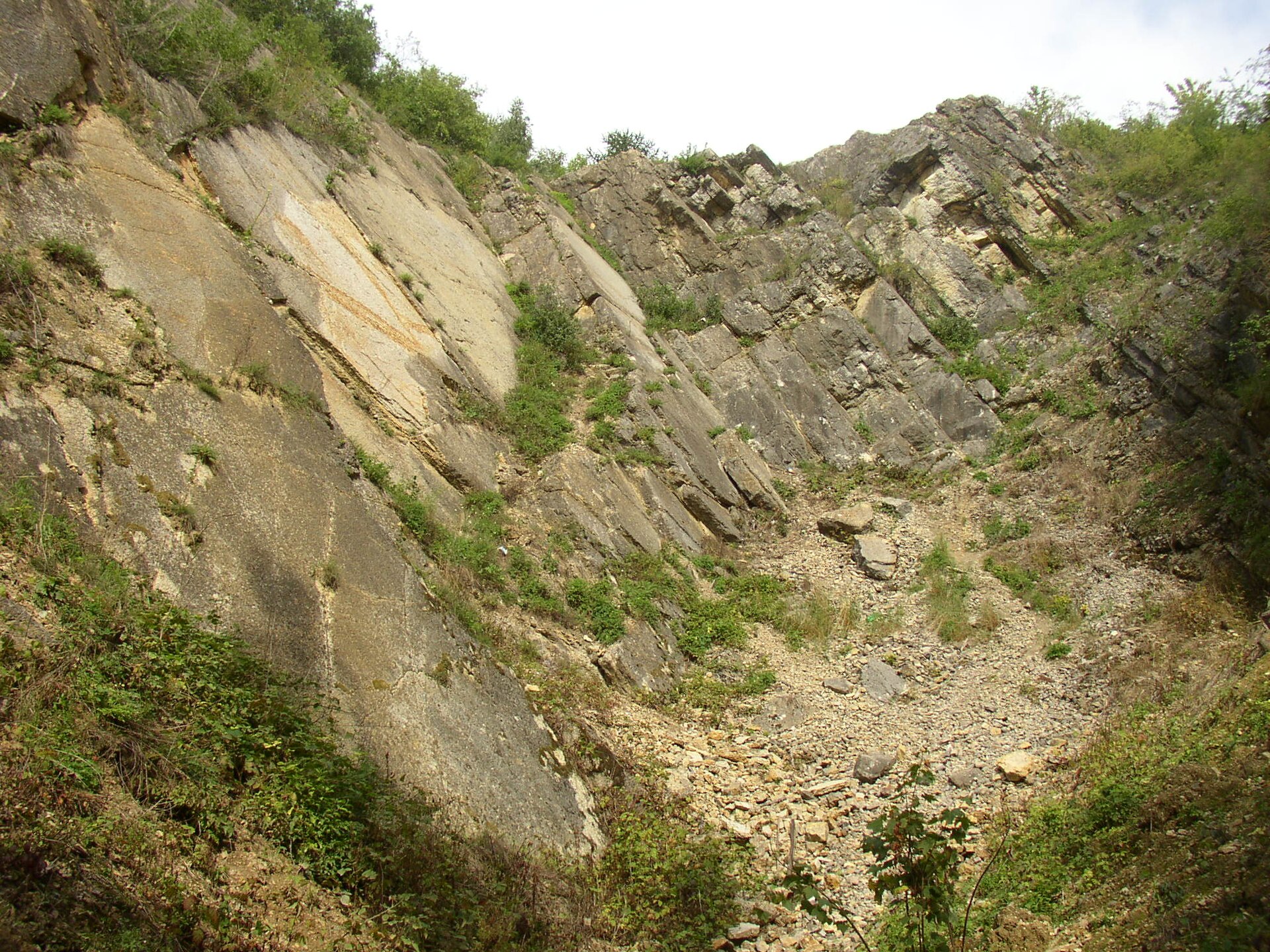
The cave entrance opens on one side of a rocky amphitheater rising above the former swimming pool. From a distance it appears as a dark, oval opening set into the slope of an isolated rocky hill. On the opposite side of the same amphitheater, separated from Klukovická jeskyně by the Prokopský and Dalejský streams, an asphalt road, and a railway line, lie the Korálové jeskyně (Coral Caves). A protected historic mill, Horův mlýn, also stands nearby.
How did it form, and what does the interior look like?
The cave developed in Zlíchov limestone — one of the Devonian limestone layers that make up the rock formations of the Prokop Valley — along a fault (dislocation) widened by frost weathering. It sits at an elevation of roughly 240 meters above sea level. Under a 1979 karst classification it belongs to karst area no. 30 (Prokopské údolí) and is registered under number 3026. The entrance faces northwest; its shape has changed over the decades — described as roughly triangular in 1979, natural erosion had given it a more oval, elliptical outline by 2021. Behind the entrance runs a narrowing corridor about 20 meters long, with no dripstone decoration — there are no stalactites or stalagmites inside.
What is the Prokop Valley, and why does it hold caves?
The Prokopské údolí reserve stretches roughly 4 km between the Jinonice and Zlíchov districts, taking in Děvín hill and the area known as Dívčí hrady, with an elevation difference of about 110 meters. The landscape of this part of Prague is built mainly from Silurian and Devonian limestones — layers such as Lochkov, Dvorec-Prokop, and Zlíchov limestone, with Třebotov and Chotěč limestones occurring higher up. These rock layers are responsible for the steep limestone cliffs, numerous caves, abandoned quarries, and small rock pools found throughout the area, as well as for its rich plant and animal diversity. Traces of human presence in the valley go back around 30,000 years, when Paleolithic hunters used the local caves for shelter. The Prokop Valley itself was declared a protected nature reserve by a decree of the Ministry of Culture of the Czechoslovak Socialist Republic on 28 December 1978.
How to get there?
The area is served by bus lines 149, 170, 225, and 230, with train connections and a metro line B station also nearby.
Frequently asked questions
Can Klukovická jeskyně be visited on a guided tour? Available sources give no indication of organized guided visits — the cave sits in open terrain within the nature reserve.
Is it a large cave? It is the largest cave in Prague, though its passage is relatively modest in length — about 20 meters.
Are there stalactites inside? No — the interior has no dripstone decoration.
What else is worth seeing nearby? On the opposite side of the rocky amphitheater are the Korálové jeskyně (Coral Caves), and the area also holds the historic Horův mlýn mill and the wider Prokop Valley with its numerous limestone outcrops.
Nearby places

Earn badges for the places you visit
Download NextOnTrip, discover new places and check off your trails.