About this place
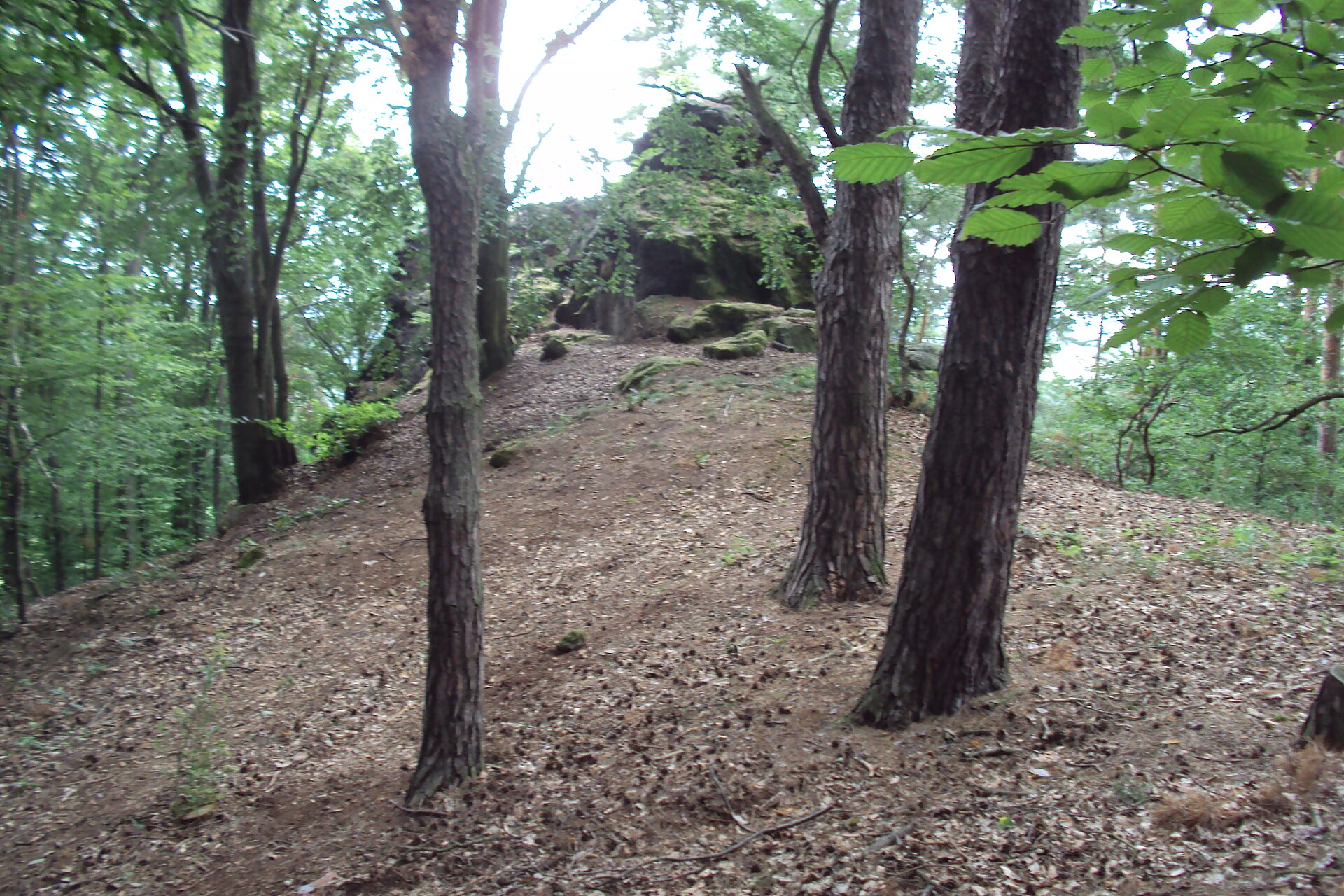
Kamenný vrch u Křenova is a small natural monument just outside the village of Rozprechtice, part of the Dubá municipality in the Liberec Region of the Czech Republic. Covering barely 0.39 hectares of sandstone ridge, it hides one of the more unusual geological curiosities of the Kokořínsko area: a boulder that visibly rocks when pushed by hand.
Where is it located?
The site sits on the western slope of Kamenný vrch hill (382 m above sea level), at an altitude of roughly 360-370 m, within the Ralská pahorkatina uplands south of Dubá. It falls inside the Kokořínsko - Máchův kraj protected landscape area, a region famous for sandstone rock towns, deep gorges and forests that inspired the Romantic poet Karel Hynek Mácha. Rozprechtice lies along a hiking route connecting Dubá and Křenov, so the reserve fits naturally into a longer countryside walk.
What will you see there?
The protected area centers on a compact but striking rock ridge, about 28 by 7 meters and up to 12 meters high. Over thousands of years, selective weathering shaped the sandstone here: sections saturated with iron hydroxides hardened into dense crusts, while the softer surrounding rock eroded away faster. The result is a set of wavy, petal-like surface patterns that locals simply call "stone roses."
The real highlight, though, sits on top of the ridge - a boulder known locally as "the Viking," or the rocking stone. Measuring about 1.81 by 7 by 1.5 meters, it shifts by a few centimeters when pushed, thanks to an unusually narrow contact point left by erosion. Rocking stones of this kind are genuinely rare, and this one is a small point of pride for hikers exploring the sandstone reserves of northern Bohemia.
How do you get there?
Marked hiking trails - blue and red - lead to the reserve, starting either from Dubá, which is served by bus, or from nearby villages including Rozprechtice. The walk from central Dubá takes a bit more than half an hour one way, through quiet, wooded terrain typical of Kokořínsko. It's worth combining the visit with a longer loop through Křenov, since sandstone formations are fairly common in this part of the region and a single outing can take in several similar sites.
When is the best time to visit?
Spring and autumn offer the most comfortable hiking conditions and the clearest views of the rock surfaces, since lower vegetation makes the weathering patterns easier to see. In summer, tree cover shades much of the ridge, which is pleasant on hot days but hides some of the detail. Winter visits call for extra care, as damp sandstone can get slippery close to the ridge itself.
Frequently asked questions
Can you climb on the rocks? The site is a protected natural monument, so visitors should stay on the marked paths rather than walking directly on the rock formations, to avoid accelerating erosion.
What exactly are the "stone roses"? They're iron-hydroxide crusts formed inside the sandstone through selective weathering - the hardened sections survived while the softer rock around them wore away, leaving wavy, flower-like patterns on the surface.
Does the rocking stone really move? Yes. The boulder nicknamed "the Viking," perched on top of the ridge, shifts by a few centimeters under light pressure because erosion left it balanced on an unusually narrow point of contact.
How long does a visit take? Walking through the reserve itself takes only about fifteen minutes, but allow one to two hours if you're combining it with the approach from Dubá or a longer walk through the surrounding villages.
Nearby places

Earn badges for the places you visit
Download NextOnTrip, discover new places and check off your trails.