About this place
Kaceřov
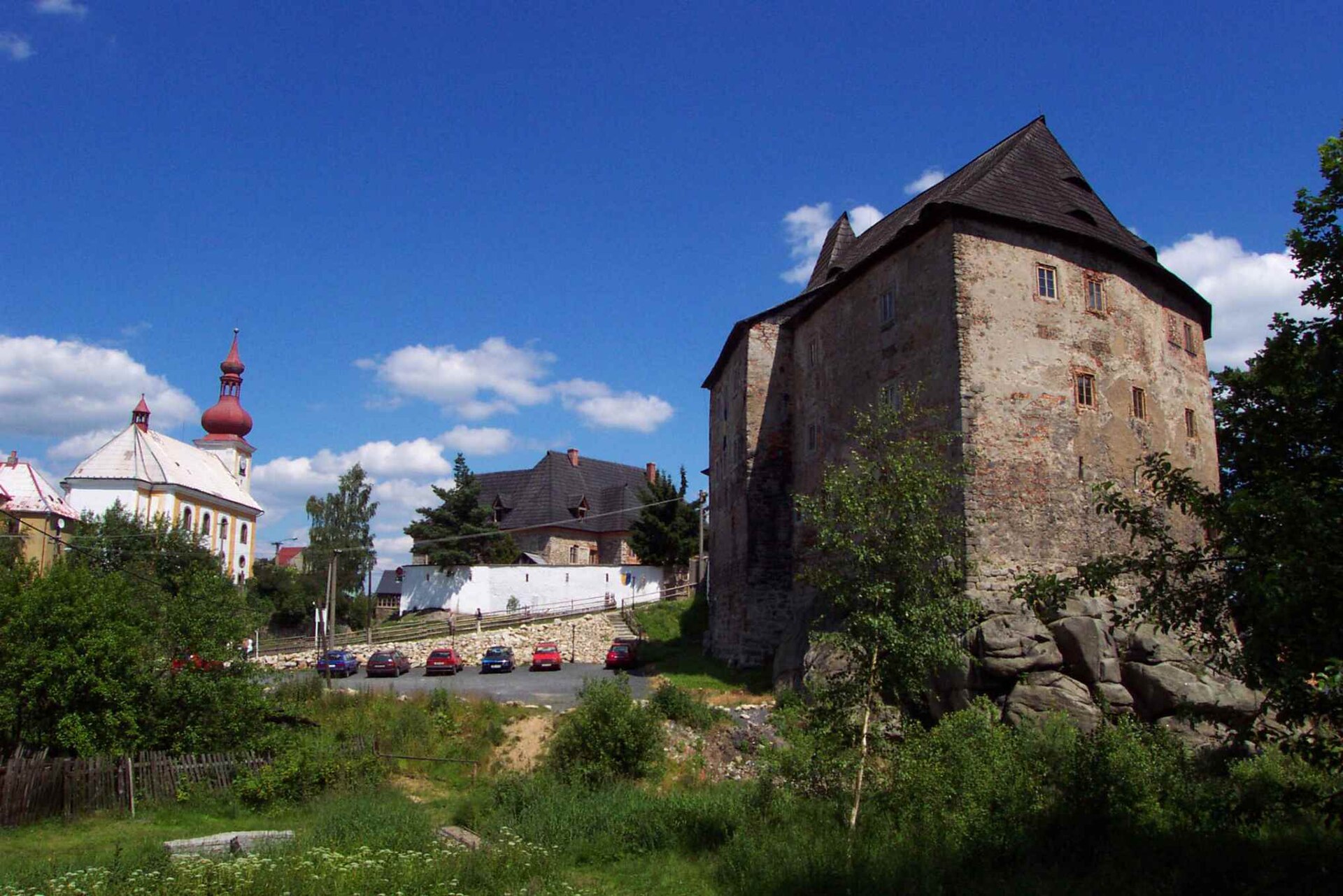
Kaceřov is a small chateau standing in the village of the same name in the Sokolov District, in the Karlovy Vary Region of the Czech Republic. It rose on the site of an older medieval stronghold and is now a protected cultural monument — though also one of the many Czech country houses still waiting for a proper restoration.
How old is the village of Kaceřov?
The village is first mentioned in writing in 1312, in a document dealing with a property dispute between Waldsassen Abbey and the sons of a deceased local landholder named Heinrich Limberger. The dispute shows that an organized settlement with its own lord already existed here more than 700 years ago, long before the current building was built.
What stood here before the chateau?
Before the present structure, the site held an older stronghold — a defensive seat that, according to available records, lost its purpose and was abandoned sometime in the second half of the 15th century. Traces of the earlier fortification survive on the slope above the village pond, including the remains of a circular structure roughly 18 metres in diameter. This older site is distinct from the later chateau and is of particular interest to visitors curious about the earlier, more fortified phase of the settlement.
Who held the estate the longest?
From the 1470s, the Kaceřov estate belonged to the Pergler (Perglár) of Perglas family. The first family member documented here is Götz Perglár, named in three deeds from 1474; he is thought to have founded a new late-Gothic residence on the site of the older administrative farmstead. The Perglars kept the estate for more than three centuries, until the end of the 18th century.
When was today's chateau built?
The building visitors see today was commissioned around 1770 by Karel Antonín Perglár of Perglas. The new residence incorporated the walls of the older late-Gothic stronghold, extended into an almost regular square ground plan. Its architecture reflects the taste of the period: a Classicist, square-plan structure with walls articulated by an intermediate and a crowning cornice, topped with a mansard roof. Inside, the main reception hall still preserves part of its original stucco decoration from the time of construction.
What happened to the chateau in the 20th century?
After the Perglar era ended, the estate changed hands several times. From 1936 until the end of the Second World War, it belonged to the firm Jan Lehrmann and Sons of Plesná — the last private owner before nationalization. After 1948, the building was taken over by the local collective farm, which used it purely for agricultural purposes without regard for its heritage value. The consequences were already visible by the early 1990s, when the chateau was found in a state of serious disrepair.
What is the chateau's condition today?
The building is now owned by the municipality of Kaceřov. Its roof has been replaced, which has at least stopped further structural decay, but the rest of the chateau remains in poor condition and is not open to visitors. In practice, this means the building can only be admired from the outside, from the village square and the adjoining former farmstead buildings next to it.
Frequently asked questions
Where is Kaceřov chateau located? In the village of Kaceřov, in the Sokolov District of the Karlovy Vary Region in western Czechia.
When was the current chateau built? Around 1770, commissioned by Karel Antonín Perglár of Perglas on the site of an older late-Gothic stronghold.
Which family held the estate the longest? The Pergler (Perglár) of Perglas family, from 1474 until the end of the 18th century.
Can the chateau be visited today? No — it is municipally owned, remains in poor structural condition, and its interior is not open to tourists.
What remains of the older stronghold? Traces of a circular fortification about 18 metres in diameter, on the slope above the nearby pond.
Nearby places

Earn badges for the places you visit
Download NextOnTrip, discover new places and check off your trails.