About this place
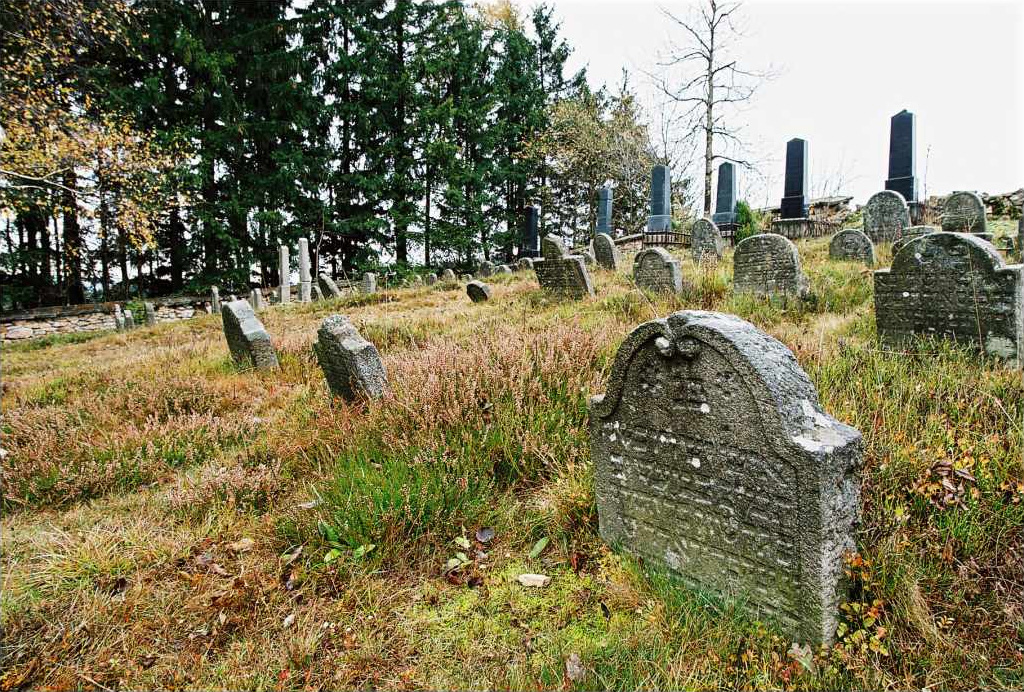
The Jewish cemetery in Markvarec is one of the quietest and most evocative traces of Jewish life in South Bohemia, tucked away in a forest roughly a kilometer southeast of the village, along the road toward Lipolec and Dačice. Its isolation is precisely what makes it worth seeking out — this is not a polished memorial site but a genuine forgotten corner of history.
How did a Jewish community come to exist in Markvarec?
Jewish settlement in Markvarec dates back to the second half of the 17th century, after 1670. Over time a distinct Jewish quarter, known locally as Židovna, took shape, and a synagogue was built there in 1786. The community grew steadily — by 1857 it numbered 212 people. As Jewish residents gradually moved to larger towns, the religious congregation was formally dissolved in 1888, with remaining members joining the community in nearby Písečné. The last Jewish family in Markvarec, the Schulzes, left in 1927.
When was the cemetery established and what does it look like today?
The cemetery was founded in 1794. It follows a regular, square layout, enclosed by a stone wall, with a stone ceremonial hall still standing near the entrance. Most of the surviving tombstones date from the first half of the 19th century, though the oldest legible inscriptions go back to 1804. Across an area of about 1,223 square meters, roughly 200 gravestones have survived — a notable number for such a small, rural burial ground. The site is now protected as a cultural monument of the Czech Republic.
Why did burials continue long after the community had disappeared?
This is one of the more striking details of the site's history. Even though the local Jewish congregation formally ceased to exist in 1888, and the last resident family departed in 1927, the cemetery kept serving Jews from the wider region — particularly from nearby Dačice — all the way until 1939. The final burial took place in December 1939, when Zikmund Zimmer, a merchant from Dačice, was laid to rest here. It's a reminder of how a cemetery can keep functioning for a scattered community long after the town itself stopped being a center of Jewish life.
What survived the war and decades of neglect?
For decades the cemetery sat neglected, hidden in the woods with no marker or sign along the road. It wasn't until 1999–2000 that the Jewish community of Prague carried out rescue work, partially saving the site from further decay. Today the grounds remain enclosed by a stone wall, reachable directly from a public road; the gate is not permanently locked, though at times access is managed through a key held by a local custodian.
Frequently asked questions
Can visitors walk in freely? The site is accessible directly from a public road, and the gate is generally not locked, although access at certain times is managed by a custodian who holds the key.
How many gravestones remain? Around 200 tombstones survive across the roughly 1,223-square-meter grounds, most dating from the first half of the 19th century.
Why did the cemetery stay active after the congregation dissolved? Because Jews from the surrounding area, especially from Dačice, continued to be buried here until 1939, even though the local religious community had formally ceased to exist in 1888.
How do you get there? The cemetery lies in a forest about a kilometer from Markvarec, along the road toward Lipolec and Dačice — it's best reached on foot, as there is no dedicated parking right at the site.
Nearby places

Earn badges for the places you visit
Download NextOnTrip, discover new places and check off your trails.