About this place
Iglesia de San Juan Bautista is a Romanesque parish church standing in Respenda de Aguilar, one of the villages that make up the municipality of Pomar de Valdivia in the province of Palencia (Castile and León). The building occupies a striking position on rocky, sloping ground at the southwestern edge of the settlement, functioning almost like a viewing balcony over the surrounding countryside.
How do you get there?
Respenda de Aguilar sits in the northeastern corner of Palencia province, close to the border with Burgos, roughly 14 km east of Aguilar de Campoo — the small town that serves as the natural base for exploring the region's Romanesque heritage. The route runs along local roads that connect the scattered villages of the Pomar de Valdivia municipality, so it's worth planning a loop that takes in several of the other churches spread across this same municipality.
What will you see inside?
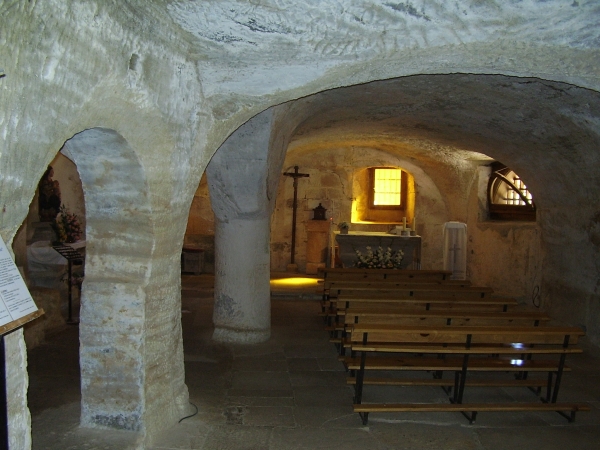
The building dates to the 13th century and represents the late Romanesque style. The interior consists of a single nave covered by a pointed barrel vault, divided into three sections by paired pointed arches — a solution typical of the transition from Romanesque to Gothic construction in this part of Spain.
The most valuable piece inside is a 12th–13th-century baptismal font, decorated with a pearl-pattern border and carved scenes showing combat with a dragon and figures wrapped in elaborately draped cloaks — one of the more notable examples of Romanesque stonework in the Palencia region.
On the western façade rises a stone bell gable, built with two round arches and a triangular finial holding a small bell. Beneath the roofline runs a frieze of corbels carved with geometric motifs — ship's-prow profiles, stepped rectangles and rope-like rolls — while the Romanesque doorway, set into the gable end, is sheltered by an enclosed stone porch.
Why is its history worth knowing?
The church stood abandoned and in ruins for years, and by 2008 the deterioration was severe enough that it was placed on the Hispania Nostra Red List, a registry of heritage sites at risk of being lost, due to structural collapse and the theft of decorative elements. That same year, in March 2008, the building was granted formal legal protection as a Bien de Interés Cultural, Spain's equivalent of a listed monument.
Its rescue came through the Plan de Intervención Románico Norte, a restoration programme for Romanesque monuments across northern Spain, backed by the regional government of Castile and León together with the Fundación Santa María la Real. The work included repairing the roof, reinforcing the vault and repointing the cracked stonework. The results were strong enough that by September 2009 the church was removed from the Red List and reclassified among restored heritage sites.
When is the best time to visit?
Thanks to its elevated position, the church offers sweeping views over the valley, stretching from Fuencaliente to Aguilar de Campoo — a view best appreciated in spring or autumn, when clear light brings out both the stone façade and the landscape around it. The church is also one of the stops along the Románico Palentino route, a well-known trail linking the province's most important Romanesque churches.
Frequently asked questions
Is the church open to visitors? The building has been restored and is accessible as a heritage site, though interior access can be limited — it's best to check current opening arrangements or contact the Pomar de Valdivia municipal office before visiting.
What is the most important feature inside? The 12th–13th-century baptismal font, carved with a dragon-combat scene and a pearl-pattern border, is one of the most distinctive pieces of Romanesque stone carving in the area.
Is this the only church worth visiting in the Pomar de Valdivia municipality? No — the municipality covers more than a dozen villages, many with their own Romanesque or Gothic churches, making it easy to plan a longer sightseeing route in a single trip.
Why was the church placed on the Red List? Because of advanced structural damage and looting of decorative elements recorded in 2008 — a problem resolved through the restoration completed the following year.
Nearby places

Earn badges for the places you visit
Download NextOnTrip, discover new places and check off your trails.