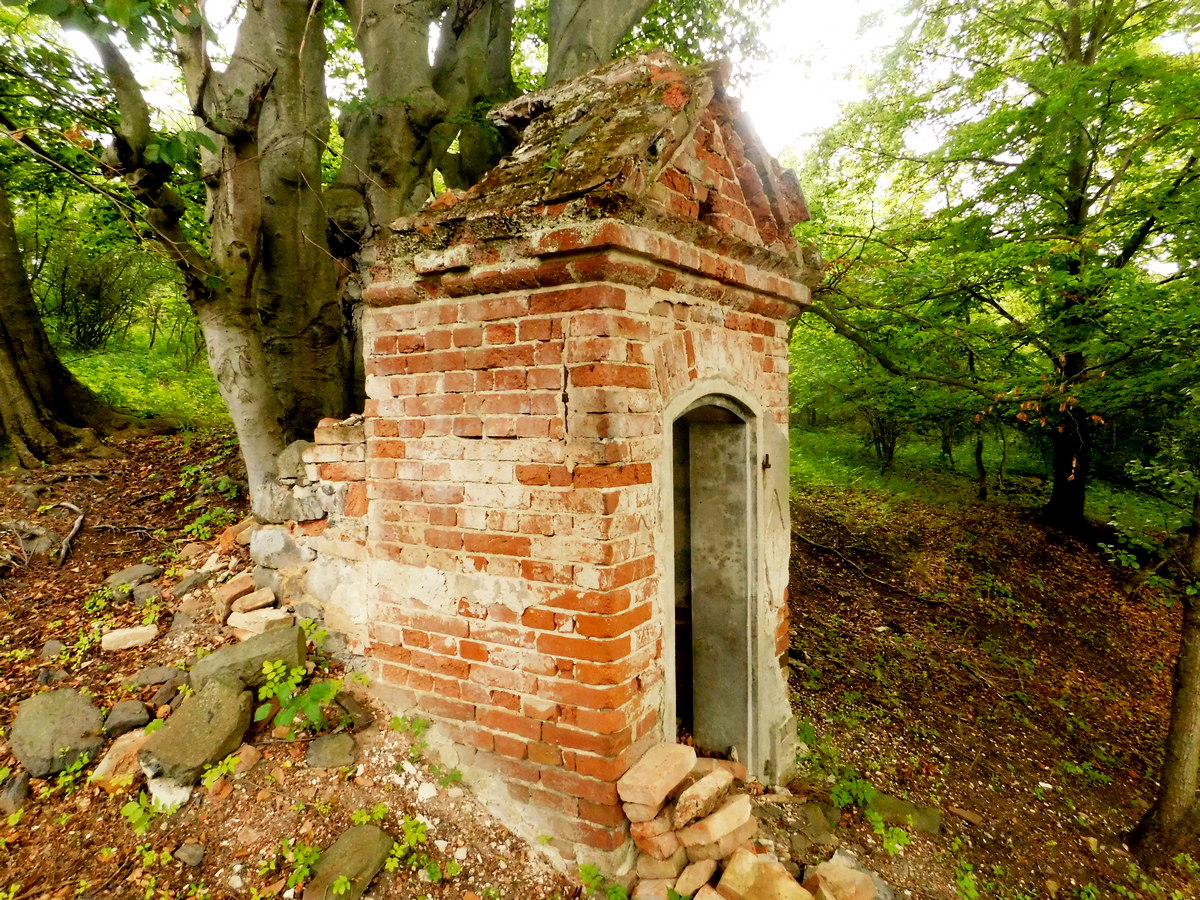
About this place
Hoppova kaple is a small classicist chapel standing on a wooded hill above Valeč, right where the town's Way of the Cross comes to an end. It's less a headline sight than a quiet destination for a walk in the woods — a spot that draws local-history enthusiasts and hikers following the Calvary trail rather than casual sightseers.
Where exactly is the chapel located?
The chapel sits on high ground roughly 350 metres southwest of Valeč's town centre, tucked into dense woodland about 100 metres east of the Calvary group that marks the end of the Way of the Cross. The easiest way to spot it is by looking for the large, old trees growing around it — the chapel hides in their shade, so it's easy to walk past if you're not deliberately looking for it.
Why is it called "Hoppova" (Hopp's) chapel?
The name has nothing to do with the chapel's original religious dedication — it comes from the family that looked after it. Before 1945, the chapel was maintained by Anna and Ervin Hopp, who farmed a nearby homestead. Locals simply started calling it "Hopp's chapel" (Hoppova kaple), and sometimes "Hopp's suffering" (Hoppova muka) — the latter referencing the traditional Czech term for roadside penitential shrines known as "muka."
How has the building changed over time?
The site's history runs deeper than its nickname. In the second half of the 17th century, a small baroque stone niche chapel was built here, at a crossroads on the old path leading to a forest mill (recorded in sources under its German name, Holzmühle). It wasn't until the first half of the 19th century that this modest structure was enlarged and rebuilt in the classicist style visible today — and it's this later, expanded version that locals know as Hoppova kaple.
What happened to the chapel after 1945?
The postwar expulsion of the German-speaking population from the region meant the chapel lost the family that had cared for it for generations. Without regular upkeep, the building began a slow slide into ruin. That decline stretched across decades, and by the early 21st century the chapel had reached a critical state — the rear wall and part of the roof had collapsed, with rubble scattered both inside and around the structure. At that point it was genuinely at risk of being lost for good.
Has the chapel been restored?
Yes. In 2022, the devastated building underwent a complete restoration. Thanks to that work, Hoppova kaple survived and once again serves as a waypoint on the forest route leading to the Calvary above Valeč, rather than fading into a forgotten ruin.
How do you get to the chapel?
The most practical approach is on foot, following the Way of the Cross from Valeč toward the Calvary, then continuing roughly 100 metres further into the woods, aiming for the cluster of old trees. It's worth treating the walk as an extension of a visit to the Calvary and the Way of the Cross itself, since the two sites sit close together and form one continuous historical and scenic route.
Frequently asked questions
Is Hoppova kaple an officially protected monument? It's documented and described in regional heritage and nature registers for the Karlovy Vary region as part of local cultural heritage, though it isn't a major standalone tourist attraction.
Can you drive there? No — the chapel stands in the forest on a hillside reachable only by a footpath along the Way of the Cross. You'll need to park in Valeč and continue on foot.
How long does it take to walk there from the town centre? The distance — about 350 metres in a straight line plus another 100 metres through the woods — takes roughly ten to twenty minutes on foot, depending on pace and trail conditions.
Is it worth combining with a visit to the Calvary and the Way of the Cross? Definitely — the chapel sits at the very end of that same route, so it's naturally visited together with the stations and the Calvary group.
Nearby places

Earn badges for the places you visit
Download NextOnTrip, discover new places and check off your trails.