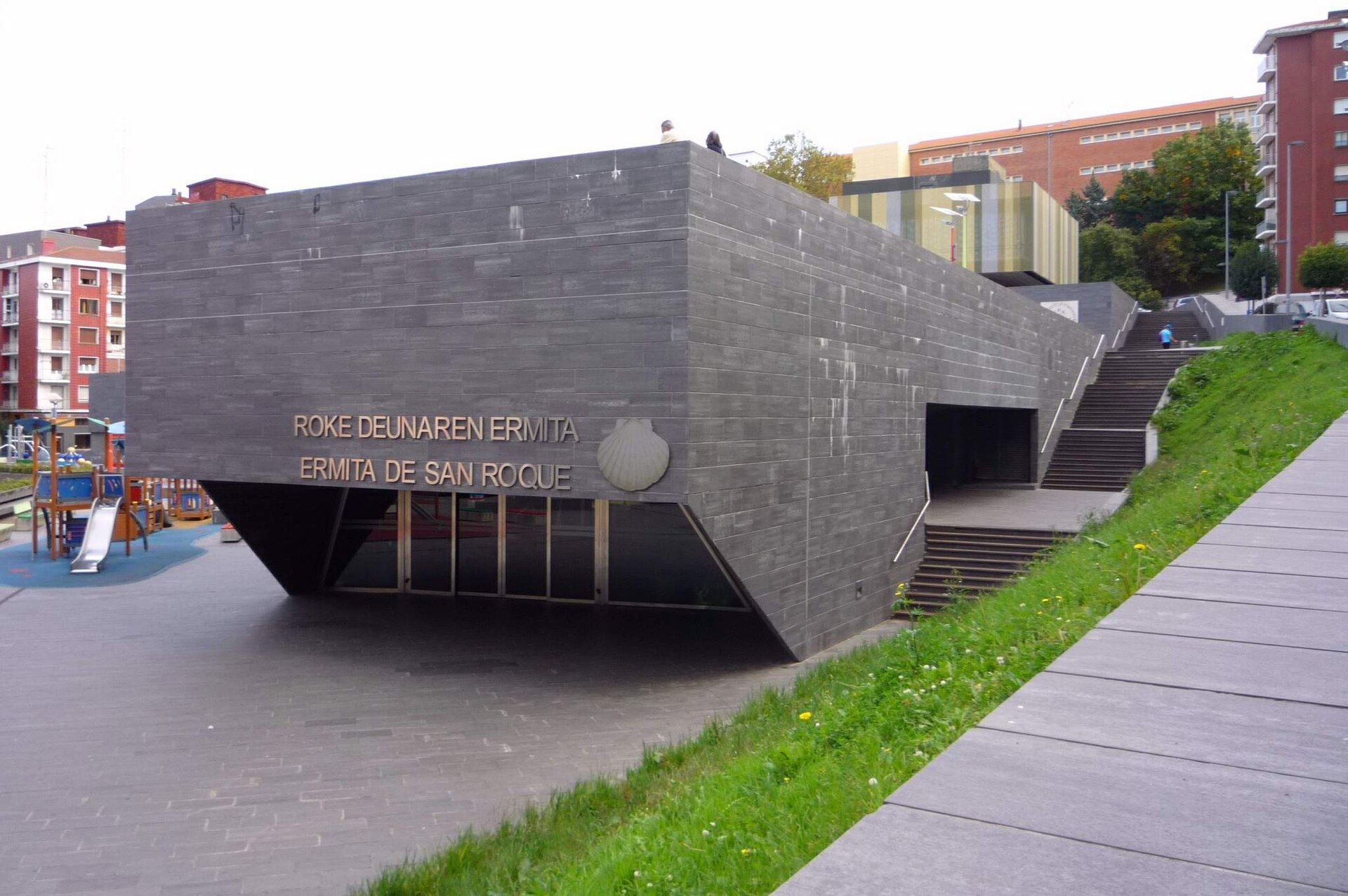
About this place
Hermitage of San Roque is a small chapel in Portugalete, a town on the Nervión estuary in the Basque Country, standing along the path that climbs to the Alto de San Roque hill. The building you see today is modest, but the story behind its name stretches back to the seventeenth century and is tangled up with the town's turbulent past.
How do you get there?
Portugalete sits on the estuary opposite Getxo, linked to it by the Bizkaia Bridge (Puente Colgante) — the world's first transporter bridge and a UNESCO World Heritage site. From the town centre, a short but noticeably uphill walk leads to the Alto de San Roque, a popular viewpoint over the estuary and surrounding hills. The easiest approach is by metro or Renfe train to Portugalete station, followed by a walk up toward the hill.
What will you see?
The earliest documented reference to a hermitage of San Roque in Portugalete dates from 5 August 1674. Records from 1706 and 1714 describe visits by the Archbishop of Burgos to the chapel, and a note from 1745 mentions its roof being in poor condition, with repairs ordered soon after. Processions to the top of Alto de San Roque were already taking place by 1667 — meaning the devotional tradition on this hill predates even the earliest written mentions of the building itself.
That original chapel did not survive intact into the modern era. In 1808, during the Napoleonic invasion, it was burned down along with a nearby holm oak that had long marked the spot — an event that closes the first, oldest chapter of the hermitage's history.
The later story of San Roque devotion in Portugalete becomes intertwined with a separate building: a hermitage dedicated to Santo Cristo, built in 1678 next to one of the gates in the town's walls and known locally as "the Cristo of the Portal." In 1910, a new chapel was inaugurated in a field beside the old washing place (lavadero). When the Cristo del Portal hermitage was demolished in 1913 to make way for road improvements, both the image of Christ and the image of San Roque were moved to this new building. Because processions honoring San Roque were held there, the chapel gradually became known simply as the hermitage of San Roque — the name that has stuck ever since.
Visiting today, it helps to know you're looking at a building with layered history: the name and devotion trace back to the original hermitage destroyed in 1808, while the physical structure and its religious images were relocated from the Cristo del Portal chapel in the early twentieth century. It's a pattern common to Basque towns, where local cults and their sacred buildings shift location and blend together across centuries.
When should you visit?
This is a small, active devotional chapel rather than a museum with fixed opening hours, so it's best appreciated from the outside as part of a longer walk. Pair a visit with exploring Portugalete and crossing the Bizkaia Bridge, and time your climb up the hill for daylight hours when the views over the estuary are at their best. If you're interested in local religious traditions, it's worth checking whether any San Roque processions coincide with your trip, since the devotion has continued here for centuries.
Frequently asked questions
Is the current hermitage the same building from the 17th century? Not quite. The original chapel from the late 1600s burned down in 1808 during the Napoleonic invasion. The structure associated with the cult today dates from 1910, when a chapel "del lavadero" was built; in 1913 it received the religious images transferred from the demolished Cristo del Portal hermitage.
Why is it called San Roque if the building was originally linked to Santo Cristo? After the image of San Roque was moved into the new chapel in 1913, processions in his honor began being held there, and over time that association became stronger than the chapel's original Santo Cristo dedication.
What else is worth seeing nearby? Alto de San Roque is a viewpoint over the Nervión estuary, close to the famous Bizkaia Bridge (Puente Colgante) connecting Portugalete and Getxo — a UNESCO World Heritage site.
Is there an entrance fee? No. The hermitage is a small local devotional site, not a ticketed attraction, and the area around the hill is freely accessible.
Nearby places

Earn badges for the places you visit
Download NextOnTrip, discover new places and check off your trails.